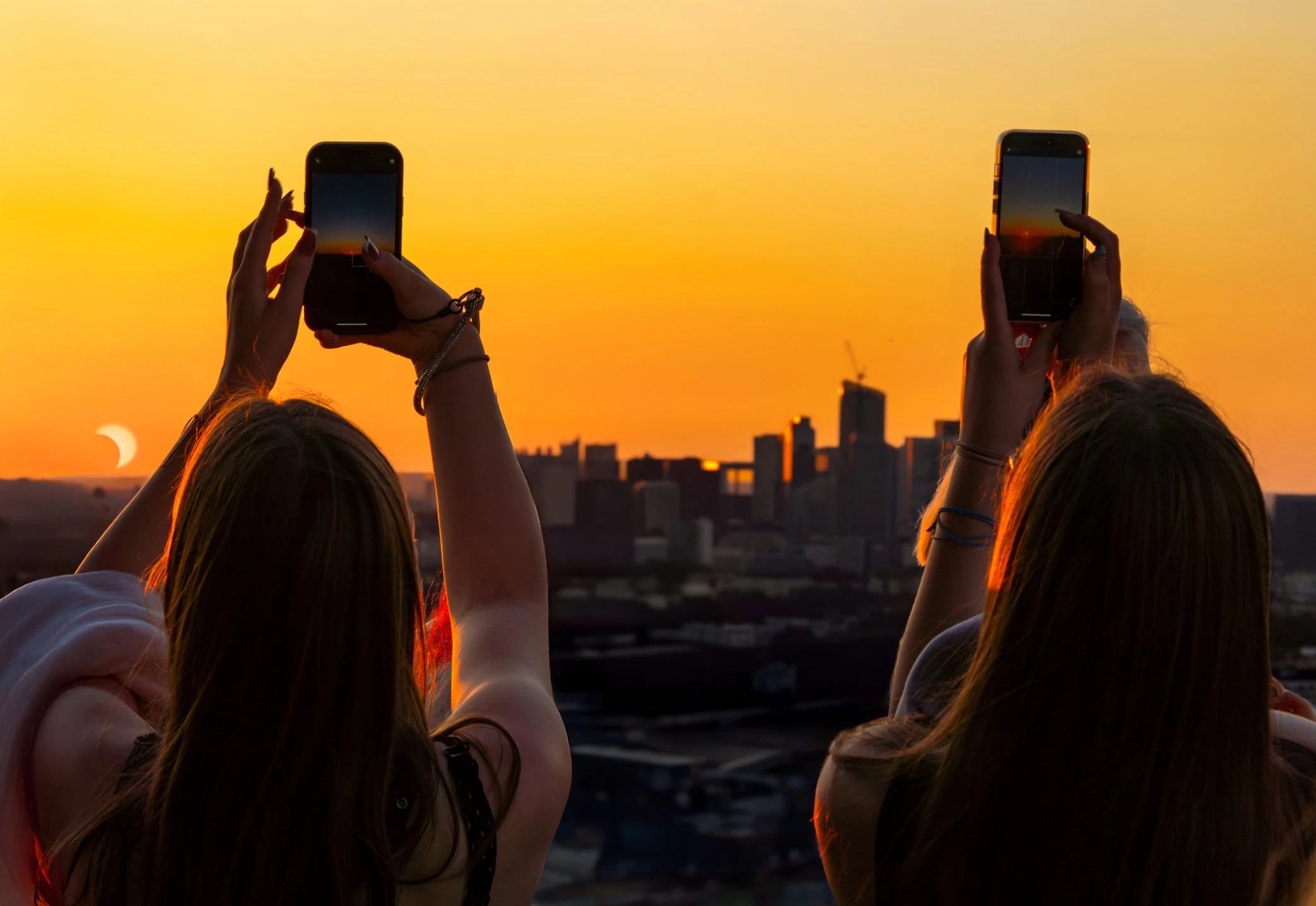
Unless you live on Mars, you will have known it by now too: the August 12, 2026so tomorrow, there will be a new total solar eclipse which will greet Europe and will be visible from Iceland and some areas of Spain (unfortunately in Italy the phenomenon will only be appreciable in partial form and will begin between 7.27pm and 7.38pm). If among the lucky ones who were able to organize themselves to go and see the phenomenon in one of these places, you will surely have thought of taking some souvenir photos and filming the solar disk.
You should be careful though: just as you have (hopefully) already taken care of adequately protecting your eyes, you should also do the same for the sensor of your smartphone or that of your camera, using a filter that satisfies the ISO 12312-2:2015 standard or a ND100000 filter. Without adequate protection, concentrated sunlight can irreparably burn the sensor’s photodiodes and, if you look directly at the Sun through an unfiltered optical viewfinder, it can also damage your eye. So let’s see how to photograph the eclipse without taking risksdistinguishing well between the partial phase and the totality phase, which require slightly different measures.
Why protect your photo sensor during the eclipse of August 12, 2026
Let’s first understand why you should worry about protecting the photo sensor during a solar eclipse. You need to know that the camera lens concentrates the sun’s rays on the sensorthat is, the surface composed of millions of small photosensitive elements, called photodiodeswhich transform light into digital information. If the Sun remains in the frame for an extended period of time, the sunlight that passes through the optics is concentrated in a limited point of the sensor surface. This could permanently damage the pixels that compose it and this would result in spots and dark areas in the photos that will be taken later with the camera right there where the “burnt” pixels are located. Conceptually, the mechanism resembles what happens when we pass solar rays through it with a magnifying glass and, by making them concentrate in a single point on a sheet of paper, it catches fire.
The risk increases especially when using high zoom or telephoto lenses. These lenses, especially the brighter ones (with f/stop low, like f/2.8 or f/4), have a larger light entry area and therefore collect a much higher amount of absolute solar energy, which is then concentrated on a narrow area of the sensor.
Partial phase vs. totality phase: two different approaches in Italy and other European countries
As mentioned at the beginning, in Italy (as in most of Europe, we will have the possibility of seeing the partial eclipse. The Sun will never be completely covered and in some areas of the northern Italy the maximum darkening will exceed, even abundantly, the 90%. In this case the solar filter must be kept mounted on the lens for the entire duration of the phenomenonwithout ever taking it off.
In Iceland and northern Spain, which fall within the band of totality, which also passes through a small portion of Greenland and north-east Portugal), for a variable time (from approximately one to two minutes, depending on where you are) the Moon will entirely cover the Sun. Only during these minutes of totality the filter must be removed: this is to be able to adequately photograph the solar corona, the protuberances and the so-called “diamond ring”. As soon as totality ends and even just a small edge of the solar disk reappears, the filter must be immediately put back on the lens, otherwise there is a risk of damage to both the sensor and, if you are looking through the optical viewfinder, to your eyes.
Little “bonus” tip if you were to observe the totality phenomenon from Spain: consider that totality will fall in the late afternoon (one hour before sunset), with the Sun very low on the western horizon. Make sure you are at a vantage point where there is an unobstructed view to the west.
Take photos and films safely with your cell phone: glasses filters or ND100000
In general, remember that to photograph the eclipse safely, the fundamental rule to follow is one and only one: during all the phases in which the solar disk is still partially visible you must use a certified sun filter and photography. Sunglasses positioned haphazardly on the camera are not enough and not even a normal very dark photographic filter, such as the ND filter (i.e. neutral density), to be clear one of those typically used to take landscape photographs in which the movement of water, clouds or urban traffic is immortalized.
What you need to equip yourself with is a filter that has the same level of protection that you will use for your eyes. The glasses certified for the eclipsethose who meet the ISO 12312-2:2015 standard they can be used as an economical solution to protect the smartphone sensor. You can buy an extra pair, cut out the lens and secure it to the lens of your smartphone, making sure that it completely covers the optics and that there are no side openings through which light can filter. Even better if you can use very high neutral density sun filters, like ND100000: there are both suitable for installation on smartphones and those suitable for placing on the lens of cameras. The first solution is cheaper; the second is a little more expensive. In general, be careful to point the camera away from the sun when you are attaching or removing the filter.
