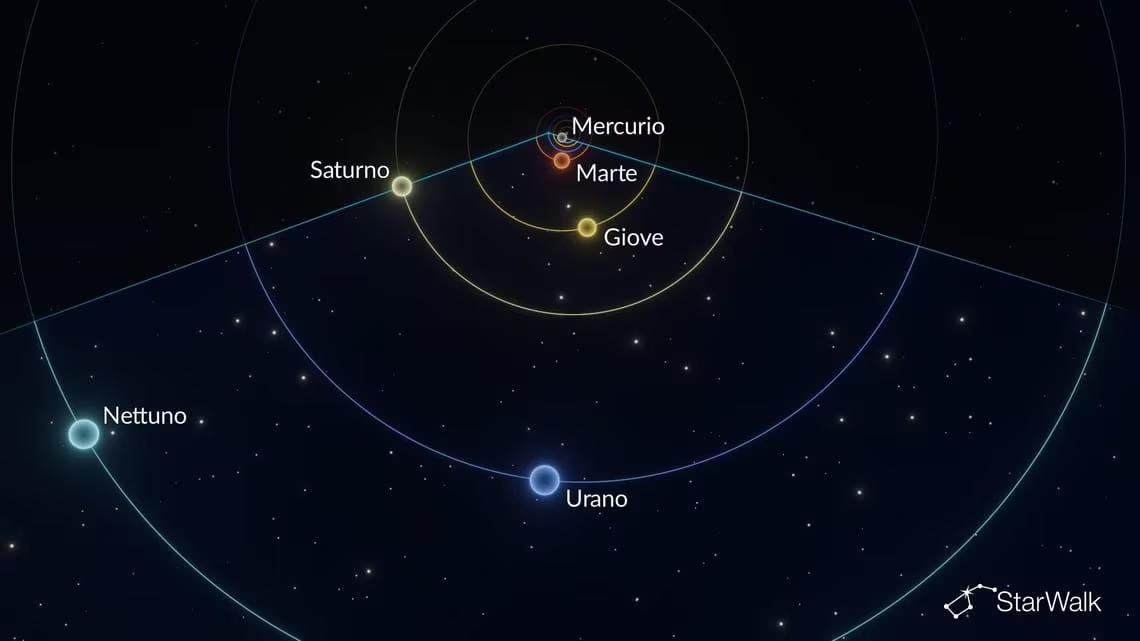
There morning of August 12th six planets of the Solar System – Jupiter, Mercury, Mars, Uranus, Saturn And Neptune – they will be visible at the same time above the horizon, giving life to what is commonly called “planetary parade” or large alignment.
To try to see all six planets you will have to start observing when the sky is still darklooking first Neptune And Uranus with the tools and then finish with Mercury And Jupiter (which will appear low in the east) when twilight has already advanced. At the latitudes of Rome, where the Sun will rise at 06:12, the best observation window will be between 5:27 and 5:46.
It must be said immediately that the word alignment, however, risks misleading: the planets they will not line up perfectly straight and they won’t even be really close to each other in space. They will simply all be visible at the same time. From our point of view, they will appear along the same wide arc of the celestial vaultnear the ecliptic.
There is good news for those who fear missing the appointment: a similar configuration can also be observed in immediately preceding and following mornings.
August 12, 2026, among other things, will be an exceptional astronomical day: in addition to the planetary parade, in Italy we will also witness a partial solar eclipse (with coverage ranges of up to 94% in some areas of the country) and the peak of the Perseid meteor shower“the shooting stars”.
Where and when to observe the alignment of the planets in the sky
Since this is a morning event, the observation must be scheduled in hours before dawn. Taking the coordinates of Rome as a reference, the planets rise one after the other during the night.
The first to appear will be Neptunearound 22followed by Saturn towards 10.30pm. We will then have to wait until 00:30 about to see it emerge Uranus and the 02:15 For Mars. The last two will arrive with the light of dawn: Mercury will arise around 05:00 And Jupiter approximately twenty minutes later, with sunrise expected at approximately 06:12.
But what is the best time to enjoy the show? There is no single time that is valid for everyone, because the ideal moment depends on your position, the local time of sunrise, the available horizon and the fact that Mercury has already risen enough before the sky becomes too light. For many observers in the Northern Hemisphere (ours), the optimal compromise is to observe about 30-60 minutes before rising local of the Sun: is the range in which Mercury appears low to the east (with Jupiter even lower), while the sky has not yet completely illuminated.
However, a good observation plan also takes into account the fainter planets, which must be looked for first. Already 2-3 hours before sunrise Saturn And Neptune they will be well position yourself and Uranus is usually high enough to be searched for with binoculars. About 1-2 hours before sunrise Mars it will become easier to see, with the sky still dark enough to tempt Uranus and Neptune. Only in the last ones 30-60 minutesFinally, Mercury and Jupiter will enter the scene near the horizon.
How to find the 6 planets: naked eye or telescope
Not all the planets are equally easy to locate and it pays to know in advance what to expect. Mars and Saturn they will be the objects simpler to be identified with the naked eye, because they are quite high and visible in the still dark sky. For Uranushowever, you will need at least one pair of binoculars, while for Neptune you will need a telescope.
The matter becomes more complicated Mercury and above all for Jupiter (despite being the brightest planet of the six): as we mentioned, both will remain very low on the eastern horizon and they will be immersed in the light of dawn.
To be able to see them you will need a clear sky and a perfect view free from buildings, trees, hills and mist. The direction to keep an eye on is therefore the eastern horizon, from which the alignment then extends along the ecliptic towards the sky of south-west. Being able to just see two or three planets with the naked eye is already considered a good result.
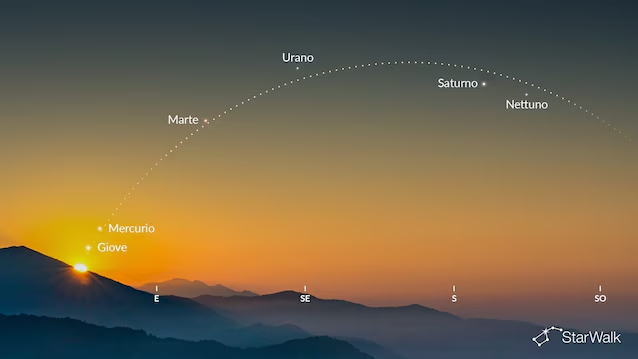
The best strategy to try to see all six planets is therefore to proceed graduallywithout starting from the brightest Jupiter (which is also the more insidious). A practical path to naked eye can track the order Saturn, Mars, Mercury and finally Jupiter.
We reiterate that the planets they will not form a perfect straight lineneither in space nor in the sky. Seen from Earth, they will appear as a broad arc along the ecliptic.
