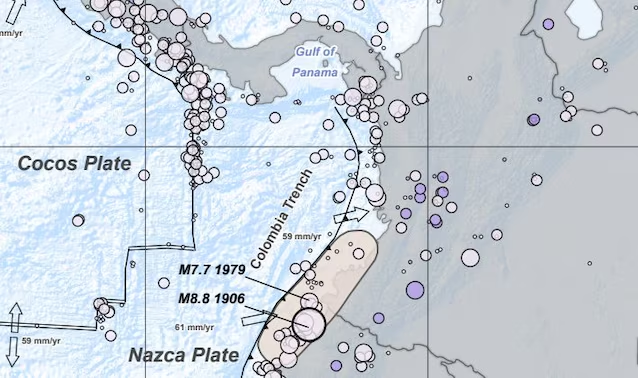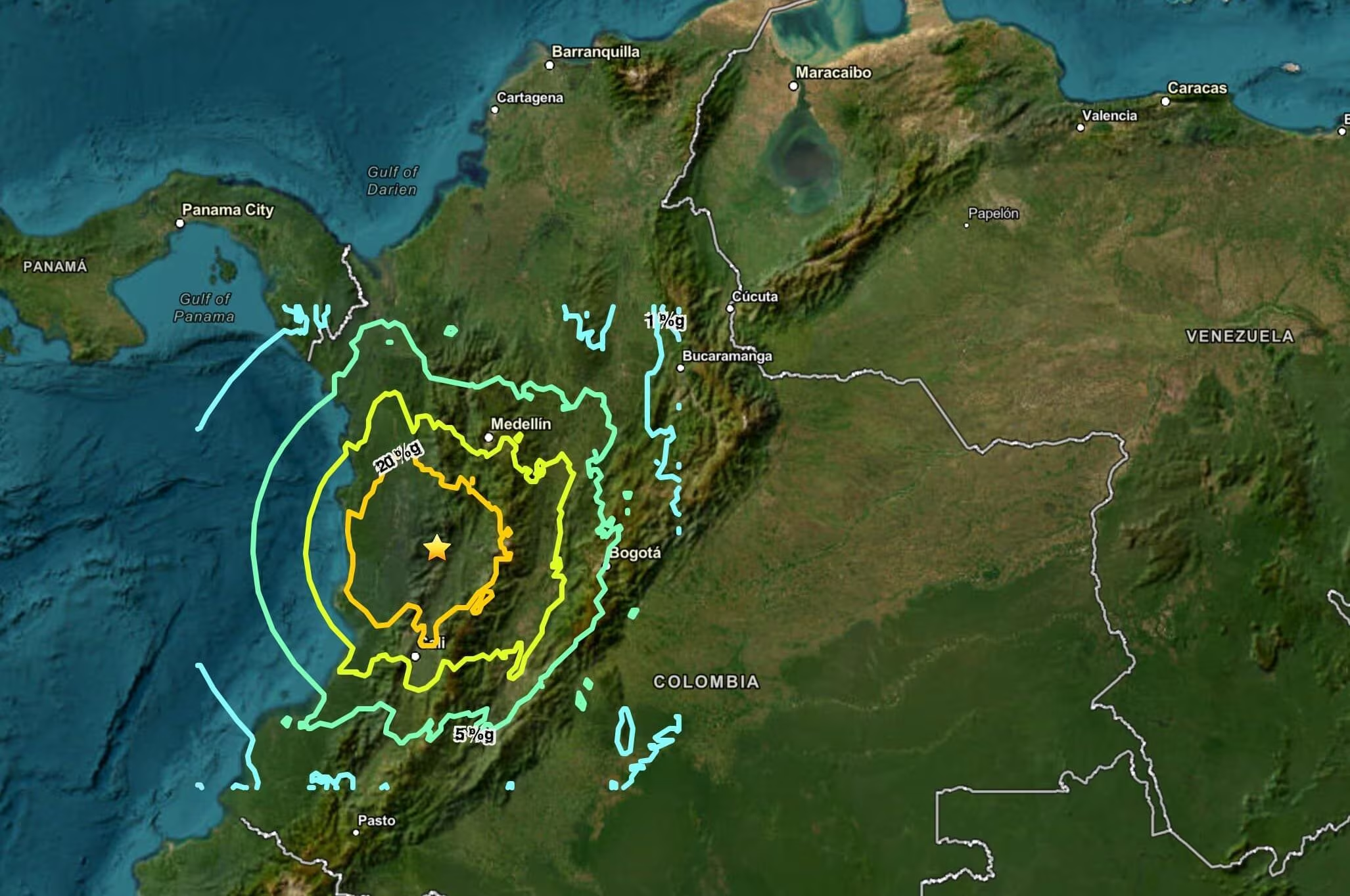
The 7.4 magnitude earthquake that struck the Western Colombia it occurred in a highly seismic area. At the origin of this seismicity is the tectonic context of Colombia, which is located along the Pacific Ring of Fire, the band of territory surrounding the Pacific Ocean in which active volcanoes and earthquake epicentres are concentrated. In particular, the country is located on the edge of South American plateunder which the Nazca plate it sinks, generating great friction and accumulating energy which is periodically released in the form of earthquakes. However, despite the high seismicity, earthquakes with a magnitude greater than 7 are quite rare in this area. The first analyzes suggest that at the origin of a magnitude as high as that of 10 August 2026 at 2.34 pm in Italy there is a fault extended over a hundred kilometers which originated in the Nazca plate at a depth of about 110 km during its collapse, along which the blocks of rock move horizontally.
Earthquake in Colombia: the causes of the high seismicity of the area
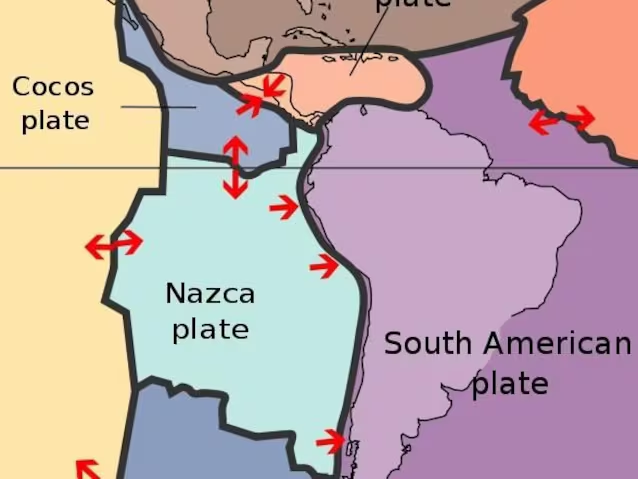
The area in which Colombia is located is characterized by an extraordinary complexity from a tectonic point of view, which makes it a country with high seismic danger. Colombia is located in the northwestern corner of South America, where they converge three large lithospheric plates: the plaque South Americanthat of Nazca and that Caribbean. To the west, the Nazca plate, which is made up of oceanic lithosphere and therefore heavier, sinks under the South American one with a process called subductionwhile to the north there is convergence between the South American and Caribbean plates. Smaller microplates are added to these plaques.
The dominant process, at the origin of the strongest earthquakes in the history of the country, is that of subduction. The lithosphere, sinking into the mantle, gradually melts generating magma which rises to the surface: in this way the volcanoes of the Andes along the western coast of South America. The rise of the magma and the compression of enormous quantities of rocky materials that accumulated along the margin between the plates due to subduction gave rise to the parallel chains that constitute the Andes mountain range.
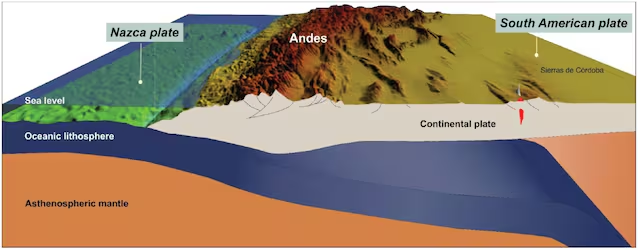
The Nazca plate has been sliding beneath the South American plate for tens of millions of years at a rate of about 5-6 cm per year. However, this movement is not fluid: sometimes it slows down and other times it speeds up. The plates can block their movement and, subjected to enormous compressive efforts, accumulate large quantities of energy which they periodically release with sudden movements and even very strong earthquakes. The three chains that make up the Cordillera are crossed by aextensive network of faults which were generated during the uplift of the Andes, along which frequent earthquakes occur. According to initial studies, the cause of the earthquake of August 10th was one fault extending over a hundred kilometers in the Nazca plate along which the blocks of rock move horizontally relative to each other.
The strongest tremors in history in Colombia
Subduction along Colombia’s coast is the source of the most violent earthquakes to hit the country in the past. Among these is the strongest ever recorded in the country in the instrumental era: the 1906 earthquake, of magnitude 8.8, with a hypocenter at 20 km depth and an epicenter in the sea at the border with Ecuador (further south than the earthquake of 10 August 2026). The earthquake occurred along a fault extended 500 kmwas accompanied by one tsunami with 5 m high waves and caused hundreds of victims. The event was also one of the strongest earthquakes ever to hit the planet since records have been kept. The second strongest earthquake in the area was that of magnitude 7.7 in 1979with an epicenter close to that of 1906. Also in this case there was a tsunami and hundreds of victims. The third strongest ever recorded in Colombia also occurred in the same area as the previous earthquakes: the earthquake of 1958, with magnitude 7.6. The epicenters of these earthquakes are relatively distant from the epicenter of the earthquake that just occurred. Since 1950 to date, within 250 km of the epicenter of August 10, the earthquakes of there were only two magnitudes equal to or greater than 7. It is therefore a rare event for that area, where earthquakes, although frequent, are usually less strong.