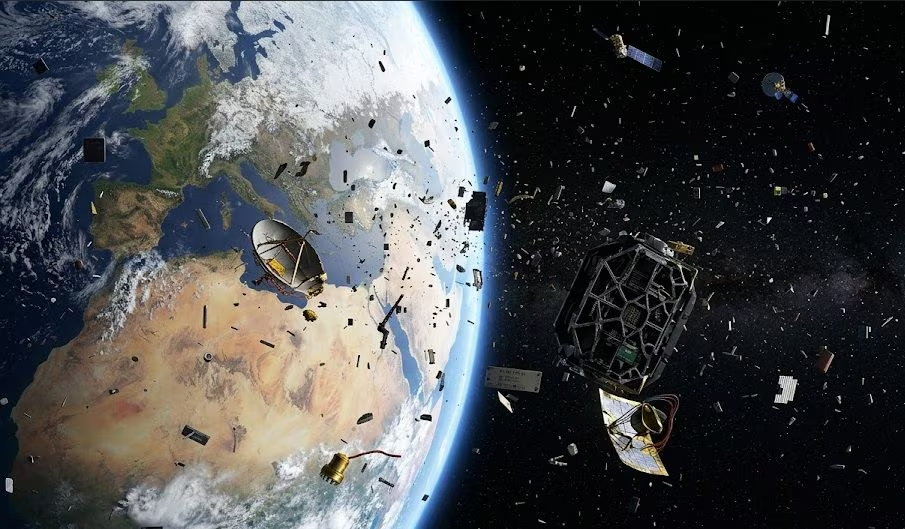
Spent rocket stages, end-of-life satellites and fragments from past collisions make up a orbital population of debris now enormous and growing exponentially. It is a different problem from that of the fall of meteoric objects and the entry into the atmosphere of large asteroids, but the detection and monitoring systems are similar: continuous tracking, forecast models, acceptable risk thresholds and, more and more often, missions dedicated to intercept and physically remove the debris before it is too late and it re-enters the atmosphere in an uncontrolled manner, potentially falling on cities and homes.
How much space debris orbits the Earth, what happens to it and how much falls
The annual report of Space Debris Office of ESA, the European Space Agency, published in May 2026, photographs a situation that scientists now define unsustainable in the long term. In orbit around the Earth there are approximately 46,000 objects large enough to be individually tracked by space surveillance networks (i.e. larger than 10 cm in size) and of these only about 16,000 are operational satellites. Everything else is junk made up of defunct satellites, pieces of launch vehicles left in orbit, and debris from past collisions. To these they add up approximately 1.2 million fragments between 1 and 10 centimeterstoo small in any case to be monitored constantly.
Of all this traffic, a substantial part sooner or later re-enters the atmosphere: according to ESA calculations in the period 2019-2024, on average 290 objects larger than 10 cm re-entered each year, i.e. on average five or six per week. The objects above 500 kg fall uncontrollably approximately every eight daysthose above 5 tons three times a year. Atmospheric reentries have gone from just 100 per year about a decade ago to around 800 in the last year recorded.
Examples of space debris that fell to Earth
In recent years, reports of space debris found on Earth they multiplied. Here are some examples of the most striking and documented cases:
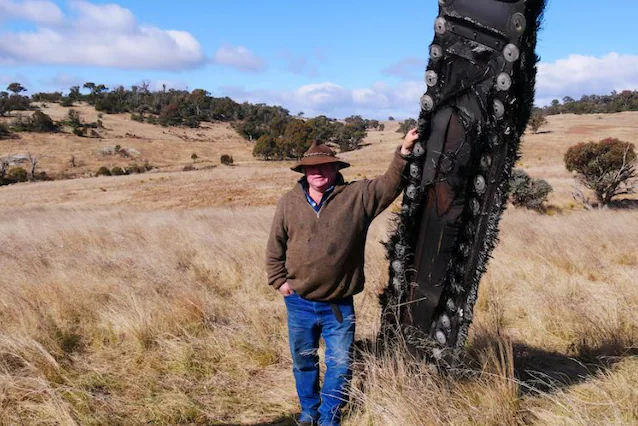
- July 2022, Dalgety, New South Wales (Australia): a charred fragment of the trunk (service module) of a Crew Dragon capsule, relating to the Crew-1 mission returned in 2021, is found stuck in a sheep pasture. Confirmed by both SpaceX and the Australian Space Agency.
- May 2023, Kyegegwa, Sembabule and Kyenjojo districts (Uganda): Debris attributable to a SpaceX launch is scattered over an area of approximately 40 km. In the village of Nakawala a large fragment pierces the roof of a house, causing a loud bang and a cloud of dust.
- February 26, 2024, Regina, Saskatchewan (Canada): A charred piece of approximately 40 kg and 2 meters, from the trunk of the private mission Axiom-3, is found by a farmer in his field during planting.
- 30 December 2024, Mukuku, Makueni county (Kenya): a metal separation ring weighing approximately 500 kg and 2.5 meters in diameter falls into bushy ground on the edge of the village.
- February 19, 2025, Poznan, Poland: debris from the second stage of a Falcon 9, which returned uncontrolled after flying over England and Scandinavia, found in the garden of a private home (but without causing any damage to people).

Who pays for the damage caused by orbital waste
On a legal level, to regulate the liability for damage caused to Earth remains the Convention on International Liability for Damage Caused by Space Objects, approved by the UN General Assembly in 1972, which holds the launching nation responsible for the damage caused by that object.
For a private company like SpaceX this means that, formally, it is the state that authorized the launch (in this case the United States) to be responsible towards the damaged country, not the company itselfto directly.
The However, the mechanism only works between statesnot between private individuals: if debris pierces the roof of a private home, the owner cannot sue directly to NASA or SpaceX internationally. The government must submit a formal diplomatic request to the government of the launching state, within one year of the damage.
In over fifty years of force of the Convention, there is only one case of concrete application, namely that of the return of the Soviet satellite Cosmos 954 in 1978, which scattered radioactive debris across 124,000 km² of the Canadian Northwest Territories. Canada asked the USSR for compensation of approximately 6 million Canadian dollars for the cleanup operations.
For citizens and private individuals who suffer damage from space debris in short, it isn’t there no real possibility of obtaining compensationor.
Regulation, monitoring and debris removal
There FCC (Federal Communications Commission) American, the body that manages frequencies and regulates national telecommunications, introduced from 2022 the obligation for satellites in low orbit to return in a controlled manner in the atmosphere within five years of the end of the operational mission (against the 25 years previously expected), while ESA created the Zero Debris Cardwhich aims to eliminate the net production of new debris by European missions by 2030 e prevent the accumulation of objects which could generate debris and uncontrolled collisions.
Furthermore, the role ofand commercial surveillance networks which integrate data from government networks to refine collision predictions. This monitoring is necessary for estimate possible collisions and will slowly lead to a real one orbital highway code for satellites.
The first ones are also being activated active debris removal missions. For example, ESA’s ClearSpace-1 project aims to test docking and controlled deorbiting of a rocket upper stage abandoned in orbit since 2013.
“Garbage in space” is also a threat to astronauts in orbit
The International Space Station must perform on average at least one evasive maneuver per year to avoid a piece of debris on a collision courseand when there is not enough time to maneuver the crew takes refuge in Soyuz or Dragon capsules docked to the station, ready for an emergency detachment.
A similar event already happened in November 2021, when a Russian anti-satellite weapon test against the decommissioned Cosmos 1408 satellite generated over 1,500 new fragments traceable and forced the ISS crew to take refuge in their spacecraft for several hours.
The increasing crowding of low orbits, driven by constellations such as Starlink and the future megaconstellations of space data centersis transforming space traffic management into a continuous activity that requires the cooperation of many commercial and international operators.
For example, according to data that SpaceX periodically reports to the FCC, the Starlink constellation alone performed approximately 300,000 collision avoidance maneuvers in 2025and, 50% more than the approximately 200,000 in 2024, or an estimated average of 800 maneuvers per day across the entire fleet.
