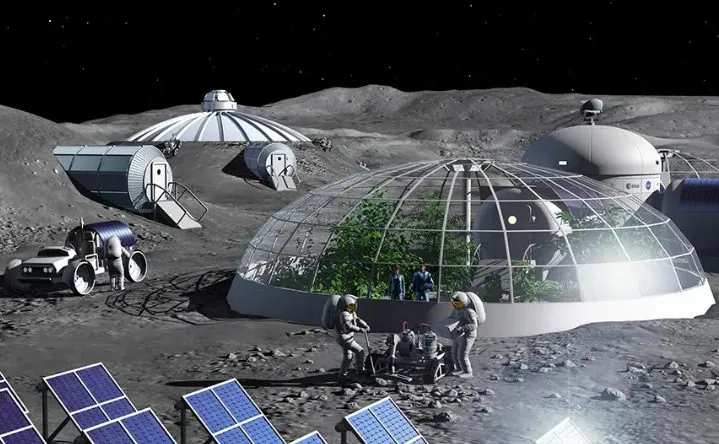
To turn the Moon into one permanent habitable base will have to be conceived food production systems. Through the program Small Business Innovation Research (SBIR) NASA is funding startups and small businesses for develop technologistsand which will allow astronauts on the Moon to be the self-sufficient as possible and not depend on the Earth. Sending food and supplies from Earth is very expensive, but the real peculiarity is in being able to use cultivated plants to produce oxygen and partially recycle the carbon dioxide produced by astronauts.
In recent years, various solutions for the future have thus arisen lunar agriculture: systems for distributing water and nutrients, lighting, environmental control, plant monitoring and autonomous cultivation chambers. The difficulty is adapting all these systems to one reduced gravity space environment like the lunar one and make it reliable and operational almost 400 thousand kilometers from Earth.
Companies selected by NASA to develop cultivation systems on the Moon
Let’s start with Space Lab Technologies that he is developing LEAF (Lunar Effects on Agricultural Flora), a small experiment intended to study directly on the lunar surface how plants react to the environment of our satellite. LEAF was selected among the scientific experiments for a future Artemis mission and consists of a growth chamber powered by solar panels, designed to independently provide the plants with light, water, nutrients and atmosphere.
Three species will be grown inside: two varieties of Brassica rapabelonging to the Brassicaceae family, and one of Arabidopsis thaliana, a much studied plant and is used as a model organism for plant sciences. The plants will grow for approximately 3-5 days and will then be analyzed on Earth to study the effects of lunar gravity and radiation on photosynthesis and their nutritional content.
Since 2017 Space Lab has obtained 15 NASA contracts (for a total value of 19 million dollars) developing technologies for space agriculture. Among these there are systems for growing and harvesting plants in microgravity and autonomous tools to monitor their health, up to a preliminary project greenhouse destined for Mars.
A different approach however is that of Interstellar Laba startup specializing in systems automated and closed-cycle bio-cultivation. The company is developing small cultivation chambers in which temperature, lighting, irrigation and other environmental conditions may be controlled independently. One of his projects, NuCLEUS (Nutritional Closed-Loop Eco-Unit System), is composed of six modular growth chambers and in 2024 won the NASA Deep Space Food Challengereceiving the final prize of $750,000.
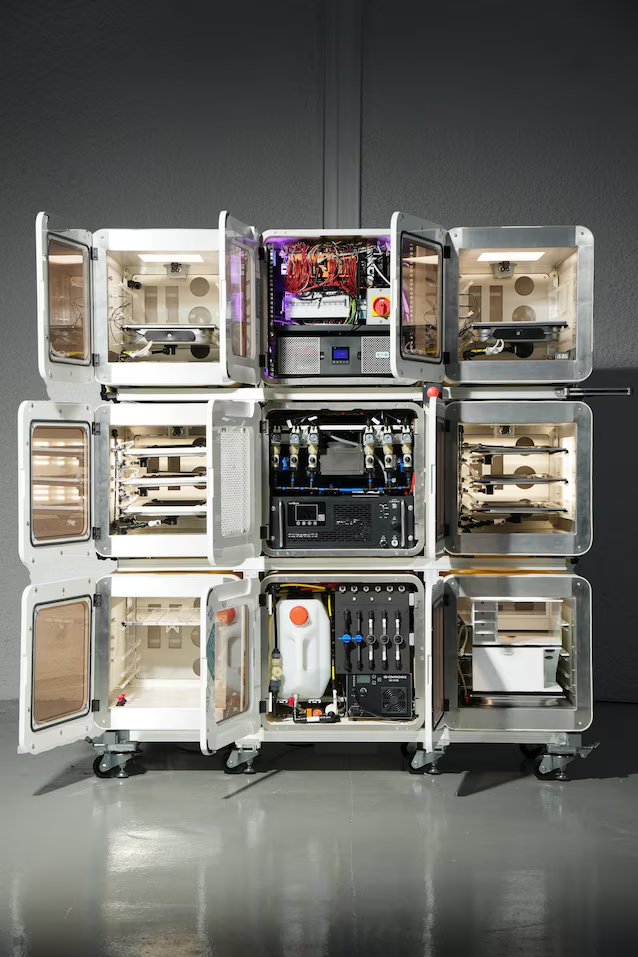
The concept behind NuCLEUS is particularly important for the Moon: instead of designing a large greenhouse right away, you can use them relatively small modules to experiment with different plant species and growing conditions, collecting data that later allows us to design larger, more reliable systems. Artificial intelligence will be used to optimize and check independently parameters such as temperature, lighting and irrigation.
The company SafetySpect instead addresses a different problem, viz that of the health of plants grown in a protected atmosphere. The system uses the spectroscopyanalyzing the way in which matter interacts with light to obtain information on its composition and identify specific biomarkers. This data is then combined with machine learning algorithms to derive models and additional data.
SafetySpect has developed a device capable of observing plants and identifying them early signs of stressrelating them to environmental conditions such as temperature, humidity, presence of pathogens and light intensity. The company is developing a portable version equipped with artificial intelligence which will allow the system to work autonomously thanks to an NVIDIA chip for data processing directly remotely, without the need for direct control by scientists.
The food and oxygen experiments already active aboard the ISS
NASA has already been growing on board the for several years International Space Station (ISS) lettuce, radishes, tomatoes, mustard, Chinese cabbage and other species. Some have been selected precisely because they have a relatively rapid cycle, have a reduced foliar and root system and can provide important micronutrients.
The Veggie, installed on the ISS in 2014, is a cultivation chamber relatively compact that uses LEDs and small stands containing a clay-based substrate and fertilizer. Each unit can hold approximately six plants. The water is distributed through the substrate using capillary action, preventing the roots from remaining completely submerged or, conversely, without water in microgravity.
The next generation is theAPH (Advanced Plant Habitat), a much more sophisticated and automated structure. It’s there largest indoor growing facility fully automated and closed circuit present on the ISS. Installed in 2018, it is practically a fully insulated growth chamber (i.e. it can recreate a particular atmospheric condition inside), equipped with LED lighting and a porous clay substrate that supplies the roots with water, nutrients and oxygen.
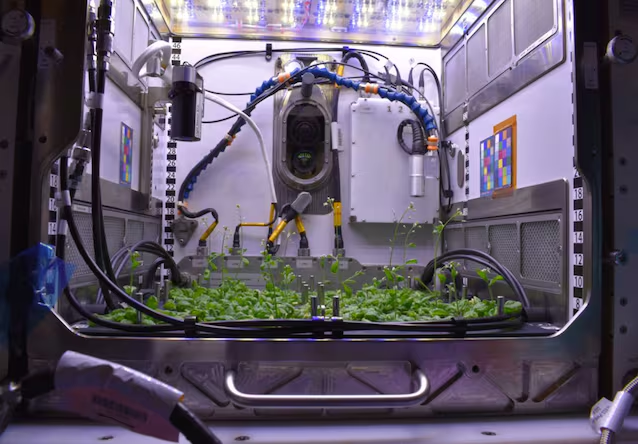
The system has more than that 180 sensors and can control parameters such as temperature, humidity, CO₂ concentration, oxygen, lighting and root zone conditions. It can also conduct experiments lasting 135 days with minimal crew intervention.
A complete ecological system to reduce astronauts’ dependence on Earth
This is also where theESA with the MELiSSA program (Micro-Ecological Life Support System Alternative). That is, the goal is to develop a closed biological system capable of transforming organic waste, CO₂ and other waste products into usable resources againexploiting bacteria, algae and plants. In the MELiSSA model, plants represent one of the fundamental compartments: they can contribute to the production of food and oxygen and the purification of water, while other microorganisms transform waste into reusable nutrients. It is an example of how, in the future, a space base could have a food production system that also functions as a life support system known as BLSS (Bioregenerative Life Support System), i.e. capable of generating oxygen and recycling water and carbon dioxide.
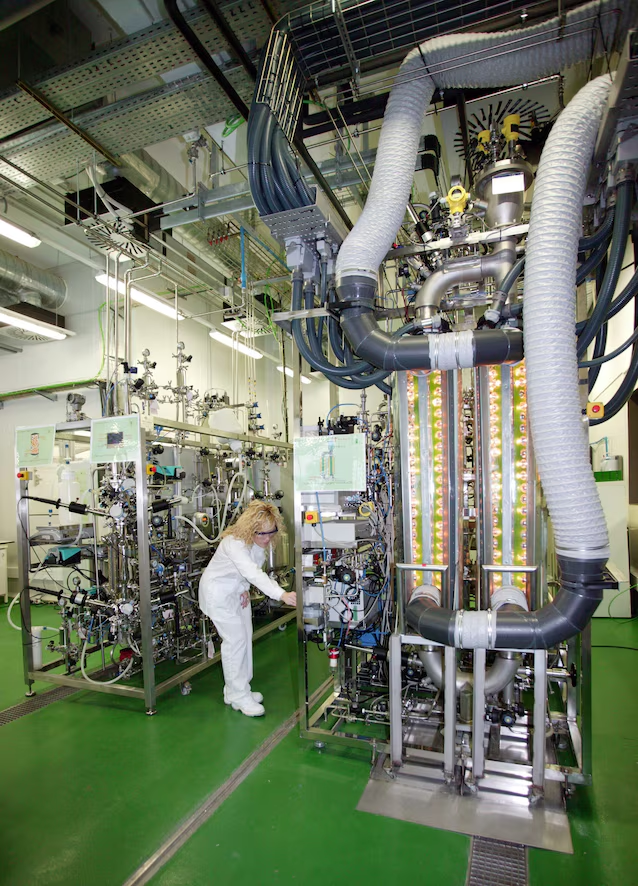
The bio-regenerative recycling at the basis of the MELiSSA project it has already been studied also in experiments on the ISS, where ESA has tested systems based on algae Arthrospiracommonly known as spirulin algaeto. This microorganism is interesting because in a relatively small cultivation space it can consume CO₂, produce oxygen and, if grown correctly, provide protein-rich edible biomass.
