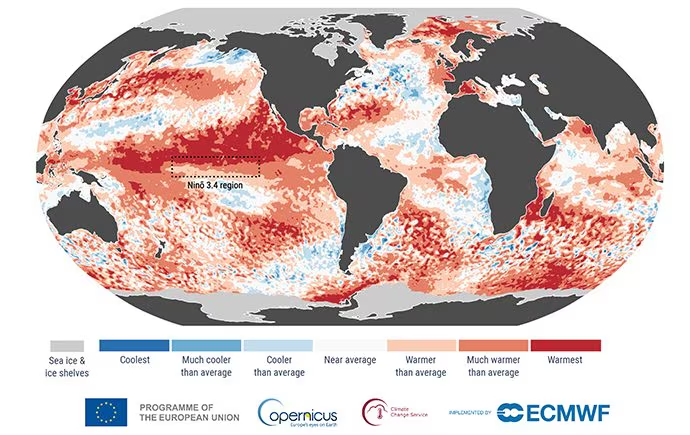
The heat wave that is hitting Italy and Europe shows no signs of abating, continuing to grip the continent in the grip of intense heat and temperatures above the seasonal average, with effects that will also affect autumn 2026. Yet, on a global level, we will have to deal not only with intense heat phenomena, resulting from anticyclones or anthropogenic global warming, but with a further increase in temperature, a periodic climatic phenomenon whose power is such that it causes intense atmospheric phenomena in different parts of the worldor El Niño.
According to oneanalysis by climatologist Zeke Hausfatherresearcher for Stripe, Carbon Brief and Berkeley Earth, The odds of 2027 becoming the hottest year ever measured on Earth are around 95%.. Adding the effect of El Niño to that of climate change, the average global temperature could rise by about 1.76 degrees above pre-industrial levels. In fact, as we read in the article of Washington Post, this phenomenon will work like a climatic time machine, showing us as early as 2027 temperatures that, at this rate, we wouldn’t hit before the late 30s. It’s a value that Hausfather himself calls surprising: “I’m not sure people realize how crazy the second half of 2026 and 2027 will be as far as global temperatures are concerned, in the wake of a record-breaking El Niño event,” he wrote on X in the post below.
The effects of El Niño on autumn and the year 2026-2027
A few weeks ago, the World Meteorological Organization (WMO) community issued a statement warning that El Niño is expected to intensify between August and October, with possible repercussions and extreme meteorological phenomena in different areas of the world.
“El Niño is strengthening, fueling an already burning planet, with searing heat domes, apocalyptic wildfires and record-breaking sea temperatures,” said the United Nations Secretary-General, António Guterres. According to Guterres, El Niño is already at home and is raising temperatures, as fossil fuels are fanning the flames of this crisis: “If we do not act to protect people and address the root causes of the crisis, the dangers will become even more lethal. The pre-warming is over. We cannot afford to wait for the main event.”
Why warming is accelerating: rising temperatures and future NOAA scenarios
According to the definition of NOAA, the US atmospheric and ocean agency, we speak of El Niño when the surface temperature of the central-eastern equatorial Pacific exceeds the climatological average by at least 0.5 degrees for at least about 5 consecutive months.
According to Hausfather’s analysis, a 2027 at +1.76 degrees it would mean about 0.29 degrees warmer than expected by projecting the warming trend of the last decade. In the most extreme scenario, the planet would make a leap of about 13 years, reaching temperatures that should become the norm only around 2040; in the lowest scenario the advance would still be around 7 years, bringing us to the levels expected for 2034.
It is also true that El Niño arrives at a particular time. As Hausfather points out, it overlaps with a “sharp acceleration in the pace of warming associated with continued increases in greenhouse gas emissions.” In the central equatorial Pacific, where the intensity of El Niño is measured, ocean temperatures have broke records for 75 consecutive days, and by December they could increase by more than 4 degrees, exceeding the previous record by more than one degree.
According to the journal Nature, the climate phenomenon of El Niño it is destined to become the most intense of the last at least 150 years. According to Justin Mankin, a climatologist at Dartmouth College in Hanover, New Hampshire, it closely resembles those events that scientists had projected for the end of the century, amplified by anthropogenic climate change.
This is why El Niño will be a accelerator of global warming: the phenomenon, in itself natural and periodic, is grafted onto an already warmer planet due to greenhouse gas emissions, amplifying its effects and giving us a preview of the climate that awaits us.
