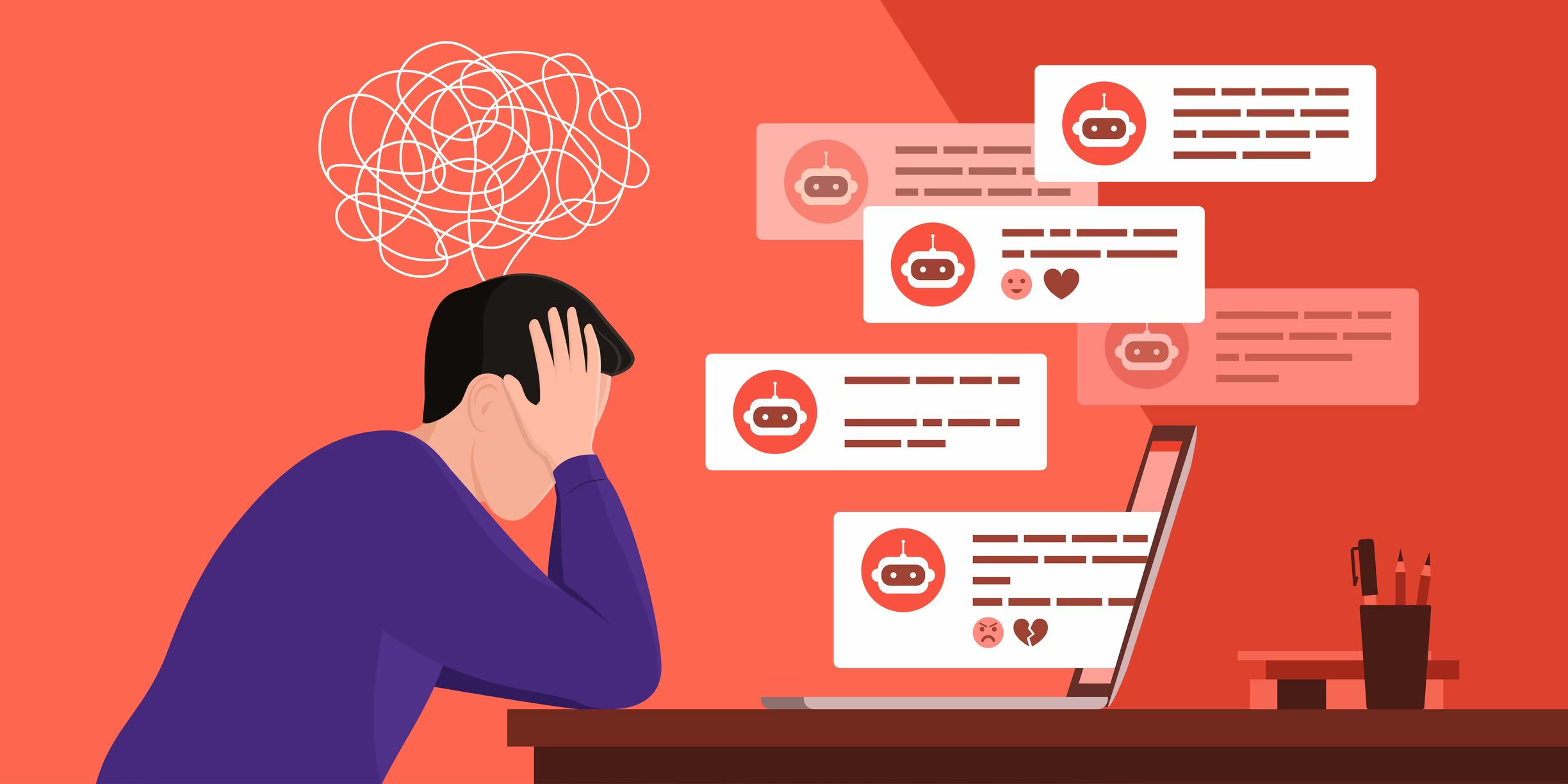
It’s becoming normal: thank the AI assistant on the phone, vent to him or describe an emotional/sentimental problem to receive suggestions and seek relief. I mean, what’s happening is, even though we know they’re just programs, we settle with them intimate bonds. A new study, published in the journal Technology and Societyexplains something more to us than what we already knew until now.
Why we confide in chatbots
We are now surrounded by conversational assistants increasingly advanced who know how to replicate the characteristics of technicians and consultants, but also of an apparent friend and confidant. We users are turning to them more and more for confess secrets, express affection or seek support to manage pain and relieve loneliness.
The report produced by Microsoft on its Copilot chatbot clearly tells us that, in 2025, chatbots used on telephones are often questioned on personal topics and existential topics. A very recent study published in Technology and Society shows that, out of around 5,300 chatbot users from Germany, China, the USA and South Africa, 48% consider the assistant a Friend61% are polite by saying “thank you” or “please” and 35% feel the need lack after days of non-use.
This trend doubles for chatbots designed explicitly for social companionship, where more than half of users develop a stable bond. The smartphones it has become the instrument of choice for this intimacy. If during the day work dominates on the office computer, in the evening on the mobile phone users dedicate themselves to well-being and personal growth, with peaks of conversations on love and relationship problems close to holidays such as Valentine’s Day.
What are the psychological causes that push us to connect to AI and the risks: the study
The study published on Technology in Society identifies in “perceived emotional support” the main reason why we increasingly choose to confide in chatbots. There are three elements that we particularly appreciate: the reduction of lonelinesstheabsence of judgement and the total sense of privacy that inspire us.
According to the survey participants, the chatbot offers an interaction without moral evaluations: a user knows he can confess a professional mistake or a health problem without fear of social disapproval and, consequently, this promotes exceptional openness. 20.9% of users prefer it share your secrets deeper to a chatbot than to close friends, family or healthcare professionals.
Attachment, however, varies by culture. In China and South Africa the connection is more intense: around two thirds of users appreciate the lack of judgment of chatbots and the protection of privacy, while in Germany only a third of users feel completely free from the judgment of others and around half value their confidentiality. In the western regionstending to be more heterogeneous and pluralistic, moral evaluation anxiety is less felt and reduces the feeling of needing a digital confidant.
Furthermore, the research disproves a common misconception: It’s not isolated people who are most connected to technology. On the contrary, users with a larger network of real friends show higher emotional attachment. This involvement, however, has a price: it has the possibility of translating into dependence. The stronger the attachment, the more users claim difficulty to live and work without chatbots, the more they risk withdrawing from their network of friends, showing themselves willing to purchase premium versions so as not to interrupt the interaction.
Sources
Roberts, 2026, Talkative AI and the fiction of artificial minds Chatterji et al., 2025, How People Use ChatGPT Costa-Gomez et al., 2025, It’s about time: the copilot usage report 2025 Kotska et al., 2026, Emotional attachment to AI chatbots: Evidence from Germany, China, South Africa, and the United States
