
According to numerous Italian media, several Northern European countries are ready to “send back to Italy” thousands of asylum seekers: these are the so-called “Dubliners”, i asylum seekers entered theEuropean Union through a certain country (for example Italy) and then move to another member state to submit a new asylum application.
The term, coined at a journalistic level, refers to Dublin Regulationaccording to which the first Country of entry into the EU is responsible for examining the application for international protection, except for family ties, visas or other specific criteria.
While on the one hand there are those who are already screaming about the risk of a return invasion, on the other there are those who link the harsh attitude of the European partners to the recent tensions between Italy and Spain after the events in Ceuta. Let’s look at the whole issue in detail.
Who really are the “Dublinists”?
The term “Dublinante” is not found in legal texts: it is an expression used by the mass media. Indicates a asylum seeker who entered theEuropean Union through a particular country (for example Italy, where he was identified and fingerprinted in the Eurodac system), but then moved to another Member State to submit a new asylum application.
The expression derives from Dublin Regulation, convention signed in 1990. Revised several times, since 2013 we have been talking about Dublin III, the principle on which the system is based has remained the same: the first country to enter the EU it is normal responsible of the examination of application for international protection, except family ties, visas or other specific criteria.
In December 2022, Italy made a turning point, denouncing the saturation of its reception system and the unsustainability of a mechanism that placed almost all the burden on the receiving countries. Rome therefore suspended the return of “Dublinarians”.
This move formally put the old regulation into crisis, pushing the European Union to re-discuss a meeting point between the protection of external borders and internal solidarity. The diplomatic tables therefore produced a new agreement, reached in 2024 and officially applied from 12 June 2026: the Asylum and Migration Management Regulation – AMMR 2024/1351.
Because the tension and rift between Northern and Southern Europe has increased
But why has tension erupted in recent days? To understand this you need to look at the calendar. At the end of 2025in turn, Italy and Germany they found an understanding to manage the re-employment of asylum seekers. Everything seemed to proceed on agreed tracks, until on June 12, 2026 did not come into force on new European Pact on Migration and Asylum. Since that moment the law has changed, and a dispute has arisen between Rome and Berlin over the interpretation of the dates.
According to the Italian Ministry of the Interior, the entry into force of the new regulatory framework has de facto “reset” the past: for Rome, all old pending requests on movements that occurred before June are no longer valid. The response of the Northern countries was of the opposite sign.
There Germany (which immediately carried out a formal test asking Italy to take back the first three migrants who arrived before 12 June) together with Sweden, Finland, Switzerland and Austriamaintains that previous practices are still valid and demands therigorous enforcement of the principle of “first country of entry”.
This push from the Nordic countries arises from an increasingly heated internal political debate on the topic of asylum: being the final destination of the majority of flows, these states are pushing for theautomatic execution of indentations to demonstrate that they know how to control borders. Italy, on the other hand, defends the idea of what to do load alone of anyone who touches its shores is an unfair principle, especially in the absence of an automatic relocation system in the Union.
Mediterranean countries like France and Spain they are maintaining with our country a much softer approach. Having to manage the Atlantic route and complex borders themselves, Paris and Madrid prefer to find practical agreements rather than bog down the bureaucracy with legal disputes that end up producing only papers and zero real transfers.
The administrative request does not mean immediate repatriation
It must be made clear from the outset that one administrative request is not equivalent to a direct and immediate physical transfer. As you can see in the image, approximately 167,000 requests were made in 2024. Of these, only 10% of the total were approved.
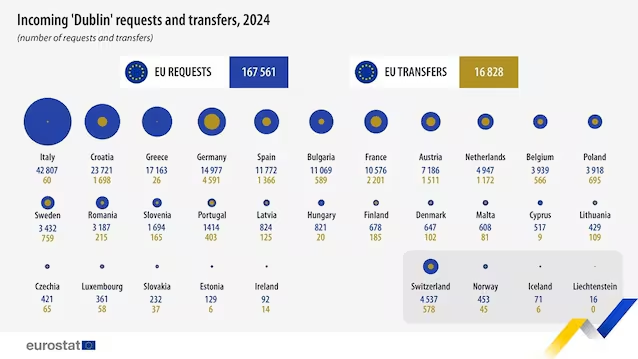
When the authorities in Berlin or Helsinki detect a person who has entered from Italy, they send an electronic notification via the European inter-ministerial software (DubliNet). Simply put, it is an automatic bureaucratic practice.
THE official Eurostat data relating to recent years show the actual distance between the cards sent and the actual transfers:
- Across the EU, compared to over 150,000 requests sent every year between member states, only a small percentage translates into a real physical transfer.
- Despite theItaly receive regularly even up to 40,000 requests per year (2023/2024)the actual transfers carried out number a few hundred people.
If we take the data, released by Eurostat, between 2023 and 2025 they were almost presented to Italy 110,000 requests. There have been some of these just over 200 were welcomed.
The turning point of the new EU Pact: solidarity and “non-refusal” returns
With the adoption of the implementing decrees of the new EU Pact on Migration and Asylum, the regulatory framework introduces an important innovation: the mandatory solidarity mechanism.
This means that the other member states are now required to help the countries of first arrival (Italy, Greece, Spain and Cyprus) choosing between relocation of migrants, financial contributions (over 20,000 euros for each failed relocation) or support operating.
In exchange for this structural help, however, the law provides that Italy will no longer be able to unilaterally refuse to take charge of the Dubliners under his jurisdiction (with the necessary exceptions).
How bureaucracy changes with the New EU Pact
With the entry into force of the new European regulations, the bureaucratic process has undergone a profound transformation which makes the Italy’s heaviest and most binding responsibility:
- For those who enter irregularly by land or sea without rescue operations, the responsibility of the country of first landing passes 12 to 20 months;
- unlike the past, when Italy could simply freeze reception citing the saturation of the structures, with the new system all it takes is one automatic notification via the database Eurodac;
- the State of destination (in this case Italy) he can no longer refuse the transferbut can only negotiate times and logistical methods of return.
- if a migrant did before LOSE their own tracks For 18 monthsItaly’s responsibility ceased; today, however, the term comes extended up to three years;
- the standard welcome it is guaranteed to the asylum seeker exclusively in the State in which he is legally required to remain (Italy), removing subsidies and benefits from those who move without authorization to Northern countries;
- they expand exceptions related to family reunions or educational qualifications achieved, which allow jurisdiction to be legally shifted to other member states, partially relieving the countries of first arrival.
Because Schengen and Ceuta have nothing to do with Dubliners
In recent weeks the political debate on migrants has generated a lot of confusion, superimposing two events which on a practical and legal level have no connection with each other: on the one hand the notifications on “dublinants” sent to Italy by Northern European countries, on the other the suspension of the Schengen Treaty and the restoration of border controls between Italy and Spain after tensions in the Ceuta enclave.
THE border controls between Italy and Spain they simply concern the suspension of Schengen, i.e. the temporary decision to physically verify the passage of people at the internal borders of the European Union for security reasons. A decision that all European countries can adopt, if they deem it necessary for internal security, as long as this occurs for a limited period of time.
This has nothing to do with the complex asylum procedures or the transfers of “Dublinarians”, managed by the AMMR. THE’alignment between Rome and Madrid on a diplomatic levelon this topic, can be considered further evidence in this sense.
Finally, to deny any connection there is the chronology of facts: the resumption of bureaucratic notifications to Italy depends exclusively on the European rules that came into force on 12 June, and is therefore an administrative issue that arose well before the recent frictions that arose at the Spanish border.
