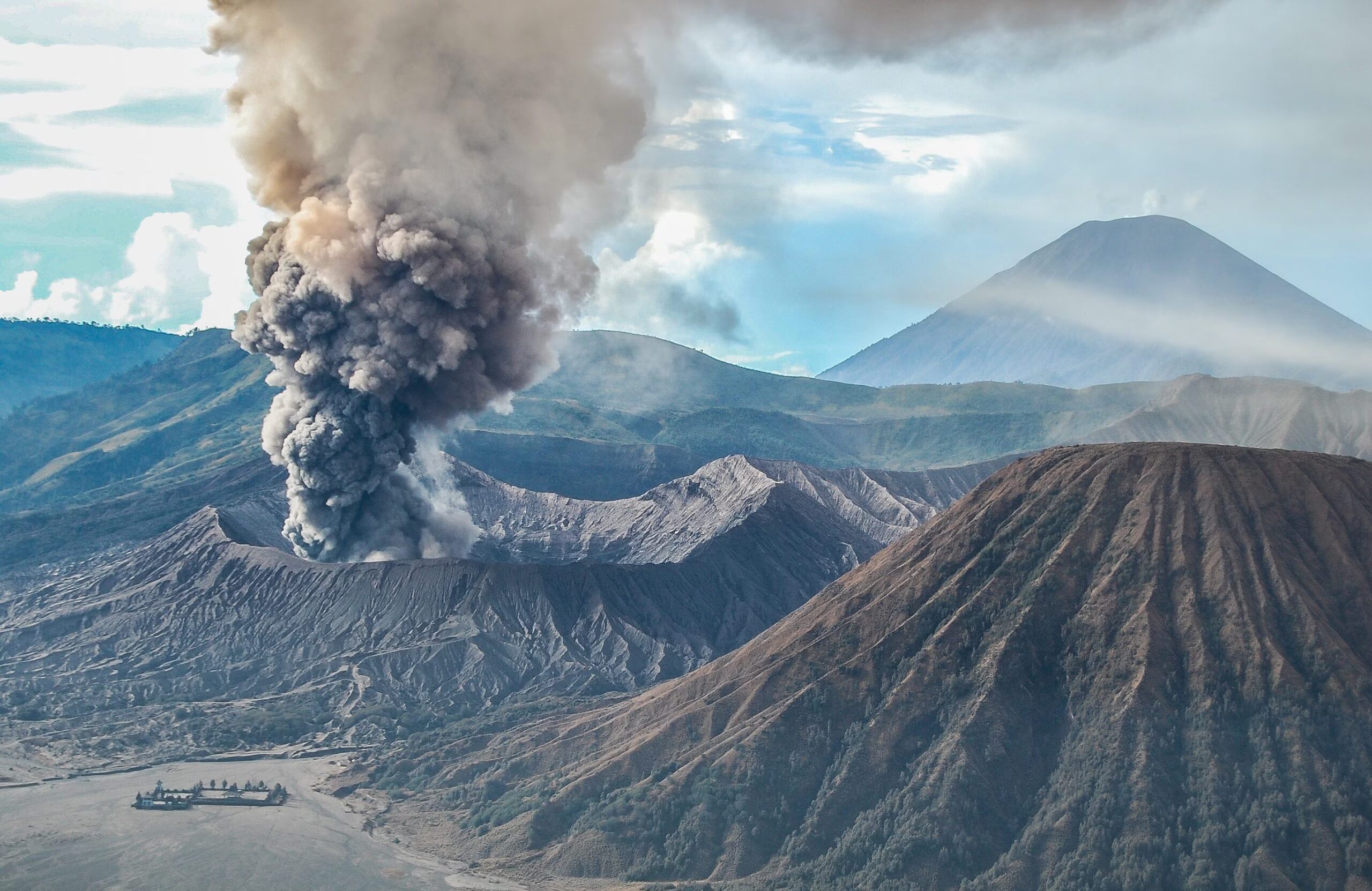
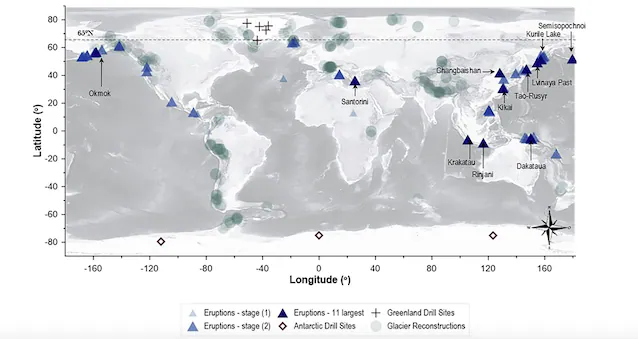
Large volcanic eruptions release enormous quantities of sulfur dioxide and particulate matter into the atmosphere that reflect sunlight back into space: this is why they can temporarily cool the Earth. THE’Holocenethe geological era in which we live and which has accompanied the development of human civilizations, is characterized by relatively mild and stable climatic conditions; However, paleoclimatic archives show a series of sudden cooling phasessome of which continued for centuries, and associated with major glacier advances. For a long time their origin remained uncertain, with hypotheses that called into question variations in thesolar activity and of ocean circulation. To shed light on the phenomenon, a research team led by Alice Paine from the University of Basel compared various geological and paleoclimatic archives, including traces of volcanic sulfates preserved in ice cores extracted in Greenland and Antarctica, the dating of the eruptive deposits and those of the moraines. The researchers thus reconstructed the 51 major eruptions of the Holocene occurred north of 20° S, many of them along the Pacific Ring of Fire, and compared their chronology with that of the expansion phases of the glaciers. The result of the study highlighted a strong temporal correspondence: over 80% of glacial advances analyzed occurred, within the margins of uncertainty of the dating, in proximity to at least one large volcanic eruption.
Eruptions can trigger secular cooling
A volcanic eruption lasts a few days or weeks, but the effects of its impact on the climate can last for generations. The process begins when large quantities of sulfur dioxide they reach the stratosphere following the explosion and, through oxidation processes, form a dense layer of sulfate aerosol. These particles scatter some of the incoming solar radiation, reducing the thermal energy reaching the Earth’s surface and causing rapid cooling. According to the authors of the study, this initial temperature drop would trigger some sort of chain reaction in the atmosphere-ocean-cryosphere system which would prolong its effects. In fact, cooling favors the expansion of the Arctic pack iceincreasing thealbedo and therefore the amount of solar radiation reflected back into space. At the same time, thermal imbalances between the two hemispheres can change the atmospheric circulation and move the tropical rain belt southwards. The reconstructions considered in the study also indicate a weakening of the Atlantic ocean circulation. The interaction between sea ice, oceans and atmosphere can thus trigger a series of climate feedbacks capable of prolonging the cooling well beyond the permanence of the volcanic aerosols in the atmosphere.
As Alice Paine explains:
The sulfur particles would only provide the initial impetus: once activated, the feedback mechanisms of the climate system can prolong their effects for decades or centuries, well beyond the time the sulfur remains suspended in the atmosphere.
Statistical analysis reinforces this interpretation. All the largest Holocene eruptions considered in the study, those of volcanic magnitude equal to or greater than 7fall within the chronological uncertainty of at least one glacial advance; for 72% of these eruptions there is also evidence of the advancement of glaciers in both hemispheres. The authors underline, however, that temporal correspondence does not alone demonstrate a causal relationship for every single event, also due to uncertainties in dating and the different regional response of glaciers.
Paine further underlines:
A solid explanation was missing for the decades-long and centuries-long duration of these coolings. By combining our statistical tests with paleoclimate reconstructions, we are certain that this is not a simple temporal coincidence and that volcanism was the real driver of these thermal crises.
What might happen on a hot planet after a major eruption
The discovery serves to reconstruct and understand the climate of the past, as well as offering useful indications for evaluating the possible consequences of future large eruptions. What would their impact be if they occurred today, in a climate system already profoundly altered by anthropogenic warming and therefore very different from that which characterized much of the Holocene? The authors explain that the climate response to an eruption depends not only on its magnitude and the amount of sulfur released into the stratosphere, but also on the latitude and starting climatic conditions. Global warming could in fact change the way in which the atmosphere, oceans and ice react to the initial impulse caused by volcanic aerosols. It is not yet clear, however, whether on a warmer planet the feedbacks identified in the study would be attenuated, amplified or take on different characteristics.
The study therefore does not envisage a precise scenario, but provides a useful framework for understanding how the effects of a large eruption can spread throughout the climate system and last well beyond the permanence of aerosols in the atmosphere. Precisely for this reason, understanding how these mechanisms can function in current climate conditions still represents a challenge open question for research.
