In the village of Pieńin the Central-northern Polandarchaeologists have identified a 17th century burial destined to become one of the most singular cases in the cemetery. The tomb, identified by number 75, belonged to one young woman and featured a combination of objects that, according to the authors of a new multidisciplinary study, documents ritual practices to protect the living from a possible danger represented by the deceased. This is a probable case of alleged vampirism or at least fear of undead.
The study on tomb 75, published in 2022 on Journal of Archaeological Science: Reportswas conducted by a Polish team, led by Dariusz Poliński of the Institute of Archeology of the Nicolaus Copernicus University of Toruń. The cemetery is part of an area in which they have been recognized two distinct funerary complexes: one medievaldatable between the 10th and 11th centuriesand one postmedievaldel 17th century. Investigations into this last part of the complex have yielded results 101 post-medieval tombs. Among these, the 75 is undoubtedly the most interesting.
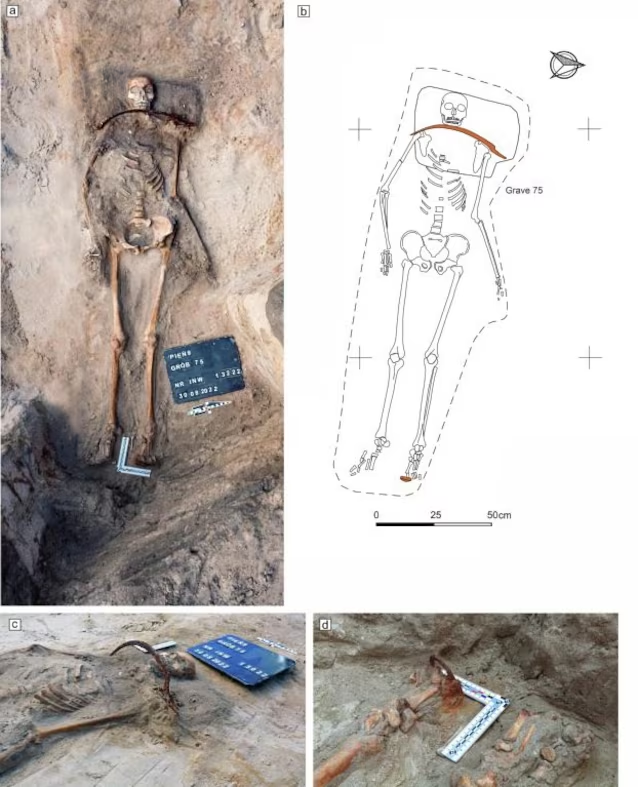
Grave 75 was shallow and had signs of an alteration following the first deposition, as if someone had reopened it after the burial. The deposed individual, following osteological, DNA and isotope analyses, was found to be a young womanapproximately tall 165cmdeceased between 17 and 19 years of age (it was not possible to identify the causes of death), without signs of malnutrition, raised in the area but with recent ancestors coming from Scandinavia.
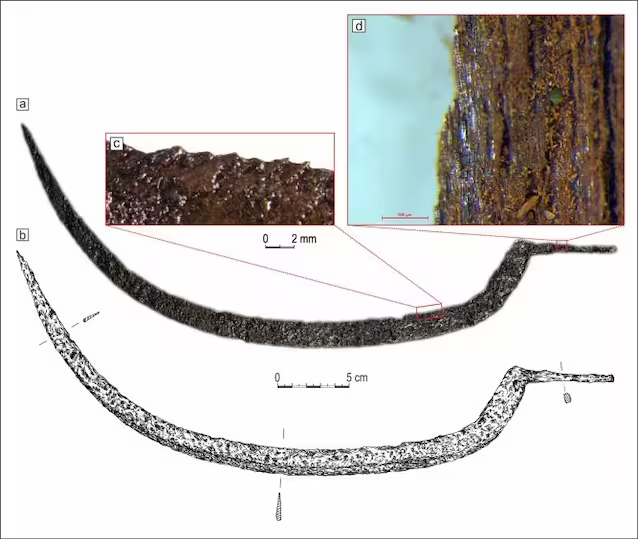
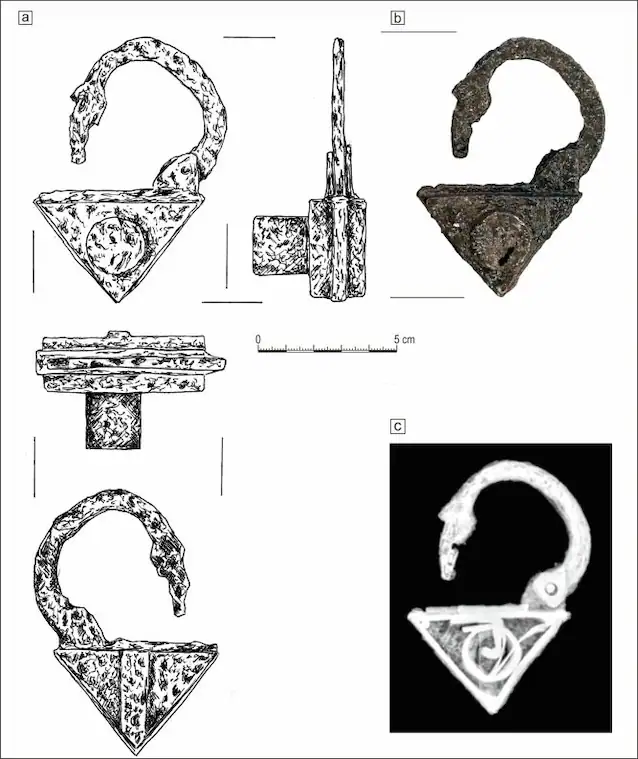
The analyzes at radiocarbon they estimated the burial as having occurred in the mid-17th century. The body was placed supine, consistently with the Christian ritual of the time, but the extraordinary nature of the deposition lies in the objects found in association with the individual. A large scythe had been placed on his neckwith the blade facing the throat. A triangular padlock it was instead hanging on thebig toe of the left foot. Post-medieval burials with scythes and padlocks are known in the archaeological record, but until now never together. It is precisely the particular combination, together with the position of the two objects, that makes the case exceptional: the authors had not found another burial with both of these practices in the published archaeological literature.
The lock is not interpreted as a simple functional object. His presence in the tomb falls, according to the authors, into one symbolic and apotropaic tradition. Its meaning could have been that of “close” the relationship between the living and the dead or prevent the deceased person from harming the livingentities. Comparative analysis shows that padlocks in tombs are also documented in Jewish contexts in Poland at the time, but the authors exclude that the Pień cemetery was Jewish: in fact, other characteristic elements of Jewish necropolises are missing and the general context does not support it, considering it more likely that it was a cemetery Protestant. The lock must therefore be interpreted within the broader framework of funerary practices in post-medieval Central and Eastern Europe.
The function of the appears even more explicit sickle. The position on the throat recalls practices intended to prevent the dead from returning or harming the living. Archaeologists also believe it is possible that the tomb was reopened after the original deposition: the pit in fact presents irregularities, reworked layers and alterations to the structure of the body. The scythe may have been added during this second manipulation, as a further protective measure.
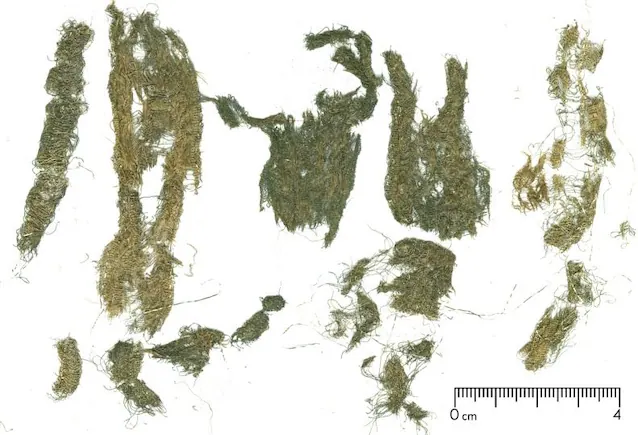
The funerary objects, as well as the absence of signs of malnutrition (rather rare in Central Europe at the time) finally offer clues to his social status. Only fragments of silk and metal threads have survived of the funerary garment, probably belonging to the decoration of a headdress. The authors interpret this element as an expensive and fashionable element in the 17th century, compatible with a high social status.
The picture that emerges is therefore complex: a young woman probably of high status, perhaps with a family history that was not completely local, who died of still unknown causes and was initially buried in relatively ordinary ways. Afterwardsthe tomb may have been reopened and transformed through the addition of the scythewhile the padlock had already been placed on the foot. For the authors, both practices belong to a repertoire of behaviors apotropaic or anti-demonic documented in Central Europe in the 17th century, an expression of the fear that some deaths could continue to represent a threat to the living.
Tomb 75 it does not therefore demonstrate the existence of a “vampire” in the modern sense of the term. Rather, it documents, with a combination of exceptionally well-preserved data from archaeology, anthropology, genetics and isotopic analyses, the way in which a 17th century community could react to the fear of a dead person perceived as dangerous.
