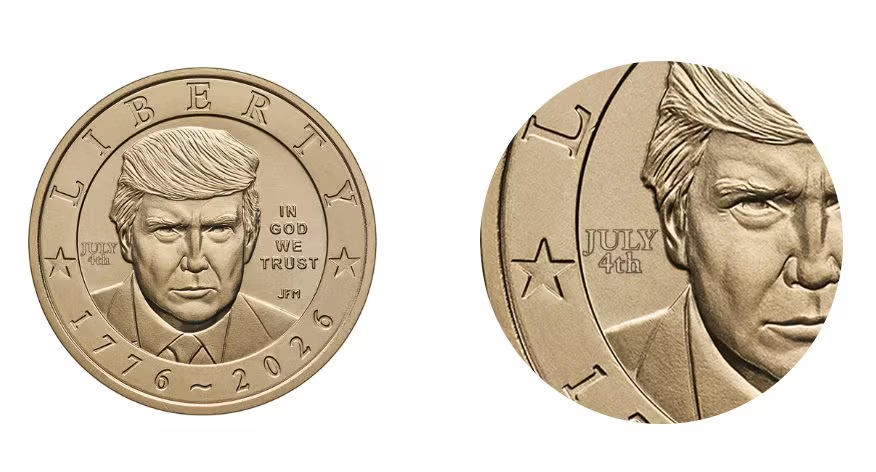
There United States Mintthe entity that produces and distributes the US dollar, has issued a $1 coin with the portrait of Donald TrumpPresident in office, to celebrate the 250 years of American independence. A fact that the United States has not seen for a century and which, according to several experts, should not even be possible: US law, in fact, prohibits portraying living people on American currency.
The Trump administration, however, justified this measure by referring to the precedent of 1926, when then President Calvin Coolidge was portrayed on a half dollar coin to commemorate the 150th anniversary of the United States.
How Donald Trump money is made, how many exist and how much it costs
Let’s start from an important point: the United States Mint has declared that $1 coins depicting Donald Trump, have legal tender and therefore, in theory, they can be used to pay. In practice, however, coins are comparable to gods collectibles and they will hardly end up in daily exchanges. According to federal law, among other things, each company remains free to decide whether to accept them or not.
On the obverse of the coin, i.e. the face we commonly call “head”, there is Trump’s face accompanied by the writing “LIBERTY”,”IN GOD WE TRUST” and by the double date “1776 ~ 2026”, in reference to the 250th anniversary of Independence. On the reverse, therefore the “cross”, appears the Presidential Seal with the eagle clutching an olive branch and a bundle of arrows, and the number 250.
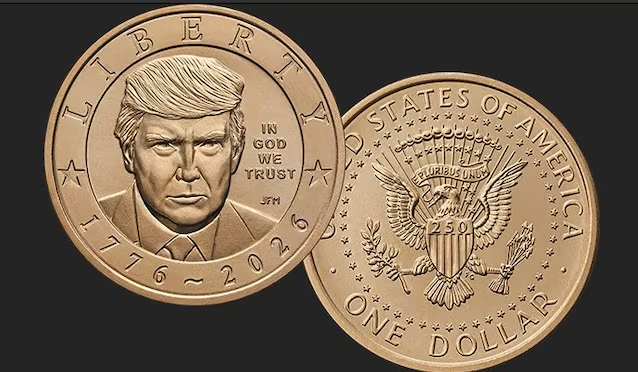
The color is golden, but there is not even a gram of gold: it is what the Mint calls “golden dollar”, a coin that owes its brilliant appearance to the alloy with which it is made, composed for the88.5% copper and for the remainder from zinc, manganese And nickel.
From a production point of view, the United States Mint it didn’t make it Note a total circulation official: from the limits of the individual products (rolls and bags) yes esteem an availability around 8.75 million pieces.
By itself, the coin is worth a dollar, but buying it costs much more. A roll from 25 pieces is sold to $61 (approximately $2.44 per coin), while a bag of 100 costs $154.50 (approximately $1.55 per coin). The recharge compared to the nominal value it therefore goes from around 50% to almost 150%, depending on the format chosen.
Despite the price, there was no lack of enthusiasm and the pieces were sold out on the Mint’s website within a few hours: in Washington it was even possible to purchase them in the vending machines of the Mint shop.
How the rule against depicting living presidents on US dollars was circumvented
To understand why all this is controversial, we need to take a step back. The United States has a long tradition, more than two centuries old, of preventing living people from being depicted on money. The story begins with George Washington himself: when he was asked to appear on the banknotes, the President refused, considering it a detail too similar to monarchies, where sovereigns are generally portrayed on money.
The written rule, however, only arrived in 1866 and was born from a truly singular episode of vanity. A five cent denomination was supposed to depict the explorer William Clarknow defunct, but a named Treasury official Spencer M. Clark took advantage of the similarity of the surname for print your face on it. When Congress noticed this, it passed an amendment with a clear rule: Only deceased people could appear on American banknotes. For metal coins, however, the ban remained a rigid unwritten custom for decades.
To justify his decision, Treasury Secretary Scott Bessent referred to a historical precedent: in 1926, for the 150th anniversary of the United States, then President Calvin Coolidge had already appeared on a half dollar coin, but he had been depicted behind the bust of President George Washington.
At the same time, the Trump administration cited the Circulating Collectible Coin Redesign Act of 2020, a law that dates back to Trump’s first term and which, according to the government, would prohibit depict living people Alone on the reverse of the coini.e. on the “tails” side. That’s why Trump’s face is on the “head” of the coin.
Despite being issued by the State Mint, several jurists and economists consider the operation to be bordering on the lawful and even in recent months there has been no lack of concrete resistance: in May a group of democratic parliamentarians wrote to the Treasury asking to stop everything, referring to a 2005 law which placed further limits on the presidents depicted on coins.
