
THE’CNR Institute for Bioeconomy (CNR-IBE) has certified that thesummer 2026 is the hottest in Italy since 1950 until todayousting the historic record of 2003 from the podium. In the collective imagination of Italians, the summer of 2003 has represented for over twenty years the absolute yardstick for defining extreme heat, a summer that has remained engraved in the memory for its duration and its anomalous temperatures. Or at least that’s how it has been until now.
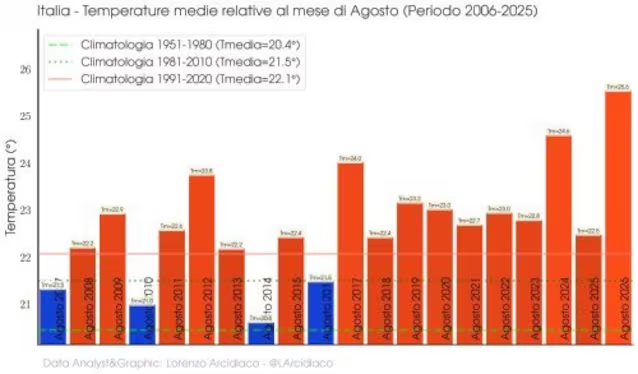
The data processed by the CNR paint an even more severe picture than in the past: the national average temperature in the three summer months reached 24.3°C two meters above the ground, significantly exceeding the peaks reached both in 2003 and in the recent 2023. In August the average rose to 25.6°C.
Why the summer of 2026 broke the 2003 temperature record: Comparison
Comparing the two historical periods, it clearly emerges how the dynamics of seasonal heat has changed over the last twenty years:
- An unprecedented August: while in 2003 the maximum peak was concentrated with exceptional force especially in the month of June, the summer of 2026 saw a month of extraordinarily hot August. With an average temperature of 25.6°CAugust 2026 was the driving force behind the entire record, clearly beating the previous records of 2024 (24.6°C) and 2017 (24.0°C).
- Continuity and absence of pauses: in 2003 the heat wave was characterized by peaks of dry air of Saharan origin. In 2026, the combination of continuously high average temperatures and high humidity has generated a persistent heat day and nightpreventing the territory from cooling down.
- The role of the seas: compared to 2003, the Mediterranean basin reached higher surface temperatures on average in 2026, reaching 27°C already in June.
The scorching heat is no longer an exception: the frequency has exploded
Perhaps the most significant data highlighted by the CNR historical series does not only concern the intensity of individual temperatures, but the frequency with which extreme summers occur.
If in the last century a summer like that of 2003 was considered an event with secular return times, today the rhythm is totally distorted: almost all of the ten hottest summers ever recorded in Italy from 1950 to today are concentrated over the last twenty years (2003, 2012, 2015, 2017, 2019, 2022, 2023, 2024 and 2026). What once represented a once-in-a-lifetime statistical anomaly has become one constant of our eradrastically reducing the time intervals between one record season and the next.
The real driver of the record: anthropogenic global warming
Although in recent months there has been a lot of talk about the onset of El Niño in the Pacific, scientifically it is necessary to maintain strong caution: the geographical distance of Italy and the propagation times of atmospheric teleconnections make a direct or immediate link is highly unlikely between the peaceful anomaly and the summer just experienced in our basin.
The true, indisputable protagonist of this record remains the anthropogenic global warmingwhose impact on the Mediterranean manifests itself through very specific structural dynamics:
- The expansion of the tropical belt: the global increase in temperatures is expanding the Hadley cell, the atmospheric circulation that delimits the tropics, northwards. Consequently, the promontory North African it rises much more easily and frequently towards the latitude of Italy, blocking the way to Atlantic disturbances and also influencing Azorean-style anticyclonic comebacks.
- An increasingly higher thermal base: the continuous accumulation of greenhouse gases in the atmosphere has raised the “starting temperature” of the planet. Extreme meteorological configurations or exceptional phenomena are not needed to reach record figures: even normal summer high pressure today acts on a starting thermal base that is already significantly warmer than in 2003.
- The Mediterranean “Hotspot” effect: our sea is warming at a faster rate than the global average. A constantly above-normal Mediterranean acts as a thermal reservoir, releasing heat and humidity even during the night hours and exacerbating the perception of sultriness in all peninsular and island regions.
The summer of 2026 demonstrates that what appeared to be a once-in-a-lifetime anomaly in 2003 has become the new and direct consequence of human-driven climate change.
