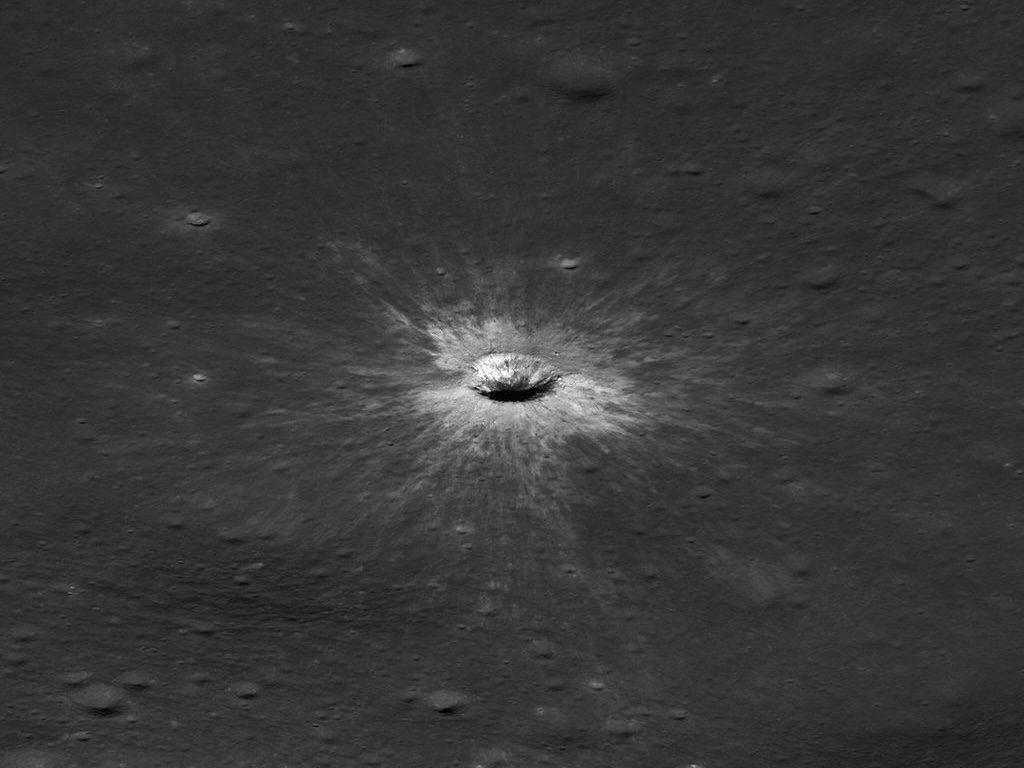
NASA has discovered a on the Moon new impact crater 222 meters wide and approximately 43 meters deepdimensions larger than those of the Colosseum in Rome. He was called McGetchinin honor of lunar pioneer Thomas McGetchin, and trained on east edge of the visible face of the Moon betweenApril 11 and May 22, 2024when a fragment of an asteroid or comet the size of a three- to six-story building hit the lunar surface.
It’s the largest impact crater contemporary discovered so far throughout the entire Solar Systemthat is, the largest for which we have observations that allow us to establish that it was formed in recent times. According to current models, an event of this size should only occur on average once every 132 years.
This was discovered in the autumn of 2025 Robert Wagneran image processing specialist at Intuitive Machines who works with data from Lunar Reconnaissance Orbiter Camera (LROC) on board the probe Lunar Reconnaissance Orbiter of NASA. Wagner was carrying out a routine check comparing images of the same area of the Moon taken at different times, when he noticed a huge bright spot surrounded by a dark halo, the signature of an impact crater. The result was published in the scientific journal Science Advances.
The interesting thing is that no observatory had detected the impact at the time it occurred. The date was reconstructed a posteriori thanks to the LRO images: in those of 11 April 2024 the crater was not yet present, while in those of 22 May it had already appeared. NASA estimates that the responsible object released a impact energy equal to that of the Hiroshima atomic bomb (65 billion kJ).
How McGetchin Crater Was Discovered
The discovery was possible thanks to Wide Angle Camera (WAC) of LRO, a camera that records almost the entire lunar surface every month with one scale of the order of 100 meters. By comparing images of the same area taken on different dates, automated software identifies every single variation in the lunar surface. Many are just image artifacts, which is why specialists like Robert Wagner they also compare the images, looking for those variations identified by the software that are in fact caused by impacts or other lunar events.
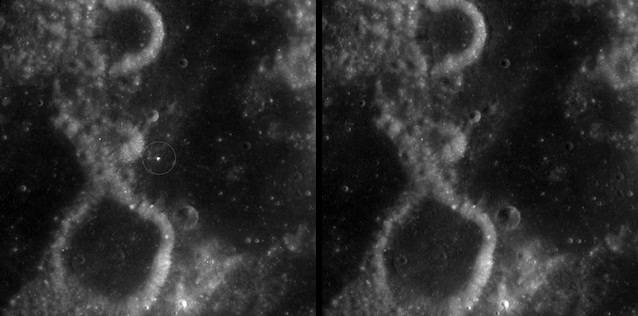
This is how the October 24, 2025Robert Wagner discovered the renamed crater McGetchinthe largest recent crater identified on the Moon. Before it, the record was held by another crater that barely measured 70 meters in diameterAfter the discovery, LRO also headed towards the area at two o’clock Narrow Angle Cameracapable of achieving one resolution of the order of one meter. The images, visible at the top of the article, have made it possible to establish that the crater has an average diameter of 222 metersa depth of 43 meters and walls with an average inclination of around 24°, which in some areas reaches almost 40°.
In over 17 years of mission, the team of Lunar Reconnaissance Orbiter he identified at least 1000 new impact craters, a large quantity due to the absence of an atmosphere capable of disintegrating them as happens on Earth.
However, few are large enough to be easily detected: according to models, impacts capable of creating craters as large as McGetchin occur on average once every 132 years. We can therefore consider ourselves lucky to have witnessed such an event.
The impact changed the lunar surface up to kilometers away
Have detailed images of the surface available before and immediately after such a huge impact it allows astronomers to test models of crater formation, the frequency of impacts, and the rate at which the lunar surface is continually changing.
The consequences of the impact were also observed by the instrument Diviner of LRO, which measures the temperature of the lunar surface. Between November 2025 and February 2026 Diviner identified an area approximately large around McGetchin 6.4km which during the lunar night is up to approx 8-9 °C colder compared to surrounding regions.
The reason is related to regolith lunar, the layer of dust and rock fragments that covers the Moon. The impact doesn’t just excavate the crater, but shakes and raises the surrounding ground making it less compact and more porous. Such a “shuffled” regolith is less efficient at retaining and transmitting heat and, after sunset, yes it therefore cools more quickly compared to the surrounding terrain.
The extension of this cold areadozens of times larger than the crater itself, shows how far the physical effects of an impact can spread. In fact, the optical images indicate surface modifications that can also be traced to more than 100 km from the point of collisionproduced by the material expelled from the crater and by the disturbance of the regolith. These data also have practical consequences for a longer-lasting human presence on the Moon. The properties of the regolith determine the behavior of the ground under the wheels of the rovers, the stability of the structures and the interaction of the dust with the instruments.
