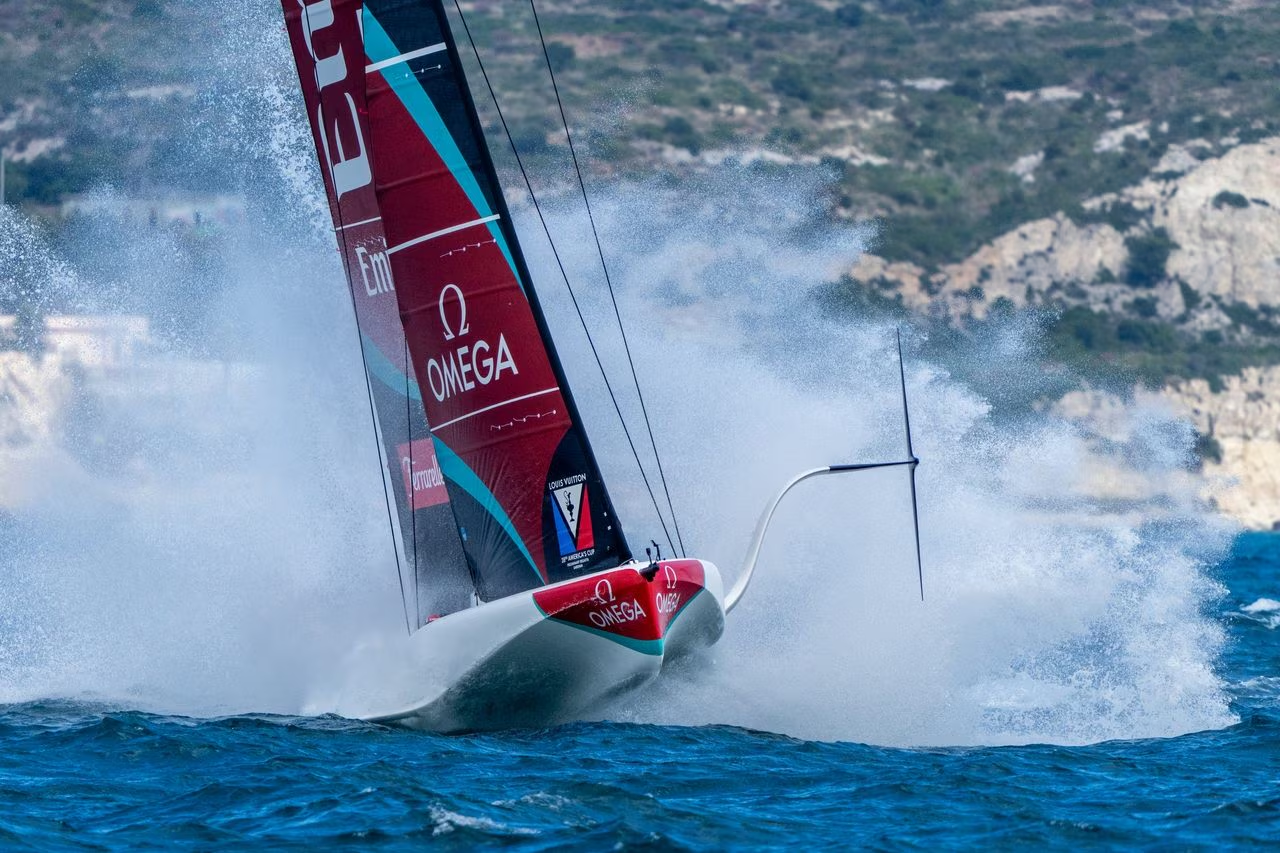
From 24 to 27 September 2026, the Gulf of Naples will host the second Preliminary Regatta of the 38th America’s Cup, with 9 boats of the AC40 class competing in 8 fleet races and in a final between the top two in the ranking. The AC40 they are monohulls flying 11.8 meters long, all the same, built by the same shipyard and operated by four people, and are usually presented as a smaller version of the AC75s that will compete for the Cup in the same waters in the summer of 2027.
What an AC40 hull and crew look like
The hull of an AC40 is exactly 11.8 meters long and 3.38 meters wide, with a draft of 3.5 with the boat stationary and the foils lowered. The project is developed by the Emirates New Zealand team, the hull is entirely in carbon fiber, and the deck opens up only two wellsone on each side, which house the 4 crew members (two helmsmen and two regulators). The regulation sets the mass of the boat, complete with mast and sails, between 2,118 and 2,126 kilos, while the crew including equipment must weigh exactly 360 kilos. Before the regattas, each crew is weighed with the equipment they are wearing and the difference in weight compared to the prescribed value is made up with weights fixed to the seats, distributed in such a way as to reproduce four sailors weighing 90 kilos each sitting in their own place.
The foils weigh a third of the boat and act as ballast
A very interesting fact concerns the appendages: on the AC40 the two lateral foils are heavy 361 kg eachthat is, a total of 722 kg on a boat that weighs 2,120, 34% of the total. On the AC75 the proportion is almost identical, because each foil exceeds one ton and the two together are worth just over a third of the total 5,875 kg.
This relationship is not a coincidence, because in this type of monohull the task of counteracting the lateral thrust of the wind is entrusted precisely to the appendages that allow the boat to fly. While it travels raised on the leeward foil, the windward one remains raised out of the water and its weight, offset by a few meters compared to the axis of the hull, generates the righting moment that keeps the mast upright. On the AC40 the foil wings are made of steel for exactly this reason, because in addition to producing the lift that lifts the boat they must necessarily be heavy.
The most important difference with the AC75 is not visible: the monohulls fly alone
It is on onboard systems that the two classes really diverge. Each AC40 leaves the construction site with a autopilot which continuously adjusts the angle of the flaps on the foils and the inclination of the rudder to keep the boat at a stable altitude above the water, and the helmsman is only left with the task of choosing that altitude, in increments of ten centimeters at a time. All this on the AC75 it is prohibitedthe flight is controlled by a person, moment by moment, while the boat runs at 40 or 50 knots, the equivalent of over 90 km/h.
The Swiss Alinghi team summed up the difference by comparing it to that between an automatic and a manual gearbox, while its skipper Arnaud Psarofaghis described the leap in performance with an automotive image, that of someone traveling on the motorway at 120 mph and being overtaken by someone going forty kilometers per hour faster. Even so, the AC40 remains an extreme boat, capable of exceeding 40 knots and going much faster than the wind that pushes it.
On board an AC40 no one produces muscle energya pack of lithium batteries powers the control unit and the hydraulic pumps that move the foil, rudder, rotation of the mast and adjustment of the sails, and it is the same feature that we will see on the AC75 in Naples. Until the Barcelona 2024 edition four of the 8 men on board were cyclorathletes who pedaled generating the energy necessary to put pressure on the hydraulic system, but the new class rule eliminates them in favor of an electrical system that is the same for everyone and was calibrated precisely to reproduce the power that those four athletes generated with their own legs.
What are the preliminary regattas and the teams: from Luna Rossa to La Roche-Posay
The Preliminary Regattas are introductory events that are raced with the AC40s and are used by the teams to compete on identical boats, where only the crew, maneuvers and tactics remain to make the difference, and by the organizers as a dress rehearsal of the entire logistics machine.
The program includes 8 fleet races and a final. The races begin on Friday 25 September in the early afternoon, with up to three races on Friday and Saturday and two on Sunday. Scoring awards ten points to the winner of each race and scales one point up the fleet, up to the ninth boat’s two points, and the two boats with the highest total will play each other all in one final match race. There are nine AC40s in the water, six from the main teams, namely Emirates Team New Zealand, GB1, Red MoonTudor Team Alinghi, La Roche-Posay Racing Team and American Racing Challenger Team USA, plus the second boats that the first three entrust to their respective Women & Youth crews, a possibility introduced with this Cup cycle. At the first Preliminary Regatta, held in Cagliari last May, Luna Rossa won beating Emirates Team New Zealand in the final.
What the America’s Cup will be like in Naples in 2027
In 2027 we will return to the AC75s, only one per team and necessarily obtained from an existing hull from the 2021 or 2024 editions, a choice designed above all to contain design and development costs. The regatta field will be in front of the city seafront, between Castel dell’Ovo and Posillipo, while the teams’ bases will be in Bagnoli.
The calendar foresees an unprecedented opening, because it will be on 22 and 23 May 2027 all seven AC75ssix challengers plus the New Zealand defender, will start together on the same line for six fleet races, what never happened in its 175 year history of the competition. From May 26th we move on to the one-on-one duels of the Louis Vuitton Cup, with three round-robin groups of 21 races each, semi-finals and final scheduled for the end of June. Whoever wins it faces Emirates Team New Zealand in Match which will decide the winner of the America’s Cup, which will begin on 10 July 2027 and will end when one of the two boats reaches seven victories. The AC40s will also return to Naples for the Women’s America’s Cupwhich had its first ever edition in Barcelona in 2024, and for the Youth America’s Cupwhich had already taken place in 2013 and 2017.
