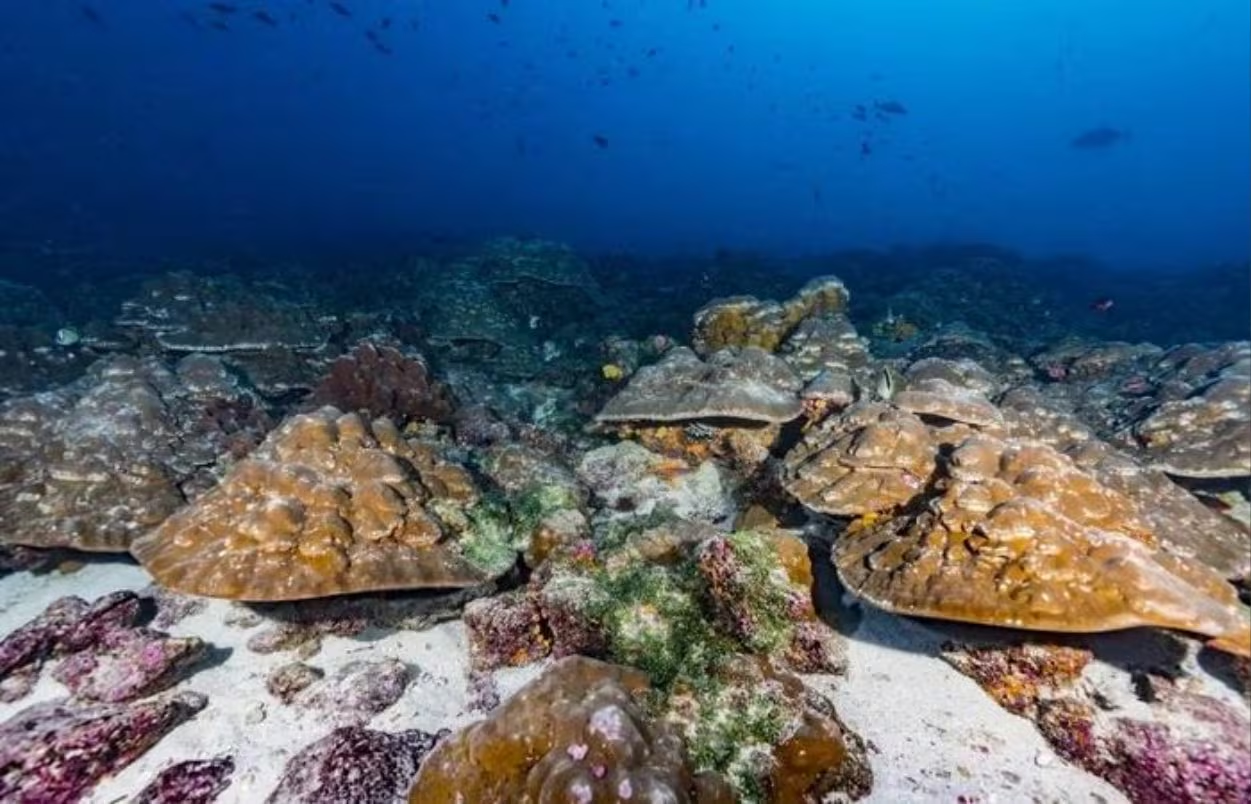
Over the last 40 years, El Niñothe well-known climatic phenomenon linked to the anomalous warming of surface waters in the tropical Pacific, has become significantly more variable and intense, recording greater oscillations than 36.5% compared to past centuries. A new study published in the journal demonstrates this, and links this anomaly directly to global warming Science which is based on an exceptional “climate archive”: the ancient corals of the Galápagos Islands.
Until today, to understand how much the system had changed over time ENSO (El Niño-Southern Oscillation), we could only rely on recent instrumental data, without having a real historical comparison. Today, thanks to the analysis of these extraordinary marine organisms, researchers have been able to precisely reconstruct ocean temperatures over the last 1000 years, demonstrating that the increased climate variability recorded in recent decades has no precedent in the last millennium.
Galapagos corals and El Niño: natural archives of ocean temperatures
To reconstruct the behavior of ENSO in the past, researchers at the University of Michigan analyzed modern and fossil corals from the Galápagos. These organisms build their skeleton by forming successive layers of calcium carbonate and, during growth, incorporate chemical information related to the conditions of the surrounding water.
In particular, the study analyzed the ratio between strontium and calcium (Sr/Ca) they oxygen isotopes (δ¹⁸O) present in the skeleton. Both can be used as indicators of changes in sea surface temperature. The comparison with modern instrumental data thus allows us to transform the chemical composition of the coral into one reconstruction of past temperatures.
The research team got it 28 data sets from corals from five islands of the archipelagodiscontinuously covering about a millennium. The data was then divided into three periods: 1000–1850used as a preindustrial reference; 1851–1982corresponding to the 20th century; And 1984–presentconsidered the modern period.
The comparison showed that ENSO variability in the eastern Pacific has been observed over the past approximately 40 years 36.5% ± 8% greater than in the period 1000–1850. Compared to the 20th century, the increase is instead 16.2% ± 10%.
In other words, it doesn’t mean that each El Niño is 36.5% more intense today. The data indicates that the oscillations of the ENSO system have become larger: particularly intense El Niño events have occurred in recent decades, increasing variability overall phenomenon.
What global warming has to do with ENSO variability: the new study
At this point a question remains: can this greater variability simply be a normal oscillation of the climate or is it linked to climate change?
To verify this, the researchers compared the reconstruction obtained from the corals with pre-industrial climate simulations carried out through 12 climate modelsconsidering the internal variability of the climate system ei natural factors that can influence itsuch as solar activity and volcanic eruptions.
The result is that the observed increase in coral reconstruction exceeds the variability range produced by the models when they are considered only natural factors. Furthermore, the increase in ENSO variability reconstructed from corals follows the increase in global mean temperature. The authors interpret these results as an indication that the Global warming is contributing to increased ENSO variability in the eastern Pacific.
The discovery is important because ENSO is one of the main natural systems capable of influencing the global climate from one year to the next. Changes in its variability can therefore have consequences far away from the Pacific, modifying the probability of some climate extremes such as drought and intense rainfall. But the most important data from the study is perhaps another: thanks to the corals of the Galápagos today we can compare the behavior of modern ENSO with that of a millennium of climate historyand the comparison shows how anomalous the last decades are compared to the reconstructed past.
