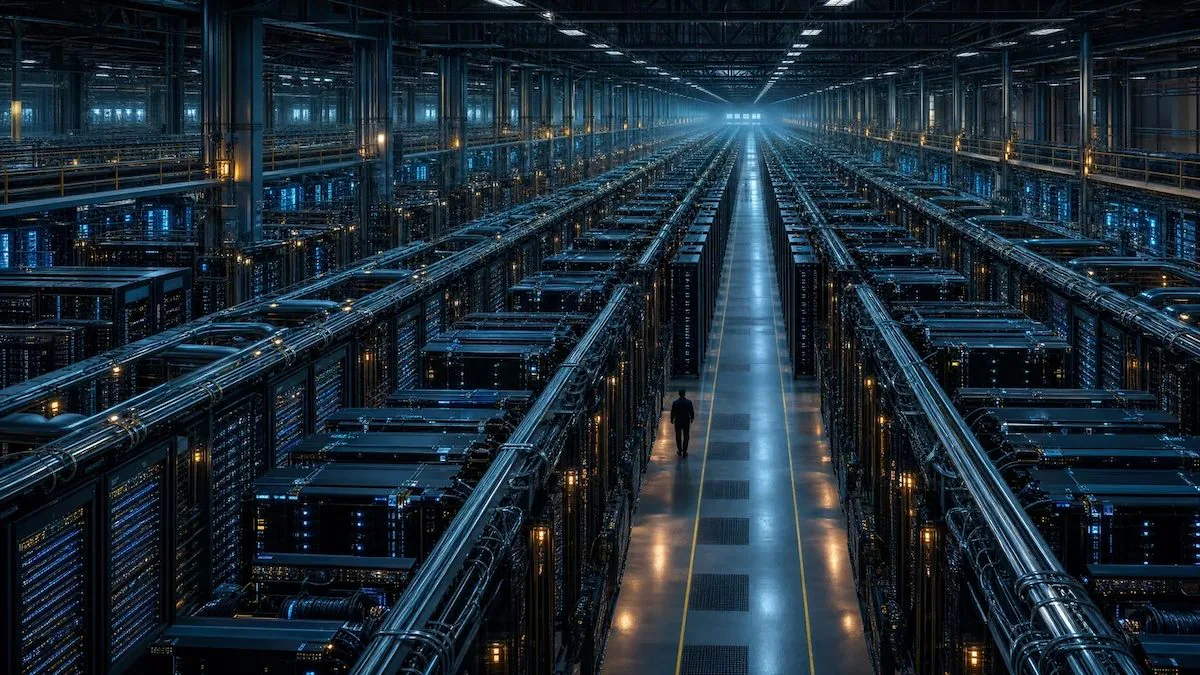
Brussels puts data centers under observation with the Data Center Energy Efficiency Package, the package of rules with which the European Commission wants to quantify the environmental footprint of the digital infrastructures of member countrieskeeping an eye in particular on how much electricity and water they consume. The new provisions apply to systems that exceed 500 kW of power, while the first labels will appear in 2027.
Every web search, every video streamed, every question asked of a chatbot passes through a data center, an industrial building that collects thousands of servers operating without interruptionday and night, to process data. It is work that absorbs large quantities of electricity and produces just as much heat, to be disposed of with cooling systems that are themselves energy-intensive and powered by water.
Google tried to quantify how much all this weighs about a year ago, with a technical report dedicated to the consumption and emissions of a median text prompt from Gemini. According to the document, a typical (i.e. median in terms of energy) text request drew 0.24 watt hours (Wh), generated 0.03 grams of carbon dioxide equivalent (CO2e), and required 0.26 milliliters of water.
Data center consumption in the EU
Tiny numbers when taken individually and when multiplied by billions of requests tell a different story. A report published by the International Energy Agency puts in black and white how tools like ChatGPT absorb increasing quantities of electricity and water, both in the model training phase and in their daily use. Behind every response generated are enormously complex data centers and computing infrastructures, whose energy demand, according to estimates, is destined to double between now and 2030: In fact, in 2024 the electricity consumption of data centers in the EU stood at 68 TWh, and is expected to grow to 114 TWh by 2030, representing 3.2% of the Union’s electricity demand. It is precisely this trajectory that makes the adoption of shared and reliable measurement criteria urgent, capable of orienting the development of models towards maximum efficiency and containing their burden on the environment.
The European Commission is moving in this direction, having recently presented a proposal with the precise objective of introduce a specific energy label system for data centers. A project that arrives at a time when the Union has implemented an ambitious strategy to play a leading role in the race for artificial intelligence, aiming to make Europe a global reference in the sector. Hence the choice to focus on the creation of at least 19 AI factories, distributed across Europe, five gigafactories designed to train complex models and triple the capacity of European data centers over five to seven years, giving priority to sustainable structures.
The European Commission’s proposal for 2027
In this framework the energy label takes on a very specific meaning because it becomes a way to make the use of water and energy resources transparent and at the same time to facilitate the integration of these infrastructures into the European electricity grid. The first step, decided on 21 September by the European Commission, is to create a common label that says how efficient a structure is and how much water it uses, valorising those who offer flexibility to the system or recover the heat produced. The format follows the one already familiar for household appliances that is, two scales colored from green to red, one for PUE and one for WUE, each divided into seven classes, a report card from A to G.
The delegated regulation adopted by the Commission establishes a classification system for data centers with installed power above 500 kW, the same facilities already subject to the reporting obligations under the Energy Efficiency Directive, with smaller sites able to join on a voluntary basis. The labels will be electronic documents, automatically generated from the data uploaded into the European data center database, and equipped with a QR code that links to the complete facility profile. The first round is expected by 15 August 2027, valid for one year, a review of the mechanism is expected by the end of 2028 and then every three years.
How the energy label for data centers works: classes A to G
Reading is what we have been used to for years with refrigerators and washing machines. Class A, in green, marks the most virtuous structures, class G, in red, those with the highest consumption. On the energy front, the technical annex of the regulation assigns class A to data centers with a PUE equal to or lower than 1.15, then drops to class B up to 1.25, C up to 1.35, D up to 1.5, E up to 1.7, F up to 1.9, while beyond that value class G is triggered. On the water front the scale indicates that for A a WUE of no more than 0.1 is required, B reaches 0.2, C at 0.4, D at 0.6, E at 0.8, F at 1, and those who also exceed this last threshold end up in class G.
The measure is based on the first technical report commissioned by the Energy Directorate General to EY, Borderstep Institute and AIT, which sifted through the data from the first reporting cycle. 770 data centers responded, or approximately 36% of those estimated in the Union. The evaluation of energy efficiency and sustainability is based on the calculation of four parametersnamely power use effectiveness (PUE), water use effectiveness (WUE), energy reuse factor (ERF) and renewable energy factor (REF).
On energy efficiency the picture is discreet. The PUE, the ratio between the total energy absorbed by a site and the energy that actually ends up on the servers, stands at 1.36 in Europe, with national fluctuations between 1.15 and 1.66. Italy records 1.46, above the average, but below the threshold of 1.5 beyond which, the report writes, the values reveal room for improvement. The study also notes that efficiency increases with size, because large facilities are often younger, more professionally managed and benefit from economies of scale.
The next steps
The water chapter is the one in which our country struggles the most. The WUE, which measures the cubic meters of water consumed for each megawatt hour of IT energy, has a European average of 0.58 with a range between 0.07 and 1.28. Italy stands at 0.70, the second highest value among large countries after Belgium and far from the reference threshold of 0.4 indicated by the Climate Neutral Data Center Pact. The report reminds us that water consumption depends above all on the cooling technology adopted and that evaporative systems weigh much more than air or direct liquid systems.
The regulation will be examined by the European Parliament and the Council who have two months to raise objections before entering into force. The Commission has opened a public consultation, scheduled until 14 December, to establish the minimum performance thresholds that the entire sector will have to comply with.
