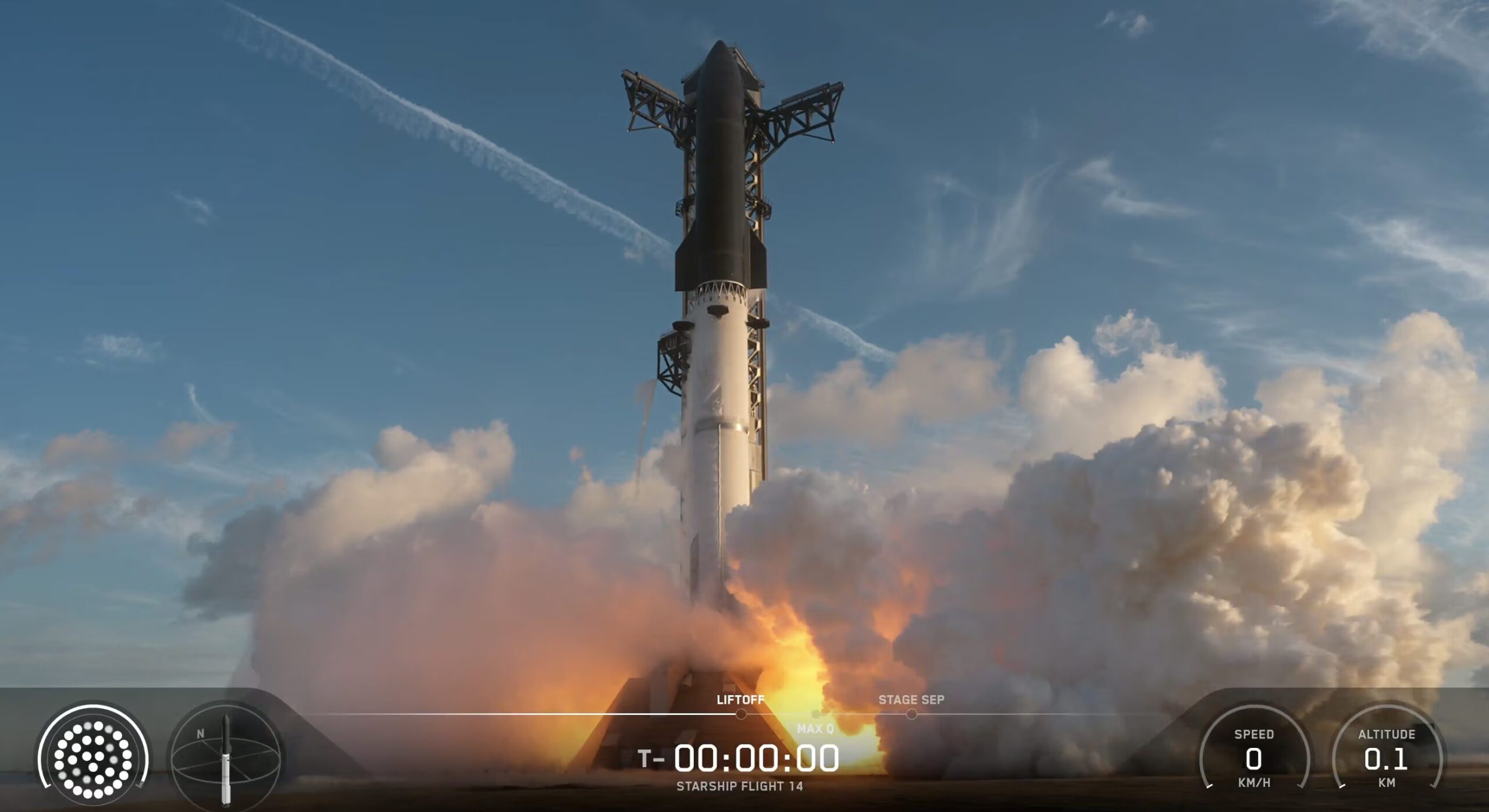
AND Starship’s 14th flight successfully departedthe first in orbits the Earth: the powerful SpaceX rocket was in fact launched at 2.48pm (Italian time) from Starbase in Texas, with on board 26 Starlink Version 3 satellites. The mission involves the use of Ship 41 and Booster 21for which operators will have to verify that they have resolved the problems that emerged in previous tests.
At 3:00 pm, shortly before the six engines were shut down, one engine Raptor passed away prematurely, but around at 3.15pm Starship is successfully entered orbit.
However, there were some unexpected events: the flight should have lasted about 10 hourscompleting six orbits around the Earth and ending with the ditching was controlled between 00:05 and 01:20 (Italian time) on September 29th. At the second checkpoint, shortly after 4:00 pm, SpaceX decided that Ship 41 would perform the maneuver de-orbit burn subsequently landing in the Pacific Ocean approximately 3 hours after launch.
For Elon Musk’s company it is however one of the most important launches of the entire Starship program: So far, the 13 previous tests have been suborbital flights, lasting approximately 1 hour, allowing SpaceX to maximize public safety and allow for maximum learning.
In addition to being the first ever to orbit the Earth, the 14th flight also represents a fundamental test for the NASA Artemis programwhich aims to return man to the Moon. More specifically, the next Artemis III mission (scheduled for 2027 with the participation of the Italian astronaut Luca Parmitano as pilot) will test the capabilities of rendezvous and own docking between the Orion capsule and commercial lunar landing systems both of SpaceX what about Blue OriginJeff Bezos’ company.
Before placing the Starship into orbit, SpaceX carried out various checks, and then released the 26 Starlinks, a procedure begun about 34 minutes after takeoff and lasted about half an hour. The video below shows the trajectory of flight number 14.
Once released, the Starlink V3 satellites deployed their antennas, activated their solar panels, and made first contact with Earth and the rest of the Starlink constellation via radio frequency and laser links.
According to the original plan, Ship 41 was supposed to accomplish six orbits around the Earth at approximately 275 km altitude. This, in fact, would have served SpaceX to test all the control systems, the management of the propellants inside the tanks and analyze the tiles of the heat shielda fundamental component especially for manned missions. Not surprisingly, three of the satellites were modified with a series of cameras in order to scan the heat shield and transmit the images to the operators.
At approximately 5pm, Starship instead left orbitstarting its descent and then re-entering the atmosphere and landing in the Pacific Ocean, off the coast of Hawaii.
