Just over a month after the collapse of the glacier which killed over 1,450 people, Nepal finds itself having to face new natural disasters: the Himalayan country was in fact hit by a violent wave of bad weather, with torrential rains lasted four consecutive days that triggered landslides and floods in much of the national territory.
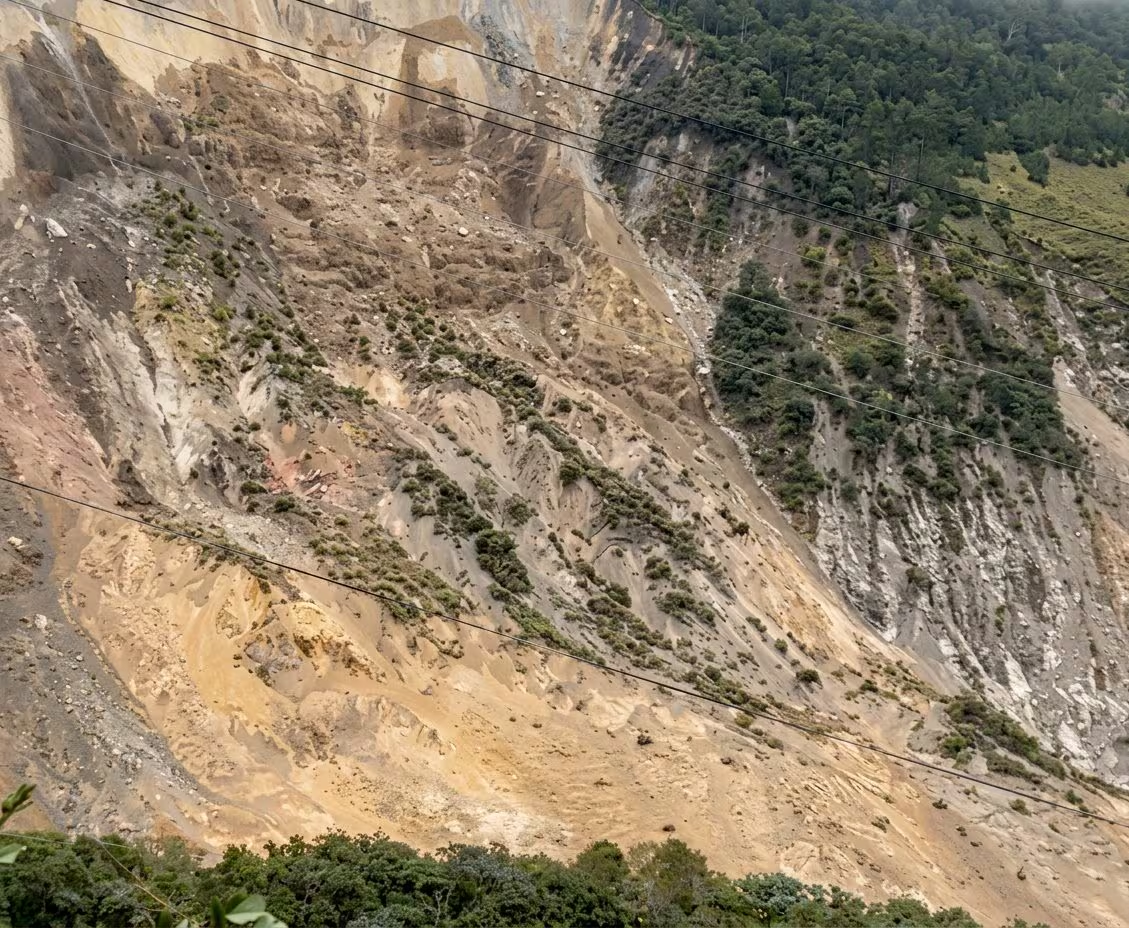
The situation is particularly critical in several districts: the monsoon rains have triggered a large landslide near the town of Lethein the region of Mustang. The landslide was filmed live by the locals, with the material collapsed that he has achieved the valley floor of the Kali Gandaki River in just 10 secondscausing its temporary obstruction.
A bridge between Syangja and Gulmi was completely swept away by the water and the authorities opened the three flood gates of the Mirmi damtemporarily halting production at the Kali Gandaki A hydroelectric plant, which produces 144 megawatts. Meanwhile, electricity supply has also been completely disrupted in the districts of Manang, Mustang, Myagdi and Baglung and floods put it out of commission 1,013.2 megawatts from the national transmission network.
The Nepalese authorities then issued a alarm For flash floods possible in 49 of the country’s 77 districtswith more than half considered high risk.
Added to all this is another tragedy at high altitude: a massive avalanche hit the Himlung Himal base campa mountain of 7,126 meters in Manang districtin north-central Nepal, near the border with Tibet. At the time of the accident, a team was in the field of Nepalese guides and support staff, sent in advance by two expedition companies to prepare the climbing route, fix the ropes and set up the tents.
Snow and rocks overwhelmed the tents, burying the occupants. A rescue team of eight people from the Nepal National Mountain Guide Association was transported by helicopter from Kathmandu to the base camp, managing to save 10 survivors and to recover four bodies. At the time of writing, 12 people are still missing and search operations have been temporarily suspended due to difficult weather conditions and huge snow accumulation.
According to the National Disaster Risk Reduction and Management Authority (NDRRMA), the government agency responsible for disaster management, at least 21 people they have lost his life5 are missing and 5 others were injured. Monitoring stations have recorded rainfall exceeding 100 millimetres in 106 locations across the country. In a few days at least 300 landslides were recorded which directly involved around 747 families, while at least 2,000 people who lived in high-risk areas were evacuate.
Landslides and floods are therefore putting a strain on a country already devastated by the collapse of the glacier which occurred on 26 August: according to the rapid damage and needs assessment report (RDNA) published by the NDRRMA, the overall damages and losses from that disaster are estimated to be over 408 billion rupees Nepalese, almost 2.5 billion euros. And the amount needed for the reconstruction and rehabilitation is enormously higher: 723.3 billion rupees, over 4 billion euros.
The numbers show the extent of the destruction: the enormous flood following the detachment has damaged 7,570 private homes48 public buildings, 18 schools, 7 healthcare facilities and 30 sites of cultural interest. But it’s the infrastructure sector to have suffered the heaviest blows: roads, bridges, ports dry, public housing, farms, businesses, containers and vehicles transiting the border were swept away by the water.
Not surprisingly, the restoration of infrastructure is the highest expense item of the entire reconstruction plan, with an estimated cost of approximately 473.57 billion rupees 2.72 billion euros. In detail, the floods have damaged 69 km of roads, 37 vehicle bridges (another 33 were completely destroyed) e 68 suspension bridges.
The price will also be high for the energy sector: the flood has hit 13 hydroelectric projects, with one total capacity of 759 megawatts and five 24 megawatt solar systems. The restoration of the energy system and the electricity grid will cost a total of at least 421 billion rupees, 2.4 billion euros.
