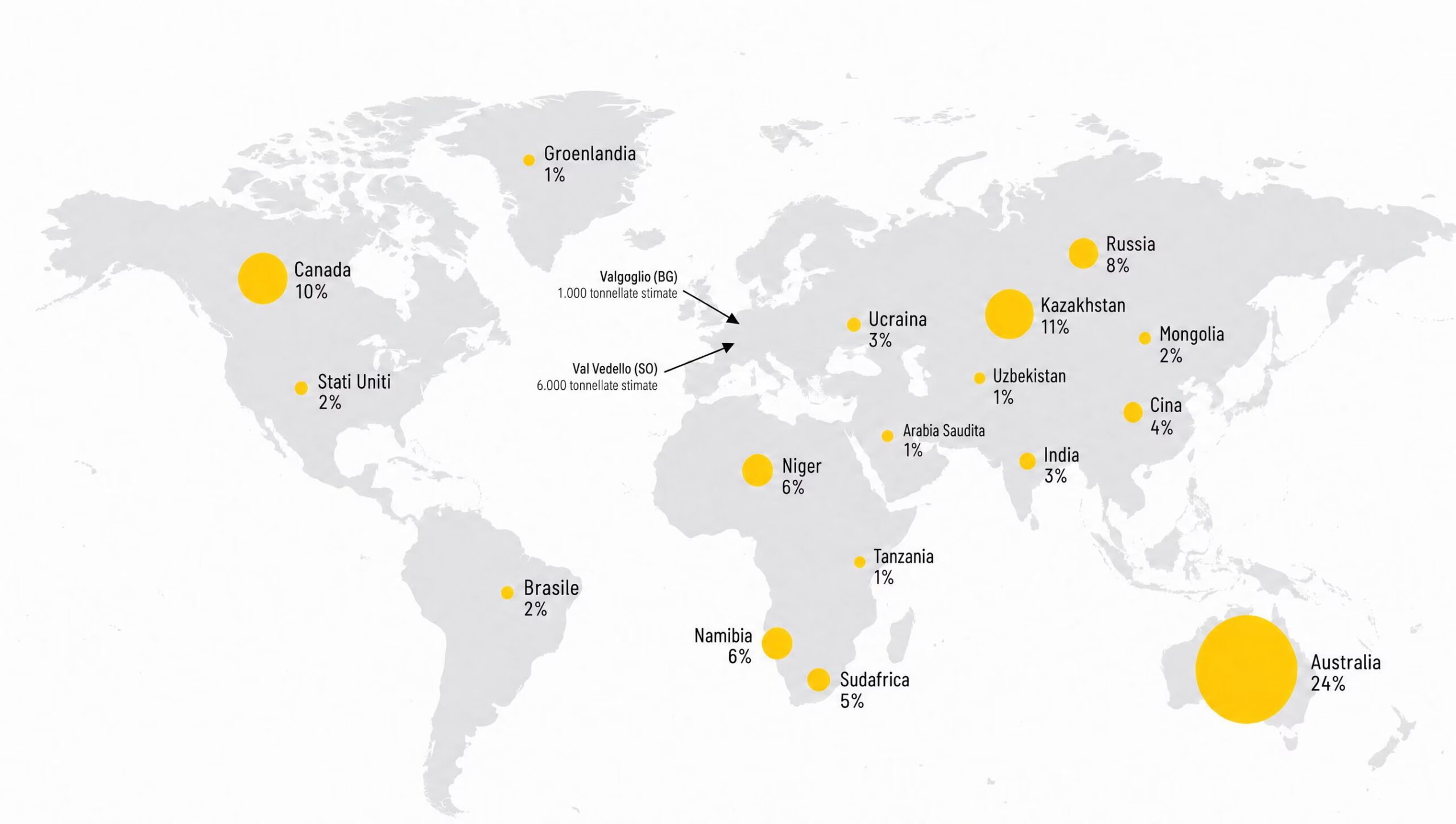
In Italy there are two main uranium deposits, of modest dimensions, both in the Orobie Alps. They are those of Novazza in the province of Bergamo, which according to estimates provides approximately 1000 tons of uranium, and of Val Vedello in the province of Sondrio, which contains some around 6000. To these are added a few hundred tons identified in some sites in the rest of Italy. The deposits of Novazza and Val Vedello, which so far are not never been exploitedrecently returned to the center of interest with the approval of the Senate of enabling law on nuclear power and with the possibility that the first nuclear power plants come into operation by 2034. However, their exploitation it is not convenient due to the modest size of the reserves, the high extraction costs and the absence of uranium enrichment facilities. Our country will therefore in any case have to import uranium to operate its power plants.
Where are the uranium deposits located in Italy
In Italy i most important deposits of uranium are found in Orobie Alpsin Lombardy. One is the deposit of Novazzaa hamlet of the municipality of Valgoglio, in Val Seriana in the province of Bergamo, the other is that of Val Vedelloin the municipality of Piateda, in Valtellina in the province of Sondrio.
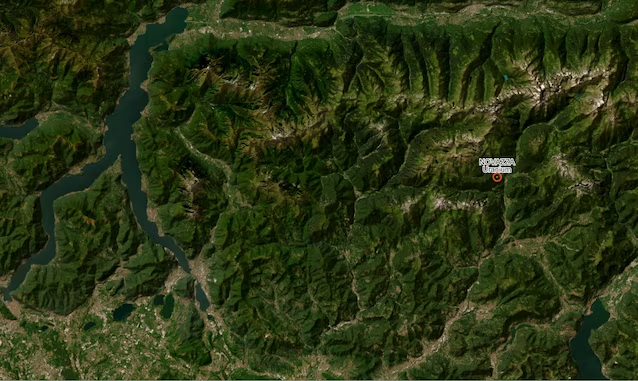
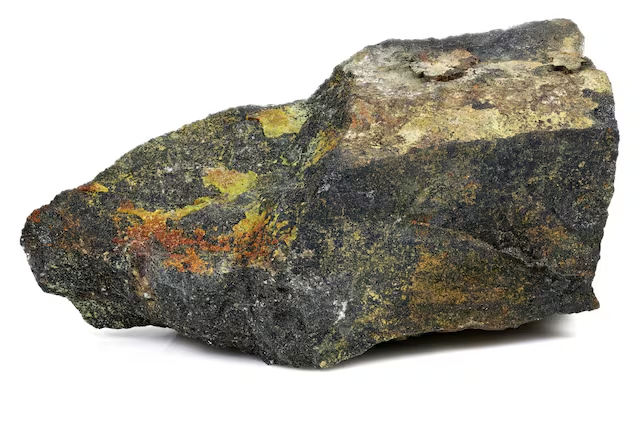
In the deposit of Novazza uranium is found in the mineral called pitchblende or uranititewhich can contain between 50% and 80% of this element. Here, according to Agip’s historical estimates, there are approximately 1000 tons of uranium metal. The deposit was discovered by Agip geologists in 1959 and in the following years, kilometre-long prospecting tunnels were dug, but the mine never became operational. In the deposit of Val Vedello Uranium is mainly contained in pitchblende as in Novazza. It is estimated that this deposit contains approximately 6000 tons of uranium metal. It was identified in 1969 and explored in the Seventies, but as for that of Novazza the investigations stopped in the Eighties with the progressive disinterest in nuclear power and its abandonment with the 1987 referendum.
Even if the significant deposits are those of Alps and the Lombard Pre-Alpsuranium was also identified in other regions of Italy in the 1970s: in Trentino-Alto Adige (in Val Daone, Val Rendena and Val Venosta), in Maritime Alps on the border between the provinces of Cuneo, Savona and Imperia, in the Apuan Alps in Tuscanyin some volcanic areas of Lazioin the Sila massif in Calabria and in Sardinia. However, in these areas its concentration is too limited to allow its exploitation. For example, the reserves of the Maritime Alps host approximately 300 tons of uraniumwhile Val Rendena 150 tons.
Obstacles to the exploitation of Italian uranium deposits
Uranium, although not a rare element, is found in very low concentrations inside the earth’s crust. Being very dispersed, its extraction is often not convenient from an economic point of view. In Novazza, for example, it is estimated that one ton of rock barely provides one kilogram of uranium. The lower its concentration, the greater the costs in economic, energy and environmental terms. The uranium reserves in Italyin addition to having a low concentration, are also limited: in total we are talking about a few thousand tons of uranium. For comparison, the reserves global they amount to approx 8 million tonsconcentrated mainly in Australia and Kazakhstan. A medium-sized nuclear power plant consumes approximately 160 tons of uranium in a year. According to historical estimates by ENI, the uranium from Novazza could have fueled a 1000 MWe nuclear power plant for approximately eight years. Our deposits, even if they were exploited, could therefore cover a minimal part of the national energy needs.
Furthermore, it must be taken into account that the uranium that is extracted (U-238) cannot be used directly in reactors, but must be enriched with 4% U-235. This is a complex and very expensive processwhich requires systems that Italy does not possess. In any case, our country should have the uranium transformed abroad. Owning nuclear power plants, therefore, does not automatically mean achieving energy independence.
Even from an environmental point of view, the problems linked to the exploitation of uranium in Italy are significant. Low concentrations of uranium would require the extraction of huge volumes of rock, with damage to the landscape and ecosystems in a protected area such as that of the Orobie Park. Furthermore, extraction would release it into the environment radon gas and radioactive dustharmful to health.
