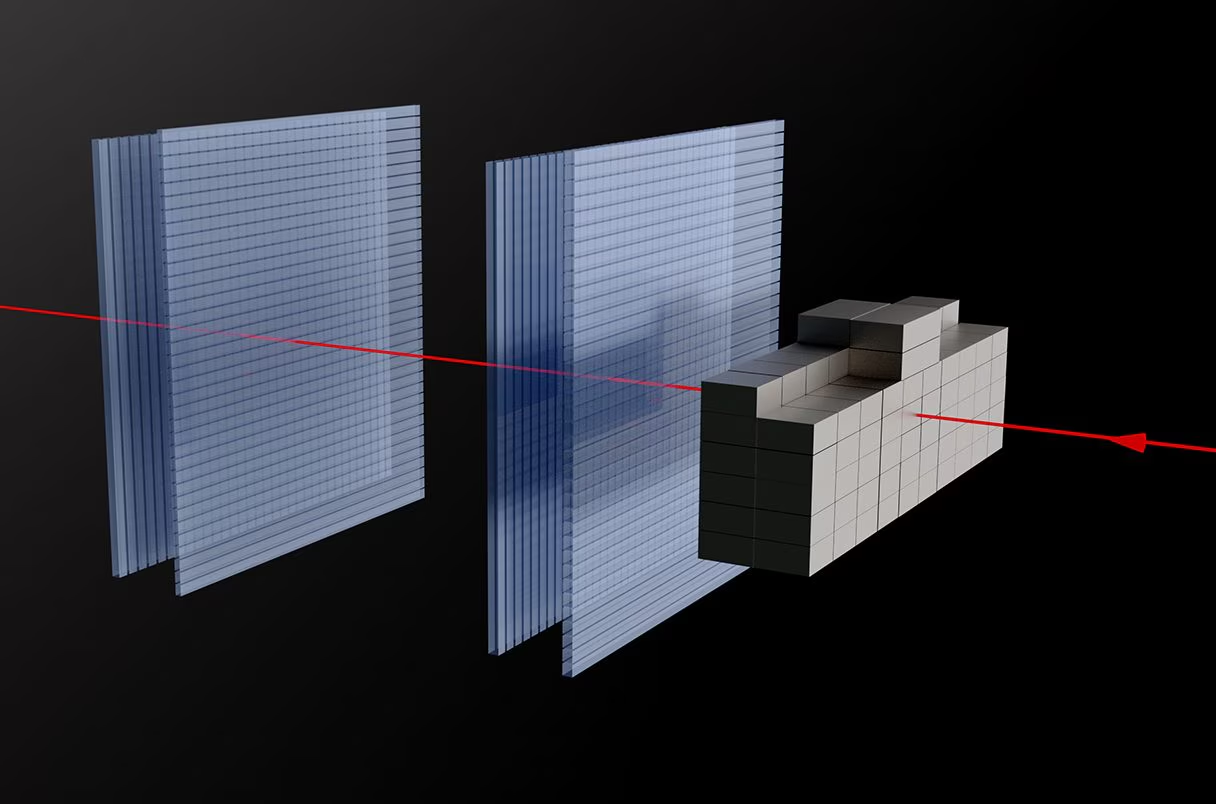
A group from ELI-NP (Extreme Light Infrastructure Nuclear Physics), a research center located in Romania that studies the frontiers of nuclear physics through the use of extreme intensity laserproduced a laser beam (considered one of the most powerful in the world) to create a particle beam and ran it through a 2 meter concrete wall. The detector placed after the concrete wall detected the image of a shadow cast by a target placed after the wall, made of a block of lead.
The team thus demonstrated that using a very powerful laser it is possible to produce particles that see through thick objects. The particles in question are i muonselementary particles similar to electrons but about 200 times heavier. To cross meters of concreterock or even metals, muons are considered the ideal particles. The team has proven that it can deliver an image made of muons starting only from a laser source, without using one of the big ones particle acceleratorsand traditional circular ones (such as the Large Hadron Collider (LHC) in Geneva).
This technique muographic (i.e. the possibility of doing an x-ray but using muons) has enormous advantages over techniques using other particle sources. For example, radiation such as i X-rays (used in common medical x-rays) they are absorbed from large, dense thicknesses while muons gradually lose energy and can pass through large structures or dense materials such as lead and steel.
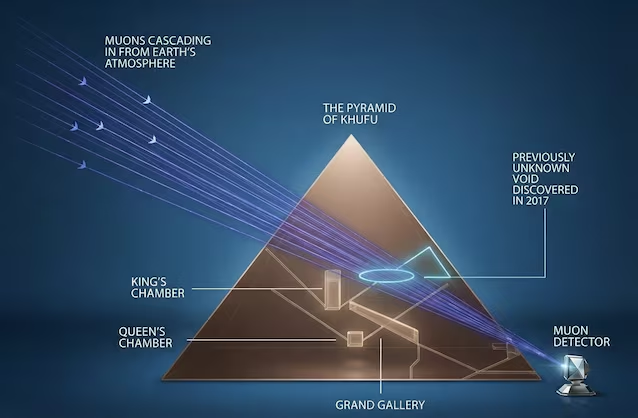
There muography made with muons coming from cosmic rays (streams of very high energy subatomic particles that come from deep space and continuously bombard the Earth) has already been used to explore the inside of pyramids and volcanoesbut the problem is that about these natural particles arrive from space one per minute per square centimeterand generating detailed images in this way is very slow and low resolution.
A artificial muon beam instead it would make this technique practicable in areas that are impossible to obtain with natural or traditional muon sources. For example in the field of customs controls or military securityto make gods check quickly inside containers in naval ports or in structures with walls composed of heavy materials that can contain radioactive material. The aim of the research team was in fact to try to produce precisely a beam of muons on demand to perform imaging faster and more controllable.
Images of this type had already been made in particle accelerators, but the determining factor that the ELI-NP researchers achieved was to obtain an image composed entirely of muons and that the particle beam was quick to generate And potentially transportable.
The countless applications of the muographic technique
Muons are generally produced inside particle accelerators, but these facilities are huge facilities and on the other hand are not used for commercial application purposes. Therefore, if you want to carry out a muography you must bring the object (such as a container or a large concrete structure) to where the accelerator is located. A system portable and transportable it would instead allow on-site muographic inspections of critical infrastructures or in places where intervention is required.
Muography with cosmic rays has already given notable results in the past. For example, it revealed a large void inside the Cheops pyramidmore than 30 meters long, then a corridor of about 9 meters on the north face, rooms in which it was impossible to physically access. Another case was that of Fukushima nuclear power plant after the 2011 incident, where two muon detectors were used. Detectors found no trace of the fuel inside the reactor core, leading to the conclusion that it had melted and settled at the bottom of the structure. This information was obtained without operators having to enter a inaccessible and highly radioactive place like the inside of a nuclear reactor.
But producing muons artificially would make it possible to extend the application scope to a much more diverse number of cases, such as for example material inspections hidden in shielded containers (to hide, for example, radioactive material for military use) or in naval containers. In fact, in ports and borders only a small percentage of containers is thoroughly inspected, and an on-demand beam would speed up the scan and could be done within minutes, e.g. inspect shielded containers without opening them. An artificial source of muons would also offer the possibility of check the direction through which to observe, producing a 3D image of the target, and would have a much higher observation frequency and resolution than a natural source such as cosmic rays.
The experiment that allows you to see beyond the walls
To create muons you need a lot concentrated energy in a very short time. In fact, the ELI-NP researchers used a laser from 10 petawattsreferred to as the most powerful in the world. The petawatt (abbreviated PW) corresponds to a million billion watts. But this power is so high because the laser energy is delivered in a very short time, approximately 23 femtosecondsor equal to a millionth of a billionth of a second.
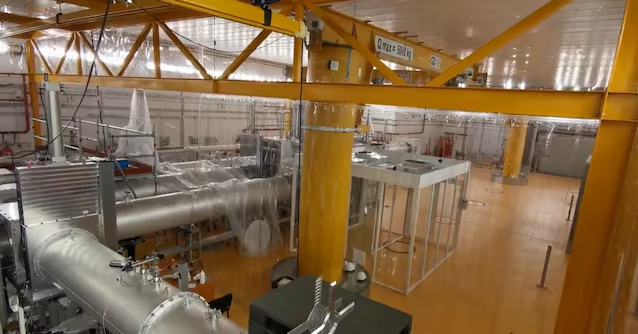
For comparison, the energy emitted by the laser of the ELI-NP would correspond to the energy emitted by a 60 watt bulb turned on for about four seconds. The power, however, is enormous because all that energy is compressed into a very short time, on the order of a femtosecond. So for an instant the laser provides more than 1000 times the power of the world’s electricity grids combined (again for comparison, the world electrical capacity average is approx 10 terawattsthat is to say one trillion watts).
To produce muons, the researchers used this laser to hit a gas that releases electrons and accelerates them to very high energies. The electrons collide with a lead target and emit photons, which, colliding with other lead nuclei, finally produce muons.
However, the beam also contains many other particles that must be shielded. For select only the desired source (i.e. the muon beam) and screen other particles that would have compromised and dirtied their muon images, the research team used, after months of simulations and experiments, a large plastic cube and paraffin.
Finally, in the experiment the filtered beam passes through a 2 meter thick concrete wall and reaches the detectors transported inside a van parked on the other side. Between the wall and the van there was a pile of lead blocks, the shadow of which was obtained. It is not a real shadow, because fewer muons arrive behind the lead, and therefore the detectors record less signal in that area. However, the decrease was such as to guarantee that the image that was formed was consistent with the size and shape of the target used.
The goal of this experiment was to demonstrate that artificial muography could become feasible and fast. The goal, however, is still far away, because the ELI-NP laser is still a gigantic system and very difficult to transportwhich fires a maximum of once per minute. So the success of this technique will depend on development of more compact lasers and with a higher repetition rate.
