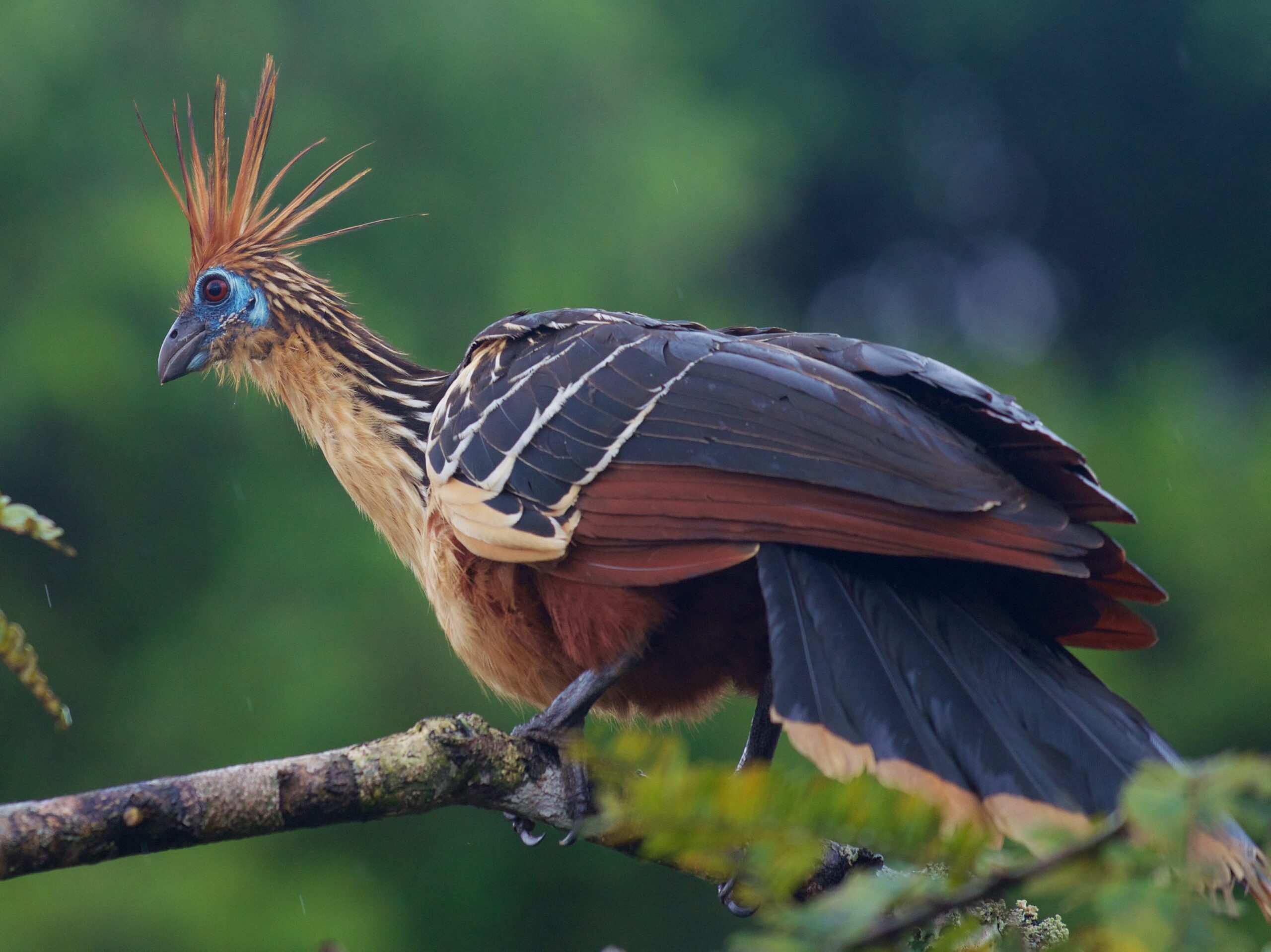
He has a crest that resembles a punk crown, a blue face and red eyes, thehoatzin (Opisthocomus hoazin) looks like a creature catapulted from a bygone geological era. However, it is not his bizarre appearance that makes him famous, but the fact that he is the only bird in the world to digest food like a cattle and, consequently, a give off a pungent odor of fermented hay and manure. It is the only living representative of its order (Opisthocomiformes), an isolated branch of the tree of life that separated from other birds tens of millions of years ago.
The hoatzin, about 65 centimeters long and characterized by an elongated neck and a small head, lives in the wetlands and forests along the large rivers of the basins Amazon and Orinocodistributed in nine countries including Bolivia, Brazil, Colombia, Ecuador, Peru and Venezuela. Its range is very vast: according to the IUCN it extends beyond that 8.6 million km². Here, the local populations call it pava hedionda (“stinking pheasant”), while in English it is known as stinkbird (stinking bird). It’s all due to one of the most ingenious adaptation strategies in the animal kingdom.
A “ruminant” bird: the chemistry of fermentation
While the vast majority of birds have fast metabolisms and digestive tracts designed to process seeds, insects or meat quickly, the hoatzin feeds exclusively on leaves. This diet rich in cellulosea polymer that animals cannot break down on their own, led to this bird having to transform its goiter (an esophageal pouch which in other birds serves only as a temporary “store” for food) in a real fermentation stomach (foregut fermentation). Thanks to the research of biologist Alejandro Grajal in the 1990s, we know that this hypertrophic goiter is divided into two rooms and it works exactly like the rumen of a cow.
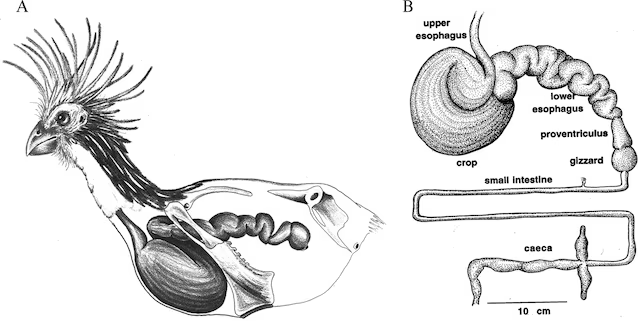
Inside this organ there is a microbiomemapped in the 2008 published study on Applied and Environmental Microbiology with molecular techniques, which breaks down leaves producing gases and short-chain volatile fatty acids (VFAs such as acetate, propionate and butyrate). It is precisely these acids, released through continuous and noisy belchingto give the animal its unmistakable character stable smell.
Pros and cons of the stink: it can’t fly, but no one eats it
Harboring a “flying rumen” involves extreme biomechanical compromises. The hoatzin’s goiter became like this massive (up to a third of the total weight of the bird) to have forced evolution to shrink and move the keel of the sternumthe bone to which the flight muscles are anchored.
The result is a bird heavy And awkwardcapable only of short chaotic glides between one branch and another. Microbial digestion also requires very long timesforcing the hoatzin to spend much of its time still. In order not to waste energy, he even developed one thick calluses on the chest: a sort of natural cushion that allows him to rest the weight of the swollen crop directly on the branches, relieving his legs.
However, being smelly seems to be a deterrent: the pungent odor could signal to predators that its meat is unappetizing, providing protection that compensates for its slowness.
Claws on baby wings and convergent evolution
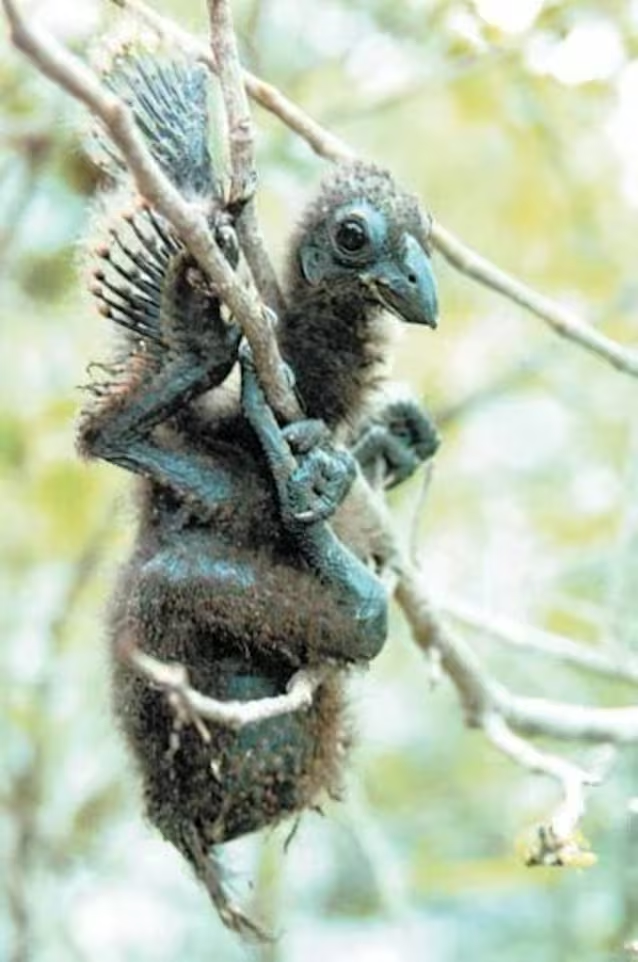
The uniqueness of the hoatzin manifests itself from the first days of life, revealing a link with the past. Chicks are born with two functional claws on the wingswhich they use to climb between the branches and climb back into the nest if they fall into the water; a trait reminiscent of ancient winged reptiles. These claws they gradually disappear with the development of adult plumage.
The fact that Opisthocomus hoazin ferments leaves like a ruminant, despite being a bird, is an example of convergent evolution: two groups of animals very distant from each other who, faced with the same problem (eating leaves), independently invented the same solution. Scientists are still not sure where to place the hoatzin in the bird family tree: it is such a unique set of characteristics that it can be considered a sort of “evolutionary orphan“, a branch in its own right.
A study published in The ISME Journal in 2009 even found methanogenic bacteria in his crop similar to those in the bovine rumen, and another work in the same journal in 2012 directly compared the hoatzin and cow bacterial communitiesconfirming the striking similarities.
Sources
IUCN Red List – Opisthocomus hoazin Grajal, A. (1995). Structure and Function of the Digestive Tract of the Hoatzin The Auk Godoy-Vitorino et al. (2008). Bacterial Community in the Crop of the Hoatzin Applied and Environmental Microbiology André-Denis G Wright, Korinne S Northwood, Nestor E Obispo, Rumen-like methanogens identified from the crop of the folivorous South American bird, the hoatzin (Opisthocomus hoazin), The ISME Journal, Volume 3, Issue 10, October 2009 Filipa Godoy-Vitorino, Katherine C Goldfarb, Ulas Karaoz, Sara Leal, Maria A Garcia-Amado, Philip Hugenholtz, Susannah G Tringe, Eoin L Brodie, Maria Gloria Dominguez-Bello, Comparative analyzes of foregut and hindgut bacterial communities in hoatzins and cows, The ISME Journal, Volume 6, Issue 3, March 2012
