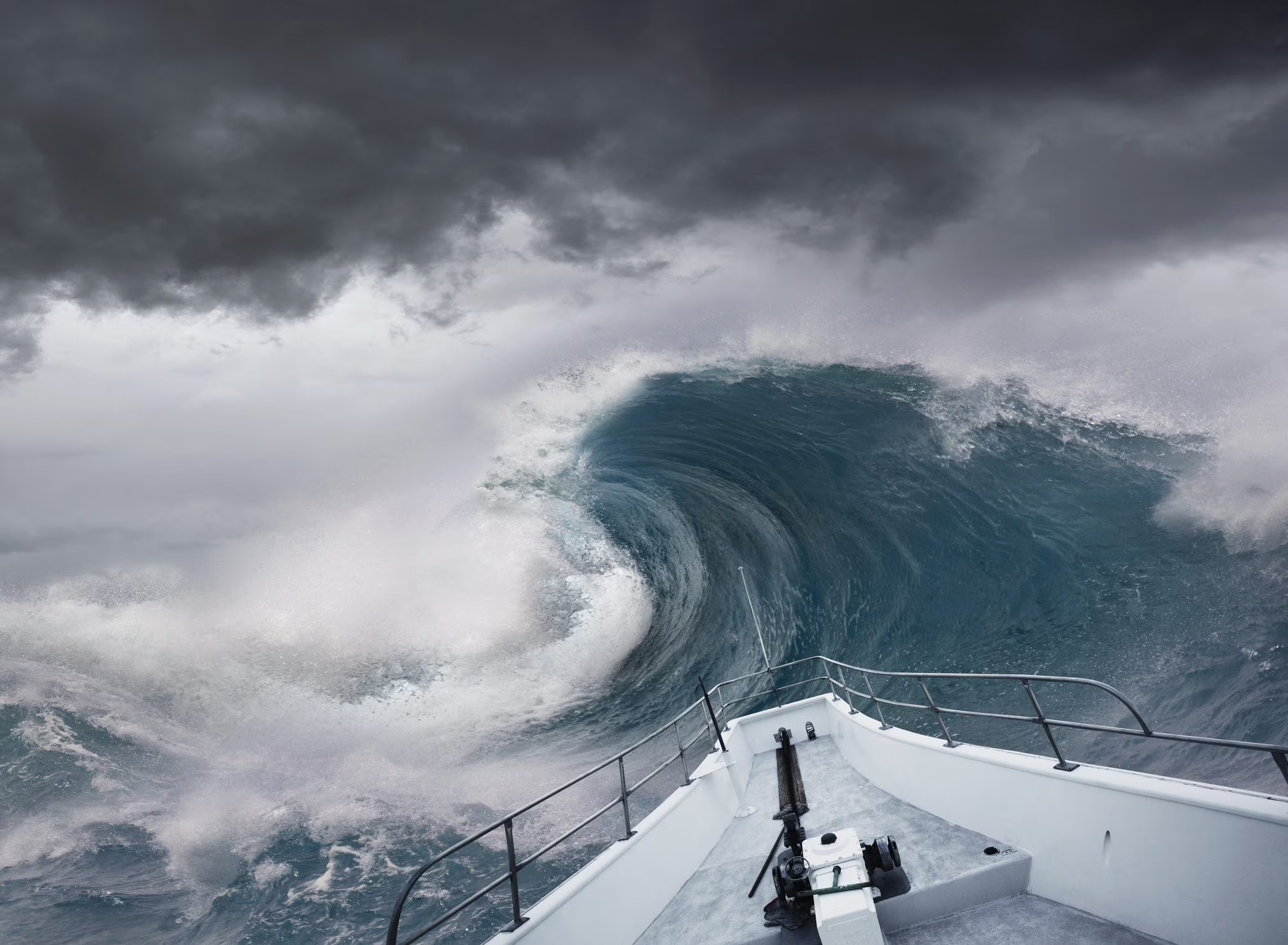
Rogue waves, off-scale winds, storms, poor visibility and currents that can send less prepared boats adrift. Even today, navigating the routes at the most extreme latitudes of the globe can be a challenge that should not be underestimated, despite modern nautical technologies and the most advanced oceanographic knowledge we have at our disposal. We are talking about regions of the planet where the combination of climate, events meteorological, characteristics geographical And dynamics oceanic can turn seemingly smooth sailing into a test of survival within some of the world’s most hostile environments.
Let’s find out in this article the three most dangerous seas of the Earth (plus one), including the Drake Passage, located between Cape Horn in South America and Antarctica.
Before venturing into the cold waters of the most extreme seas on the planet, it is good to make a small introduction: there cannot be an objective ranking of the most dangerous seas in the world. This is for three main reasons:
- the first is that the danger it is not a measurable physical quantity;
- the second is because the same concept of danger can take on different meanings based on the parameter through which we evaluate it. A sea, for example, can be dangerous because of strong winds or of strong currents that interest him, while other locations could be dangerous due to the presence of blocks navalOf activity of piracy or of international conflicts;
- finally, the third reason depends on the fact that the danger of a natural environment does not necessarily coincide with the real risk that that same area can represent for human beings. A route can in fact be dangerous due to its environmental conditions, such as the strong presence of icebergs and low temperatures, but if precisely because of these conditions it is little frequented, statistically the accidents will be lower than other busier routes even if less risky from an environmental point of view.
For our “ranking” we based ourselves on data scientific, such as those provided by Copernicus or the American Meteorological Society, of climatic and oceanographic conditions that give rise to extreme environments, and we have identified three regions of the world: the channel by DrakeThe Bering Sea and theNorth Atlantic.
1. Drake’s channel
The Drake’s channelknown in English as Drake Passageis the stretch of sea that runs betweensouthern tip of South America, Cape Hornand the South Shetland Islandsin the’Antarctic Ocean.
Although it is defined as a channel, its amplitude of 645 kilometers between one end and the other is decidedly notable and theabsence of emerged land allows the strong winds Westerners and to Antarctic Circumpolar Currentthe current that moves the largest mass of water on the planet, to continue their path undisturbed without natural obstacles to slow them down.
In this region of passage between the waters ofPacific Ocean and those ofAtlantic Oceannavigation can become truly extreme: waves several meters high, strong currents And waters shake they can make crossing difficult even for the largest vessels. Furthermore, the area is exposed to frequent stormswhich can change sea conditions in just a few minutes. Between 2016 and 2017, the scientific team of a research expedition organized by Swiss Polar Institutemonitored storms with wind speeds approaching 20 m/sthat is, approximately 70 km/h.
2. The Bering Sea
The Bering Sea is located in theNorth Pacific Oceanin that vast region between the extreme western portion of the American continent and the extreme eastern portion of the Eurasian continent.
Known as one of the most hostile and unpredictable on the planet, this sea between Russia And Alaska it is particularly rough during the boreal autumn and winter, when the storms they are more intense and frequent. The Bering Sea, in fact, is characterized by relatively shallow waters to the north and east that meet the steeps embankments continental. When he rapes them storms polar they hit these seabeds, generating compact, high and violent waves. According to the US science agency National Oceanic and Atmospheric Administration (NOAA) waves in the open sea can frequently exceed 6 meters and during particularly intense storms even 16, with exceptional cases in which they can reach 24 metres.
Given the latitude, to make everything even more extreme, the very low temperaturesi banks of fog and the presence of icewhich by accumulating on the structures of the ship can reduce its stability to the point of causing it to capsize: in the event of a fall into the water, thehypothermia would arrive in a few minutes and the great distance from large settlements makes rescue operations complex and never quick enough.
3. The North Atlantic
THE’North Atlanticin particular the corridor that goes from the island of Newfoundland (Canada), atIceland and at north-western coasts of continental Europe it is one of the trade routes busiest in the worldbut also the region in which the most extreme weather and sea conditions are generated.
This triangle is in fact considered the cradle of extratropical cyclones. The complex interaction between warm currents, such as the Current of Gulfand the icy air masses of polar origin generate impressive temperature and pressure gradients. According to recent oceanographic studies, some of the highest values of the so-called are recorded in the North Atlantic Benjamin-Feir Index (BFI), an index that measures the susceptibility of wave motion to instability associated with the formation of anomalous waves (rogue waves) which can exceed 25-30 metres. In this case, therefore, it is not only extreme weather events that represent a major risk factor for navigation, but also the intense naval traffic that circulates along some of the busiest routes on the planet.
4. The North Sea
Although it does not find a place on our podium, it seems right to also mention the North Seaoften described as one of the most dangerous seas on the planet.
The North Sea, which washes the north-western coasts of the European continentin that rectangle between the island of Great Britainthe Norway and the Denmarkis, as you may have already guessed, another extremely cold and treacherous sea.
As with its other glacial cousins, what makes it particularly dangerous are above all the strong winds and frequent storms, plus currents and tides that should not be underestimated. Furthermore, the shallow waters that characterize certain coastal regions create the ideal conditions for steep and unpredictable waves, which are difficult to deal with. Its location, between the North Atlantic and the European coasts, ultimately places it at the center of some of the most important shipping routes of the West and the world in general.
