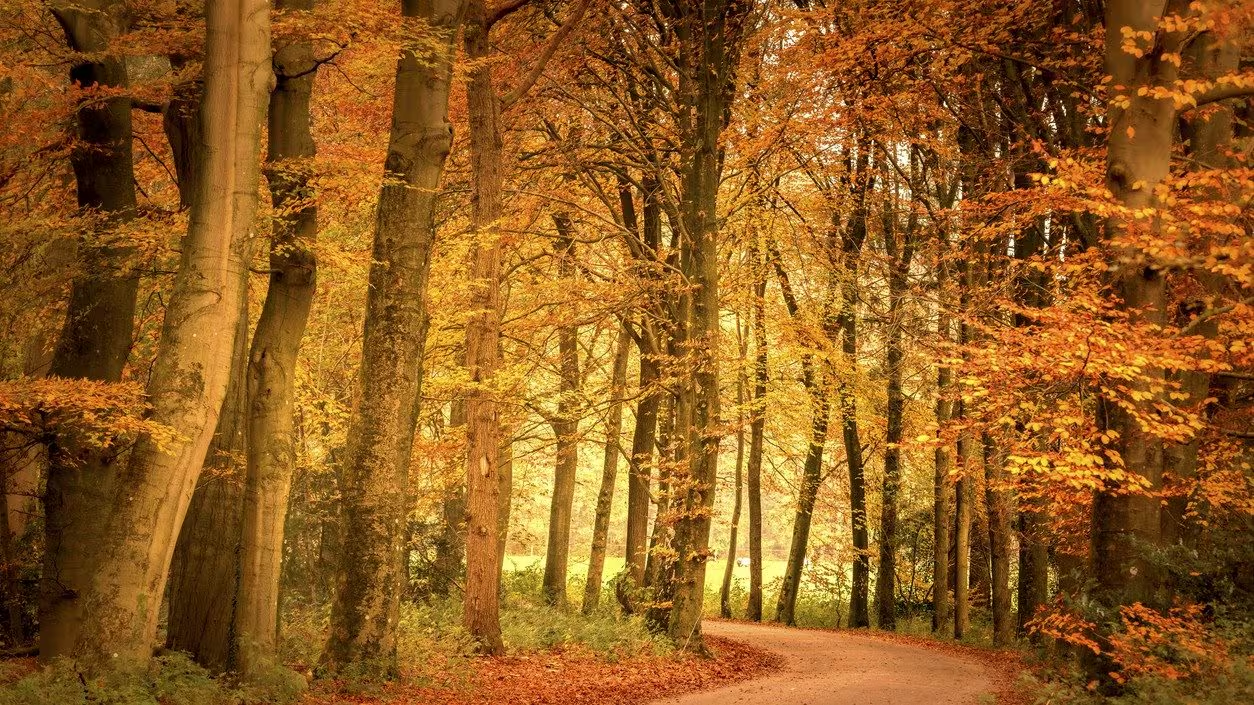
Let’s imagine a day at the beginning of October: outside it is still 25°C, the sun is warm and somefall there doesn’t seem to be any trace. Yet many plants have already started preparing for the change of season. Some progressively stop growing, others modify their metabolism, while species that lose their leaves initiate the processes that precede senescence. But how do they understand that summer is ending if the temperature is still that of a summer day? The answer, at least in part, lies in the hours of light.
Unlike temperature, which can vary greatly from day to day, day length changes regularly throughout the year. For this reason, as explained by a study published in Annual Review of Plant BiologyThe photoperiod (the quantity of light and darkness over a 24 hour period) represents a useful signal for many plants to synchronize their development with the succession of the seasons.
Plants measure day length using light
Plants do not count the hours like we do, but they have biological systems capable of relating light to their own circadian clockthe internal mechanism that marks numerous processes over the course of 24 hours. The measurement of photoperiod arises precisely from the integration between this temporal information and the signals received from specific photoreceptors.
One of the best studied examples is that of Arabidopsis thaliana. In this plant, the circadian clock helps determine when the transcription factor is produced CONSTANS (CO). Light can then modulate CO activity and, under conditions typical of long days, CO promotes gene expression FLOWERING LOCUS T (FT)involved in the activation of flowering. In this way the plant can distinguish, at a molecular level, longer days from shorter days.
However, the principle does not only concern flowering. In perennial plants, changing photoperiod can help regulate transition as well from growth to dormancy. In poplars, for example, the shortening of autumn days is a signal that contributes to interrupting growth and preparing the buds for the winter season. Both photoreceptors and the circadian clock are involved in this process, while temperature can also modify the plant’s response.
The countdown towards winter starts from the light
It is therefore possible that a plant begins to prepare for the arrival of winter before it gets really cold. The reduction of the hours of light can in fact function as an anticipatory signal: in arboreal plants of temperate and boreal regions, the photoperiod contributes to the cessation of growth and the establishment of dormancy, while the temperature intervenes together with the light in the control of these seasonal transitions.
This, however, does not mean that all plants use photoperiod in the same way, nor that day length is always the signal responsible for yellowing and falling leaves. For example, a study conducted on 116 natural aspen genotypes showed that, while the setting of the buds was compatible with a response to a certain length of day, the onset of autumn senescence of leaves could not be explained by the length of the day itself. The authors therefore concluded that, in this case, the signal must depend on light but be different from simple shortening of the photoperiod.
In short, when it is still hot in September, a plant does not necessarily have to wait for the cold to arrive to understand that something is changing. The variation in light already provides seasonal informationwhich can be integrated with temperature and other environmental signals to regulate growth, dormancy, flowering and other developmental processes. There is therefore no single “autumn thermometer” in plants: it is rather a system of environmental signals that allows them to anticipate, in different ways depending on the species, the changes of the season.
Sources
Song YH, Shim JS, Kinmonth-Schultz HA, Imaizumi T. Photoperiodic flowering: time measurement mechanisms in leaves. Annu Rev Plant Biol. 2015;66:441-64. Yanovsky, M., Kay, S. Molecular basis of seasonal time measurement in Arabidopsis. Nature 419, 308–312 (2002). Maurya JP, Bhalerao RP. Photoperiod- and temperature-mediated control of growth cessation and dormancy in trees: a molecular perspective. Ann Bot. 2017 Sep 1;120(3):351-360. Michelson IH, Ingvarsson PK, Robinson KM, Edlund E, Eriksson ME, Nilsson O, Jansson S. Autumn senescence in aspen is not triggered by day length. Physiol Plant. 2018 Jan;162(1):123-134.
