Although there is still stable and sunny weather in much of Italy, with October just around the corner, the heating period: as always, the radiators will be activated according to different times between the various regions, depending on the climate and average temperatures of the area.
We leave on October 15, 2026 with most of the cities of Northern Italy, and then gradually continues along the country up to December 1, 2026. Be careful, though: Emilia-Romagna he postponed the switching on of heating systems from 15 October to 1 November 2026 in the lowland areas of the region. As reported by the Region, the measure is part of the package of interventions adopted to avoid the introduction of the structural block of Euro 5 diesel vehicles in municipalities with over 100,000 inhabitants, while still guaranteeing a reduction in polluting emissions.
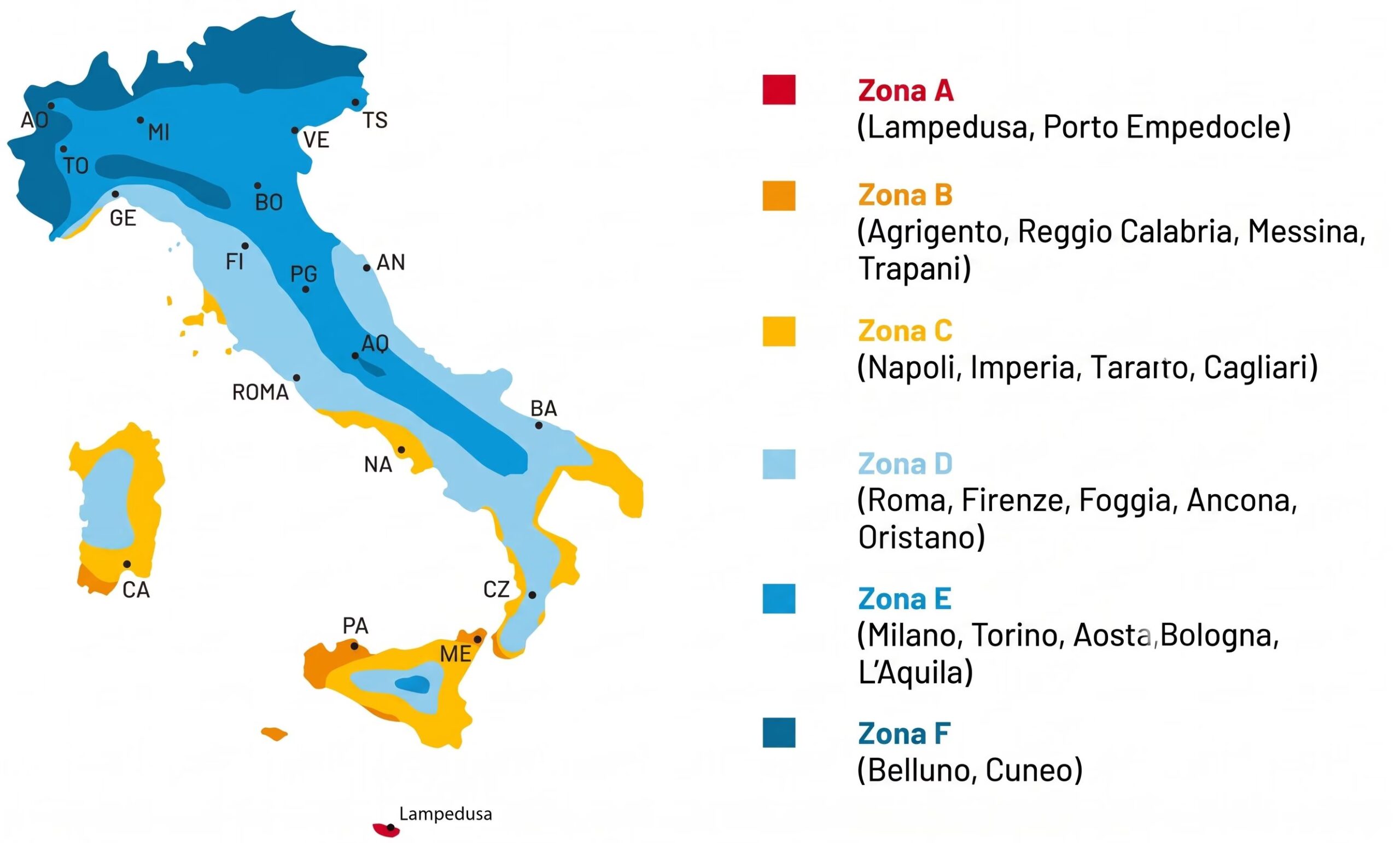
In general, however, the current legislation (Decree of the President of the Republic n.412 of 1993) provides for the division of Italy into 6 different climate zonesdepending on the average seasonal temperatures: this translates into a difference between the Municipalities in terms of the operating period and the daily duration of the heating. The shutdownInstead, will take place between March 15th and April 15th.
Municipalities will still be able to impose more restrictive criteria to limit consumption: in 2025, for example, the Municipality of Milan established 19 °C as the maximum temperature allowed in residential buildings (with +2 °C tolerance), i.e. one degree less than the 20 °C envisaged by the Decree.
| Climate zone | Ignition period | Operating hours |
|---|---|---|
| Zone A (Municipalities with the warmest climate) | From December 1st to March 15th | Maximum 6 hours per day |
| Zone B (most of Sicily) | From December 1st to March 31st | Maximum 8 hours per day |
| Zone C (which includes for example Naples and Bari) | From November 15th to March 31st | Maximum 10 hours per day |
| Zone D (most municipalities in Central Italy) | From November 1st to April 15th | Maximum 12 hours per day |
| Zone E (Northern Italy) | From October 15th to April 15th. EXCEPTION of Emilia-Romagna, postponed to November 1st for the areas of the Plain | Maximum 14 hours per day |
| Zone F | all year round | no limitations |
More specifically, the zone A it is the most reduced one and includes only Lampedusa, Linosa, Porto Empedoclewhile the E zone it is actually the most populouswith around 4,000 municipalities involved and almost all cities in the North, which can turn on the systems from 15 October 2026.
There zone F includes for example Belluno and Cuneo; that B, however, includes almost all the provinces of Sicily together with Crotone and Reggio Calabria. Lastly, most of the municipalities of the area are located in the CD area Central Italy.
But how are these climate zones calculated? Presidential Decree 74/2013 uses so-called degree-days (often abbreviated as GG or gr-g), which correspond to sumextended to every day of the year, of positive difference between the temperature conventionalinternal environment (fixed at 20 °C) and the average external temperature daily. The higher this value, the harsher the climate will be in that area and, consequently, the sooner the heating can be turned on. Below is a summary table:
| Climate zone | Degree-Days |
|---|---|
| Zone A | less than 600 |
| Zone B | between 600 and 900 |
| Zone C | between 901 and 1400 |
| Zone D | between 1401 and 2100 |
| Zone E | between 2101 and 3000 |
| Zone F | above 3000 |
The next heating switch-on period, that of zone Dthe November 1stincluding a large part of Central Italy and, as anticipated, Emilia-Romagna exceptionally.
