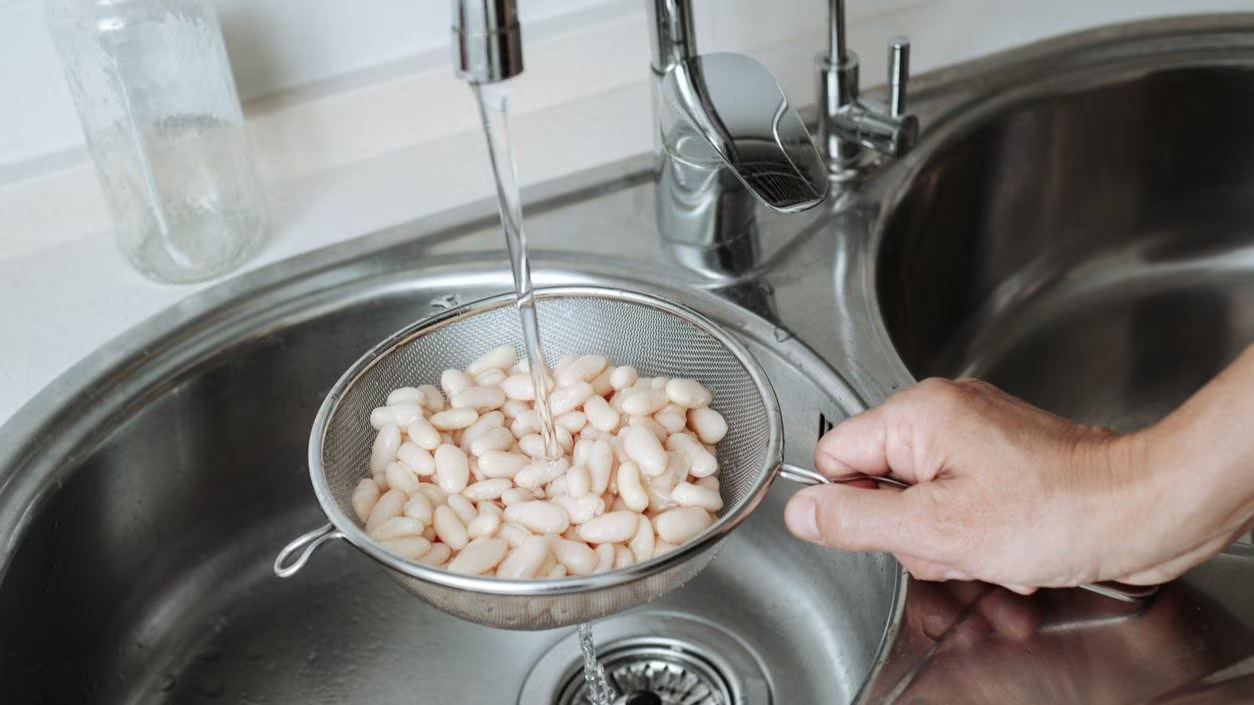
Do legumes need to be washed? First, we can do a distinction between dried ones and preserved ones. In the first case, a preventive rinsing helps to remove any impuritieswhile leaving the seeds to soak for several hours can reduce the amount of carbohydrates responsible for the production of intestinal gas. Canned legumes, on the other hand, are already cooked and ready for consumption: washing them is not necessary to make them safe. However, passing them under water can reduce some of the sodium present, modifying the flavor of the food. And before pouring everything into the sink it is worth thinking twice: chickpea preservation water, called aquafababoasts emulsifying and foaming properties that can be exploited in the kitchen, in recipes such as meringues and vegan mayonnaise.
Dried beans, chickpeas or lentils: what happens without soaking and rinsing
With dried legumes, the first rule is do not confuse rinsing and soaking: they are two different steps and therefore have different functions. Before soaking, dried legumes must be checked and, if necessary, rinsed under running water. This is mainly for eliminating small ones impurity which may be left after harvest, as also reported by the United States Department of Agriculture (USDA). Then, comes the so-called soaking.
It is said that “where there is water there is life”. Real. Except that there are also life forms that water can encourage mold and pathogenic bacteria: guests we certainly wouldn’t want to meet on our plate. In fact, many legumes are dried to reduce their water content and increase their shelf life. Before cooking, however, they are often left to soak for several hours: the water progressively penetrates the seed and rehydrates. It may seem counterintuitive, but soaking is only a temporary phase that precedes cooking: it is true that the presence of water creates conditions potentially favorable to the growth of microorganisms, but it does so for a limited period, at the end of which the legumes are subjected to cooking, a heat treatment which reduces the microbial load.
There are chemical compounds that can transfer from legumes to soaking water, for example some poorly digestible carbohydrates. A study on beans published in 2002 on Journal of Nutritional Science and Vitaminology observed that soaking followed by eliminating residual water decreased the raffinoseby 24.8% lo stachyose and 41.7% the verbascose. They are oligosaccharides that are largely not absorbed at the intestinal level, therefore they remain in the colon where they come from fermented by the microbiota bacteria: hence the production of gas and the proverbial association between beans and flatulence.
Canned legumes do not necessarily have to be washed: studies
Now let’s talk about preserved legumesthat is, those that we find ready in containers such as jars or tins. When we open the package, we find them immersed in a liquid: it’s the so-called governing watercalled so because governs in a certain sense conservation, keeping legumes in optimal conditions and accompanying them until they arrive on our tables. The name can be misleading, as it is not simply water, but an aqueous mixture of salts and other dissolved compounds. In short, it is not a simple soaking, also because during production the legumes are packaged in hermetically sealed containers which isolate them from the external environment and, therefore, also from potential pathogens. In this way the product is stable until opened.
Once opened, however, what should be done? Should preserved legumes be rinsed or not? There is no need to rinse them to make them safe: unlike dried ones, these are products that are already cooked and ready for consumption (naturally, provided that they have been stored correctly and that the packaging is intact). Rinsing them after draining them can be useful to eliminate or reduce some substances that were dissolved in the governing water. A study published in Journal of Culinary Science & Technology analyzed different varieties of canned beans, noting how rinsing the legumes can decrease the amount of sodiumthus affecting the flavor final product. Rinsing can therefore have one or more uses, but not because the tap water is harmful. Indeed, in some cases it can even be exploited for something else.
The governing water of chickpeas, called aquafabais known for having good emulsifying and foaming properties, so much so that it is used in numerous recipes, especially vegan ones, to replace egg white. Thus, the water we were about to throw down the drain can instead be recycled and turned into mayonnaise, mousse or even meringue.
