Venice manages its delicate balance with nature and the lagoon that surrounds it due to targeted and complex human interventions. However, rising sea levels combined with land subsidence threaten the city’s future, especially in the medium to long term. Although this port position has been a strong point over the centuries, today it risks turning into a great limitation. In this regard, a recent study published on Scientific Reports (Nature) analyzes the possible mitigation and intervention strategies that can be pursuedwhich are presented here in their salient points.
Venice and estimates for 2100 on sea levels and subsidence
Venice is a unique case in the world: over half of the city is located in less than 1.2 metresre above sea level. This low elevation means that even a minimal rise in water levels undermines traffic and daily life. Over the last 23 years, the frequency of floods has increased: significantly 18 extreme eventsthey submerged over 60% of the historic center. The problem is triggered by the combined cause of two combined factors:
Estimates for the future are worrying: by 2100sea levels could rise by 40-80 cmwith the real risk of exceeding one meter in the most pessimistic scenarios.
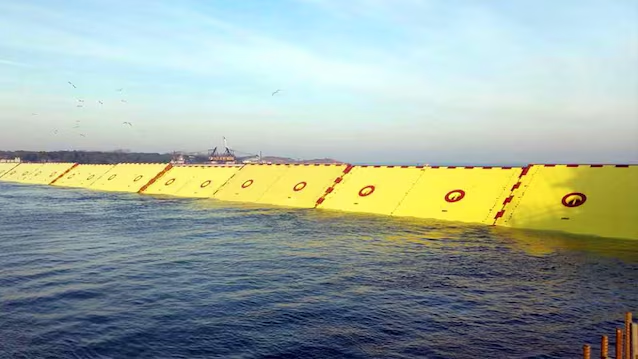
In light of this delicate environmental condition, the main protective strategy implemented to date has been the design, construction and commissioning of the Moses, acronym for Electromechanical Experimental Module: it is a system of mobile gates78 in total and independent of each other, which raise and lower as needed thanks to the use of hydrostatic thrust of waterthus varying the weight of the individual gate to facilitate its raising without using a thermal or electric motor. This artificial system, built starting in 2003 and partially inaugurated in 2020, protects the Venice lagoon by opening one or more floodgates when certain water level thresholds are exceeded induced by the tides. From 2022 the MoSE mobile barrier system will protect Venice from the most intense high waters.
However, as the authors of the study explain, this future increase in sea levels will inevitably lead to the frequent and prolonged operation of the MoSE: this will likely lead to increasing costs, interference with the port, worsening of water quality and damage to lagoon ecosystems. In essence, this condition demonstrates, in the long term, the fact that the MoSE cannot be interpreted as a definitive solution to the problem, but rather one resolution tool partial and temporary of the problem.
The 4 possible scenarios to counteract the sinking of the city
Due to the forecast study conducted on the expected rise in water levels, the authors outline possible resolution strategies – of increasing complexity – while simultaneously identifying the resulting socio-economic impacts.
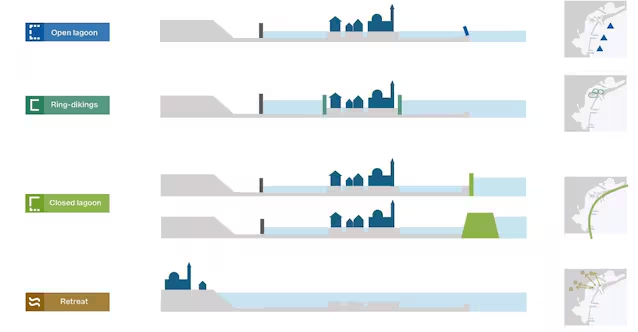
Solution 1: Keep the lagoon open
Venice continues to live inside a lagoon open to the seaprotected from extreme tides by the MoSE system installed at the harbor inlets. Maintaining the current lagoon configuration is clearly the least invasive approach from a landscape, cultural and symbolic point of view. The strategy includes the commissioning of the MoSE in the case of exceptional high waterspreserving the morphological dynamics now present. They will therefore have to be accompanied by local adaptation measuressuch as temporary protections for buildings, monumental barriers or artificial raising of the ground. The strategy requires an ever greater increase in the use of the MoSE, with associated costs and risks of malfunction. At the same time – even with all possible measures – studies show how an estimate of a rise in the order of 75 – 175 cm appears anyway no longer manageable from this intervention strategy.
Scenario 2: ring-diking
In this scenario, Venice is protected by continuous embankments that hydraulically isolate it from the lagoon (ring-diking), which however remains open to the sea. The embankments surround the historic part of the city and the inhabited islands, and inside the water is managed through drainage systems and pumps capable of regulating it correctly. At this point, the MoSE loses its usefulness and the level of protection of the lower area of the city increases significantly. Nonetheless, the city would be totally separated from the lagoonwith a drastic change in landscape and the loss of its historical identity of the water-city connection. Furthermore, a breach in the levee system would cause a sudden flooding of the city, which could therefore become less resilient in this sense.
Scenario 3: permanent closing dams of the lagoon
He prefers the more radical option a definitive separation of the lagoon from the city. This solution would provide the construction of permanent dams at the port mouths replacing the MoSE and, thanks to large pumping systems, the water level in the lagoon could be kept artificially stable. This would offer the greatest possible protection to the citywith minimal reduction in flooding risks. However, the solution stumbles upon very high economic costswith the associated irreversible destruction of the lagoon as the natural ecosystem we know today. This also results in a serious impact on aquaculture, lagoon culture and fishing activities, as well as the need to completely rethink the port system currently present.
Scenario 4: abandonment
The extreme scenario accepts that – beyond certain climatic limits – defending Venice is no longer technically or socially sustainable. The solution, therefore, would be to gradually abandon the citymove (if possible) some monuments e give up Venice as a living settlement. It is the solution with the lowest direct economic costs and an extreme reduction in the risks of sudden catastrophic disasters. However, the cultural and symbolic loss resulting from such a decision is incalculable.
An eye on the global future
Venice will not have to choose just one strategy, but will likely switch between them over time, as the seas rise. However, there are “turning points” beyond which a strategy is no longer sustainable. Since works of this type require decades of planning and construction, crucial decisions should be made well before the emergency becomes unmanageable.
Although the study focuses on Venice as the city at the heart of the problem, Coastal cities around the world will face similar dilemmas in the coming decades. The Venetian case shows that there are no painless solutions, but conscious choices between competing values: environmental protection, safety, cultural heritage, social identity. In this context, it is also worth highlighting that strong climate mitigation can slow sea rise and keep the space for solutions open, canceling or substantially reducing possible catastrophic scenarios.
