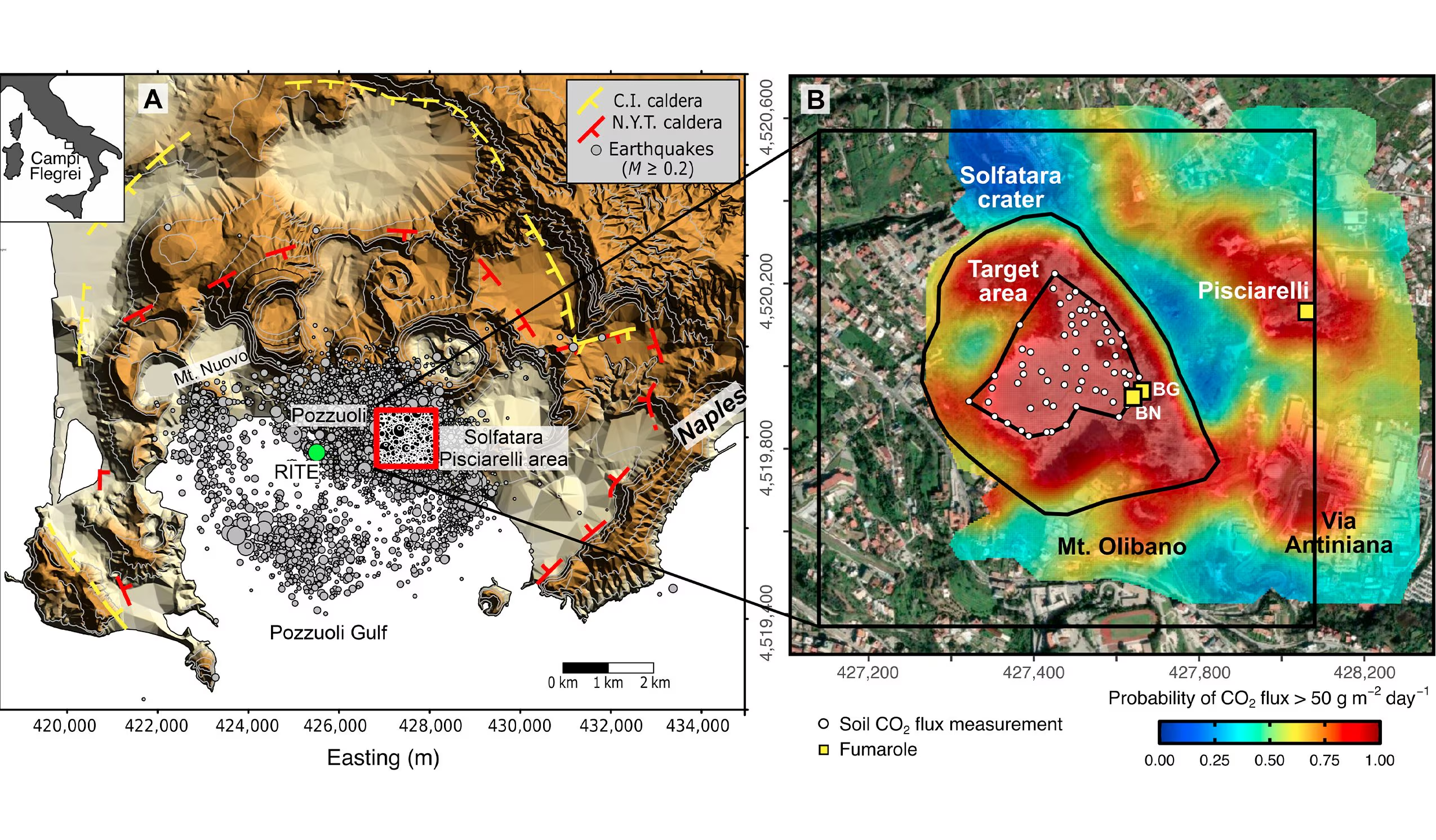
To the Fields Flegrei the emissions Of CO2 follow a very similar trend to that of lifting of soil: these are the conclusions of a recent study published in the scientific journal Science Advances. The paper was created by researchers atNational Institute of Geophysics and Volcanology (INGV), of the University of Perugia and the University of Campania Luigi Vanvitelli and has as its objective the understanding of the link between carbon dioxide emissions, land lifting and seismic activity.
What INGV researchers discovered on the Campi Flegrei
The most relevant data emerging from the study, as anticipated, is that the emissions of CO₂ they follow a trend very similar to that of soil lifting. This conclusion was deduced from over 30 thousand measurements of carbon dioxide emissions collected in the Pisciarelli and Solfatara area between 1998 and 2025. These data were then compared to the deformation of the ground and the related earthquakes.
The data shows that since the beginning of the current bradyseismic crisis, in 2005the amount of CO₂ released from the ground in that area has grown increasingly rapidly. At the same time, the ground in the Pozzuoli area rose by approximately 1.6 meters (until December 2025). Not only that: seismic activity has also intensified, showing a correlation with changes in gas emissions.
In other words, the increase in CO emissions₂ from the ground there tends to be greater ground heave. This is not to say that his lifts because of carbon dioxide but we can consider it more than anything as an indicator of what is happening deeper down.
How come the soil is raised and the link with CO emissions2
According to the model, the magma present at depth would release very hot fluids, consisting mainly of water vapor and carbon dioxide. These fluids rise through the fractures of the rocks, but it is not certain that they are always able to reach the surface. A portion accumulates to approx 3-4 kilometers deepincreasing the pressure within the earth’s crust. From here the fluids can continue to rise, feeding the hydrothermal system – that is, the set of water, steam and hot gases that circulate underground.
And right here a key process takes place: always according to the model, within the first kilometer part of the vapor condensestransforming into liquid water. During this process, energy is released in the form of heat, which in turn increases the temperature of the surrounding rocks. In addition to this, there is also an increase in pressure caused by the supply and accumulation of fluids in the subsoil: the combination of these factors would be the main driver of the ongoing bradyseismic crisis.
Finally, the study highlighted how since 2018 the CO emissions2 have increasingly concentrated in the area of the Solfatare crater. This change, according to the researchers, could be linked to the arrival of new magmatic fluids within the hydrothermal system between 2018 and 2022.
Attention: this does not mean that the study predicts an imminent eruption. However, the authors point out that the evolution of the system requires attention. Furthermore, we must always keep in mind that this research aims to better understand the geological mechanisms behind bradyseism, not to establish when an eruption could occur and with what intensity.
