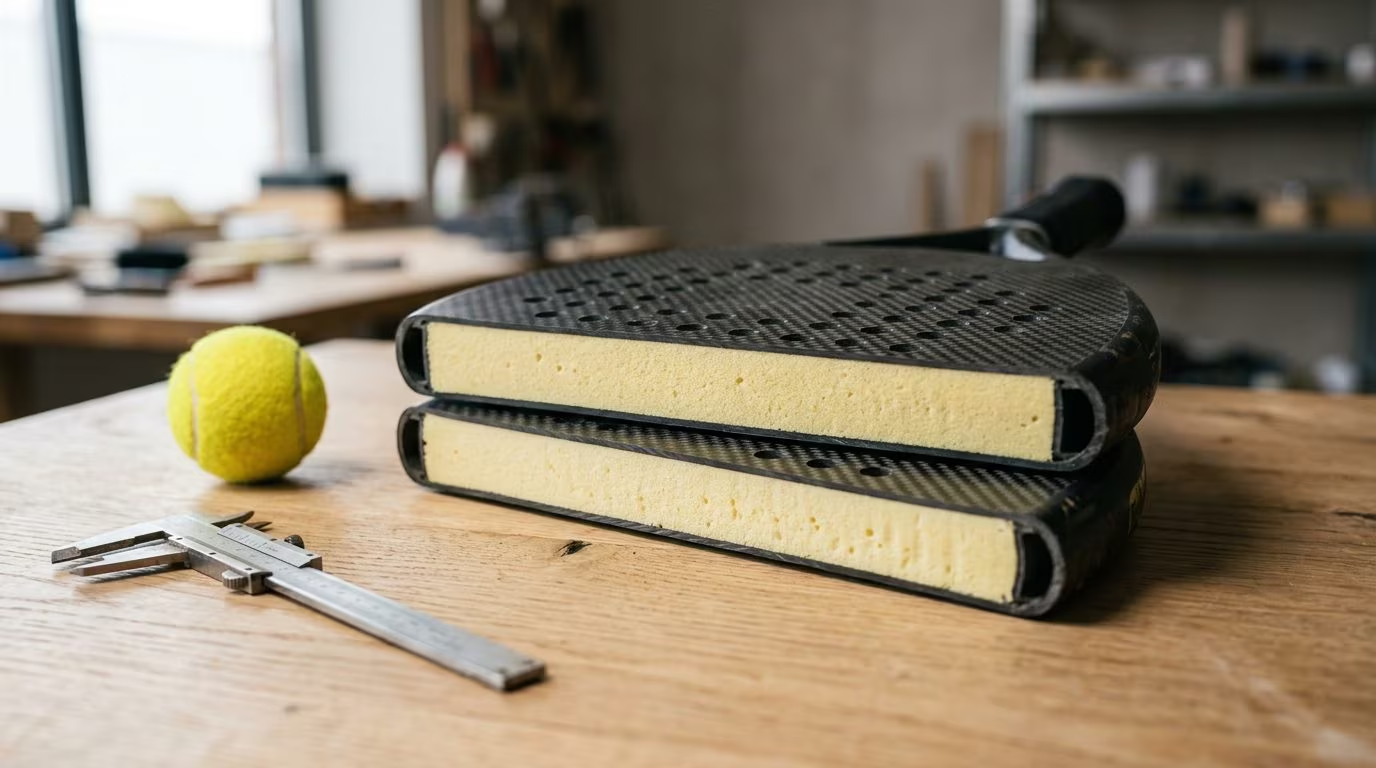
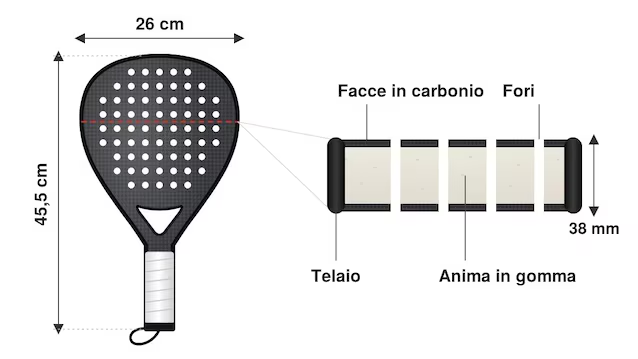
There padel racket it has no strings, in their place there is a rigid and perforated plate which is built like a sandwich, with two faces external in carbon fiber or glass, asoul rubber in the middle and a chassis that holds everything together. The international regulation establishes how large it can be, a maximum of 45.5 cm long, 26 cm wide and 38 mm thick, but says nothing about how much it must weigh. As for the holes (mandatory), according to a study they have almost no effect on the aerodynamics of the racket. A concentration of materials engineering that can be admired at the highest levels these days Milanwhere the champions of this sport are competing in a stage of the circuit Premier Padel.
What materials are they made of and how much do they measure
The rules of padel are written there International Padel Federation (FIP), which in a few lines describes the racket as composed of a head and a handle, which cannot exceed 20 cm in length, and as a whole must not exceed 45.5 cm. That’s over 20 centimeters smaller than a typical tennis racket. The head, however, can be a maximum of 26 cm wide and a maximum of 38 mm thick, just under four centimeters, with a tolerance of 2.5% on the thickness.
In the central part the surface must be crossed by holes with a diameter between 9 and 13 mm, without a limit to their number, and the faces must be flat but not necessarily smooth. Then there is the lanyard to tie on the wrist, mandatory, so much so that the couple loses the point if a player breaks it or lets the racket slip during the exchange. Weight and materials, however, remain a choice of the producers.
By “opening” a racket and examining its section, three parts are found. The chassis it is the edge that surrounds the head and must withstand hits, even accidental ones against the walls of the court, which is why it is usually made of fiberglass or, in high-end models, carbon fiber or Kevlar. In the middle there is thesoulthe thickest layer, made of EVA rubber or polyethylene foam. It is this part that determines a good part of the sensations during the shot: the EVA rubber, a spongy and very flexible material, is a little harder and makes control easier, at the expense of a little power, while beginners often use polyethylene rackets, which can be more forgiving of imprecise shots. To close the sandwich there are two facesthat is, the part that actually touches the ball, mostly made of carbon fiber, glass fiber or graphite.
What are the holes in padel rackets for?
The holes are not a choice of the manufacturers but a regulatory obligation. The purpose of these holes is related to weight, aerodynamics and stiffness, but In reality they do not have as much impact as they might seem. Each hole removes a bit of material, and with dozens of holes the savings in terms of weight are concentrated precisely in the part of the racket furthest from the hand, which is also the one that matters most when moving the racket. A lighter head makes the racket easier to maneuver, especially in fast shots at the net, and at the same time makes it less rigid, reducing stress on the elbow and shoulder.
On aerodynamics, however, opinions are conflicting. In 2013, mechanical engineering researchers at the University of Tarragona studied the behavior of rackets, highlighting that the holes have very little impact on air resistance and that the player will hardly notice any difference between a perforated racket and one without holes. In practice the holes serve above all to lighten the head, and whoever designs a racket must find the right balance between how much material to remove and how much sturdiness to maintain.
Shape, weight and differences with the tennis racket
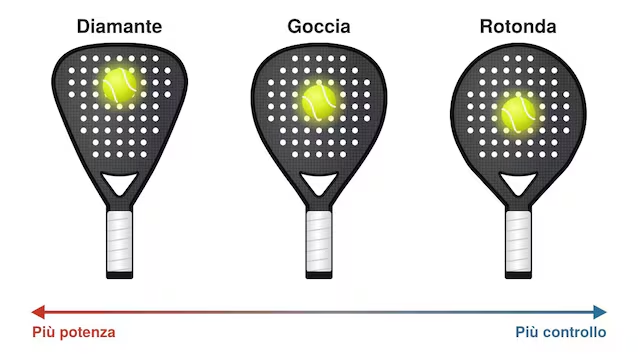
The most common forms are three: rounda drop ea diamond. In the round racket the weight is in the centre, halfway between the playing surface and the handle, and is the most suitable for beginners. In the teardrop shape the weight shifts slightly towards the tip and is the most common choice among intermediate level players, while in the diamond shape it moves even higher, giving more power but less control, and is mainly used by high level players. As for the weightrackets on the market weigh between 330 and 370 grams, more than a modern tennis racket, which stops at around 300.
Beyond shapes and materials, the difference between one model and another is smaller than you might think. A study of the large online store specializing in tennis and padel equipment Tennis Warehouse measured 50 rackets in the laboratory, calculating that the difference in power between the most powerful and the least powerful in most cases stops between 5 and 7%. What matters much more is the speed with which the racket reaches the ball, impressed by the athlete’s arm. Furthermore, during the impact, the ball deforms much more than the racket, and this is also why the padel ball has specially designed characteristics, starting from a lower internal pressure than the tennis ball. The choice of racket therefore remains above all a question of comfort and manageability, especially for those new to this discipline.
