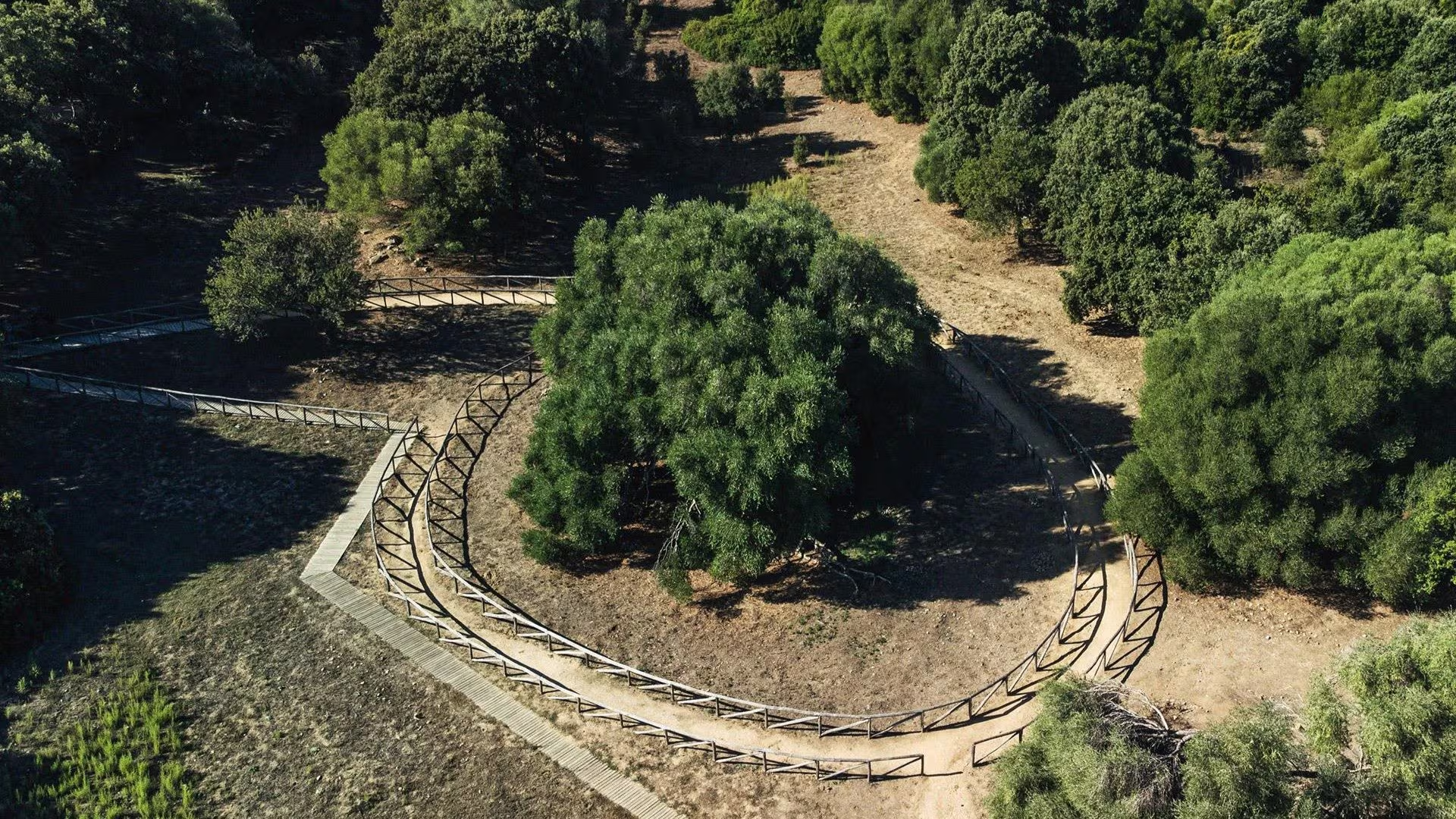
Is called S’Ozzastru (in the Sardinian language “the wild olive”) and is estimated to be between 3000 and 4000 years old. The Patriarch (this is his nickname) is located in Gallura, a sub-region of Sardinia located in the North-East, in particular in the hilly area of Santu Baltolu di Carana, in the municipality of Luras. It should be the oldest olive tree in Italy, declared natural monument in 1991 and included in the list of the “20 centuries-old trees of Italy”, under the protection of the Ministry of Agricultural and Forestry Policies.
It is located in the area of Thousand-year old wild olive trees from Luras (those that would have exceeded 1000 years of life, also called monumental due to their size), near the small church of S. Bartolomeo, at the Liscia Lake and to another specimen approximately 2000 years old. This olive tree (Olea europaea var. sylvestris, i.e. a variety of wild olive tree born from seed) has a trunk circumference between 11 and 12 m breast size (i.e. approximately 1.30 m from the ground), but over 18 m at the base, a crown of 600 m squared and a height of approximately 14 m.
The wild olive is the wild form of the olive tree and belongs to the same species of which it is an ancestor, while thecultivated olive tree (Olea europaea var. europaea) is the form selected by man to produce larger olives and oil. The wild olive also produces olives, but usually smaller: its leaves are also smaller and it has a shrubby shape, with hard, thorny young branches.
If estimates of its age, between 3000 and 4000 years, were confirmed, S’Ozzastru would have started to grow during theBronze Age, in correspondence with the birth of the Nuragic civilization in Sardinia: in fact, evidence of human presence is preserved in the Luras territory, with dolmen and megalithic monuments of the time.
Those on age, however, remain estimates based on tree structure and the comparison with other specimens: the most accurate method for counting the years of a tree is dendrochronologyan analysis of the growth rings, carried out by taking a cylindrical sample from the trunk. In the case of such ancient trees, however, the central wood may be deteriorated or missing, making it impossible to reconstruct the complete sequence of rings. In these cases, researchers can employ several alternative methods, such as comparison, or resort to carbon-14 dating. As specified Gianluigi BacchettaDirector of the Biodiversity Conservation Center and the Germplasm Bank of Sardinia (BG-SAR)an official dating has never been developed.
S’Ozzastru was elected in 2023 Tree of the year in Italy and in 2024 he placed third in the contest European Tree of the Year. Among the oldest non-clonal trees in the world, almost 4900 years old, is Methuselah, a pine with bristle cones (Pinus longaeva) rooted in the White Mountains of California, United States. A different case is that of Old Tjikkoa Norway spruce located in Sweden and belonging to a clonal system whose continuity has been estimated at approximately 9550 years. However, the stem visible today is much younger, it is estimated to be around 600 years old.
There are in other areas of Sardinia other thousand-year-old olive trees: for example in the Oristano area, on the western coast of the Region, in Cuglieri, there is the wild olive Sa Tanca Manna (large property in Sardinian) in Cuglieri, put at risk in July 2021 by a large fire that devastated the Montiferru area that summer. Its rescue was made possible thanks to a long intervention, which involved emergency irrigation, mulching, fertilization and specific treatments, protection of the trunk and foliage throughout autumn and winter. A year later, the wild olive tree put back its first shoots, as certified by Bacchetta, at the time director of the Botanical Garden of the University of Cagliari.
As with other species, the seeds of this and other olive trees are safe in the Germplasm Bank of Sardiniabased in the University of Cagliari, the most important in the Mediterranean. In the Bank, which will turn 30 in 2027, they are kept and preserved at around -25°C 4,000 seed lots. «As a Bank, in addition to the genetic material of the Luras and Sa Tanca Manna olive trees, we conserve the genetic material of all the monumental olive trees of Sardiniabut also of all the varieties of olive trees cultivated on the island.” In fact, Sardinia, in terms of native varieties of cultivated olive trees, represents a country in Italy unique, with over 30 varieties.
