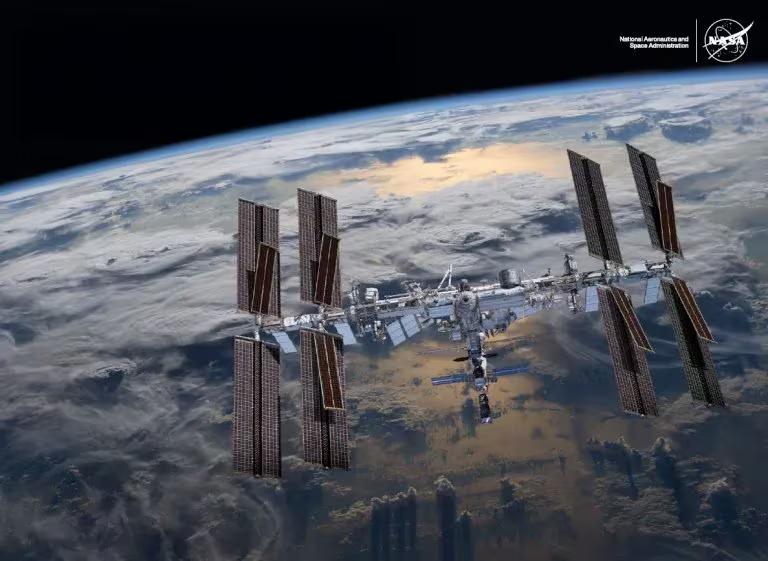
There International Space Station (in English International Space Station, ISS), 2026 candidate for the Nobel Peace Prizewill be decommissioned after 2030. The dismantling plan, in reality, had already been known for some time, but NASA recently opened a tender for the construction of commercial space stations (which will replace the ISS), with the assignment of operational contracts expected for spring 2027.
At the moment, the International Space Station is the largest structure ever built by man in space: an orbiting laboratory that from November 2, 2000 has been inhabited continuously since international crews. They participate in the project 15 countrieswith five major space agencies: the NASA (United States), Roscosmos (Russia), theESA (European Space Agency, in which Italy also participates), the JAXA (Japan) and the CSA (Canada).
Over the course of over 25 years, beyond 280 astronauts Of 26 countries (including the United States and Russia) visited the station, collaborating for its full operation. More than were brought on board 3,000 experiments scientific thanks to the work of over 3,600 researcherswith results in fields ranging from medicine to materials science to climate research.
The International Space Station will be decommissioned in less than 5 years
As mentioned, the ISS, designed for an operational life in reality shorter than what it actually had, it is meant to be decommissioned: the NASA has in fact committed to operating the station until 2030after which the process of will begin decommissioning.
But what what will happen to the structure? The decommissioning of the ISS will be managed in a shared manner between five space agencies who have operated it since 1998: NASA, CSA, ESA, JAXA and Roscosmos. According to the official plans, the operation will be divided into three phases: the natural will be exploited first orbital decay of the station (the Earth’s atmosphere, even at 400 km altitude, still exerts a resistance that tends to lower its orbit). At a later stage we will proceed intentionally lower its altitude with propulsive maneuvers and, finally, afinal re-entry ignition to point the structure towards an uninhabited area of the ocean.
For this last maneuver a dedicated vehicle will be needed: NASA has selected the company Elon Musk’s SpaceX (which will also provide the US Space Agency with essential technologies to return humans to the Moon) to develop and build the US Deorbit Vehicle (USDV), the vehicle that will provide the necessary thrust to ensure a controlled return. According to NASA, in fact, the use of Russian Progress vehicles alone, evaluated as an initial option, would not provide a sufficient margin to reduce the risk to the population to acceptable levels.
It must be said, however, that NASA examined several alternatives before arriving at this decision. Take apart the station and bring it back to earth would have been logistically impossible: ISS assembly required 37 Space Shuttle flights, 13 years of work And 160 extra-vehicular activities and today there is no vehicle designed to recover structures the size of ISS modules from orbit and return them intact to Earth.
Even the option of moving the station to a higher orbit, to try to preserve it even if it is no longer operational, was discarded: at higher altitudes the risk of impact with space debris increases dramatically.
During the re-entry into the atmospheremost of the structure (which, as mentioned, has a mass of approximately 420,000 kg) is will disintegrate: in this case, NASA technicians predict a three-phase disintegration sequence. First the solar panels and radiators will detach, then the modules and the main pylon will separate and finally the individual modules will lose their structural integrity. Some denser, heat-resistant components will survive reentry and end up in the ocean, in a remote, uninhabited area.
After the dismantling of the Station, NASA’s goal seems to be to focus on private space stations: the agency is already supporting the development of trading posts which should already be operational before the decommissioning of the ISS, precisely to avoid a capacity gap.
The history of the ISS: how to follow it from Earth in real time
In short, the younger ones have lived his whole life (or at least a good part of it) knowing that, in orbit, there was always some human being on board the International Space Station. In reality, the project for a permanent space station dates back to 1984when the US president Ronald Reagan announced the program Space Station Freedom. In the 1993 the project was redesigned with the entry of Russiataking the shape of the current ISS.
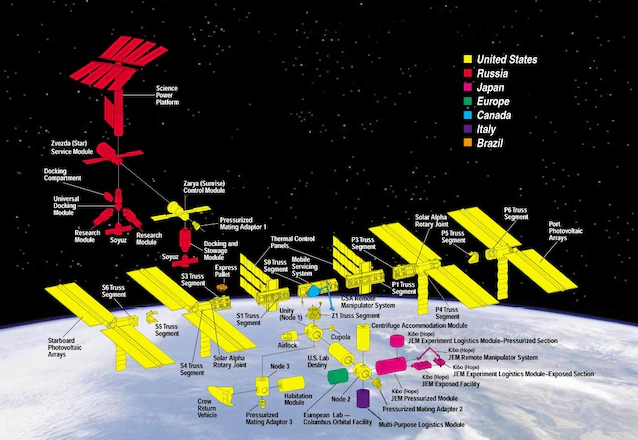
The manufacturing of the main elements began during the 1990s in various factories spread across United States, Russia, Canada, Japan and Europe. THE’assembly in orbit then actually began November 20, 1998when a Proton rocket put the Russian module into orbit Zarya: Two weeks later, the Space Shuttle mission STS-88 carried the American module into orbit Unity. Astronauts connected the two pieces during a series of extravehicular activities, beginning what would become the largest orbiting laboratory in space.
Since that time, the station has been gradually expanded: 42 launches dedicated have brought into orbit over 40 different elementswith more than 160 spacewalks necessary for its assembly. The main construction concluded in 2011but the station continues to evolve with new modules and equipment even today: among the latest arrivals, the Russian laboratory module Nauka and the docking module Prichalboth launching in 2021.
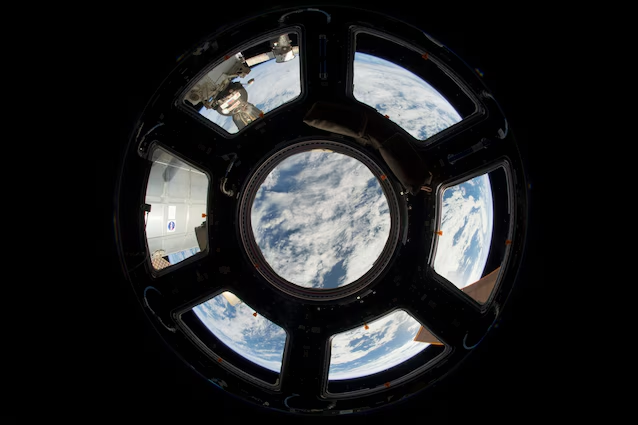
Among the countries involved in the project, Italy played a fundamental role: the Italian Space Agency (ASI) in fact created the Node-2 HarmonyThe Node-3 Tranquilitythe Dome (the large panoramic window with a view of the Earth, from which the numerous photos of our Planet arrive), also contributing to the construction of the European laboratory Columbus. With the launch of the logistics module Leonardo in March 2001, Italy also became the third nation in the world, after Russia and the United States, to send an element of the ISS into orbit.
From a structure point of view, the International Space Station is long 109 meters from end to end (so comparable to a football pitch, including the huge solar panels), it has a mass of approximately 420 tons and orbits at an average altitude of 400 kilometers. It moves at a speed of approx 28,000 km/hcompleting one orbit around the Earth every 90 minutes about. It means that those who live on board witness 16 sunrises and 16 sunsets everyday. They live and work normally on board 7 astronauts: the new crew of the mission Crew-13arrived on the ISS last October 1st, in less than 8 hours.
Perhaps not everyone knows what the ISS is often visible to the naked eye in our skies: thanks to the size of its solar panels, in fact, it appears as a bright point moving in the sky, with a brightness comparable to that of the planet Venus. To know when and where to look, theESA provides a real-time tracker (available at this link) which shows the current position of the station and its trajectory for the previous 90 minutes and the future 90 minutes.
