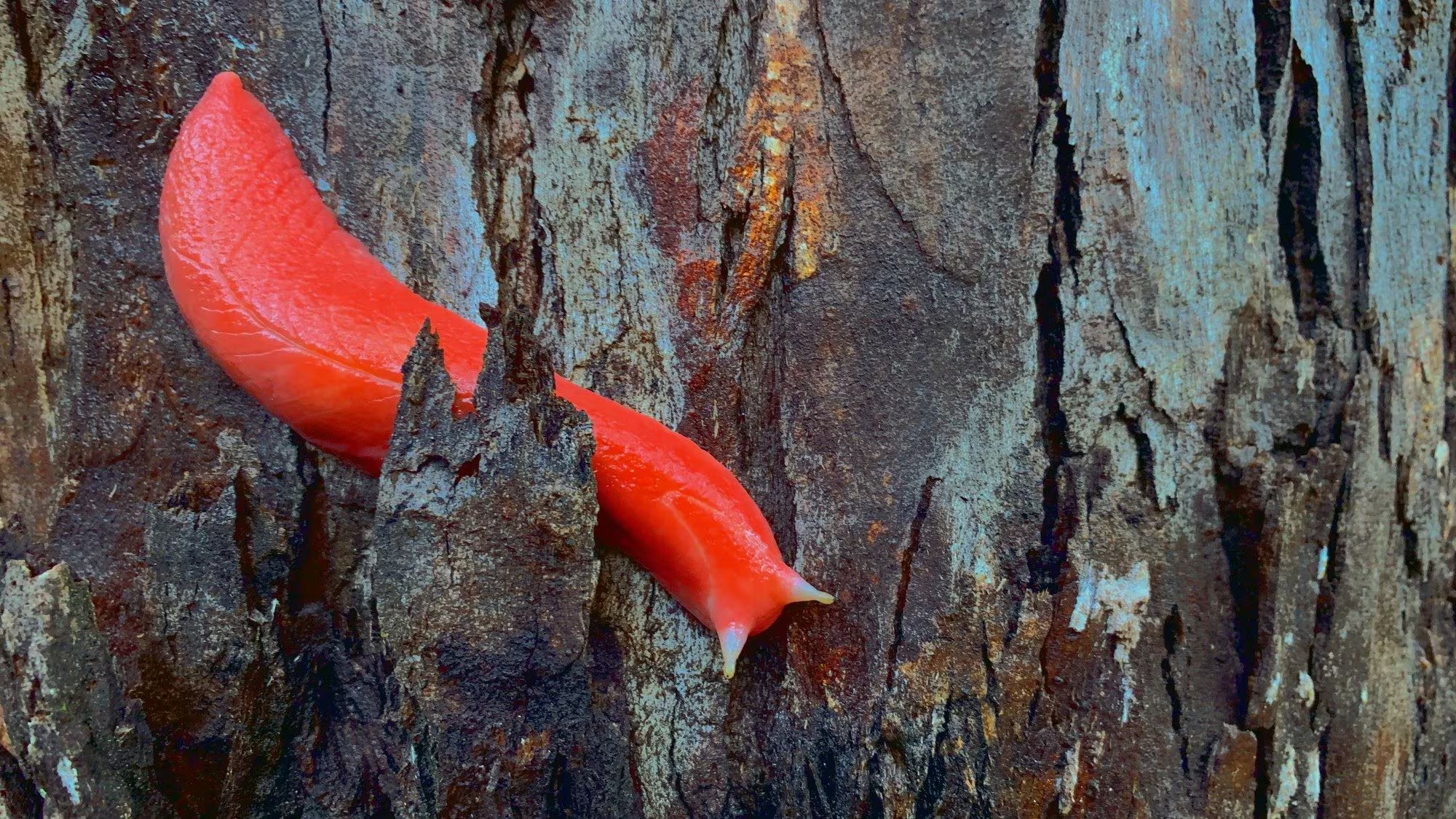
A snail without shell, fluorescent pink in color and 20 centimeters long. It looks like a Pokémon or a creature straight out of a science fiction film, but it’s an encounter you could have while walking in the rain in the Australian woods. Is called Triboniophorus aff. graeffei and it is an endemic species, that is, it lives in a single place in the world: the Mount KaputarIn the New South Wales in Australia. In addition to its record-breaking color and size, this mollusc has another peculiarity: it is part of a community of unique species isolated at 1,500 meters above sea level, on the top of an extinct volcano near the town of Narrabri.
Why is it pink? Appearance, habits and a unique habitat
This shellless snail can reach approx 15-20 centimeters long. Its habitat is found in the highest areas of Mount Kaputar National Park, above 1000 meters altitudewhere the relatively low temperatures and humidity favor the presence of terrestrial molluscs. According to a study published in 2015 in the scientific journal Molluscan Researchsurveys conducted in the park between 2007 and 2014 identified 24 native species of land snailsbelonging to seven families. Nine of these species resulted endemic and two others were present as isolated populations. It is as if the mountain had become a small ecological island, where some species remained separated from those living in other areas.
But why is this snail pink? At the moment there is no confirmed scientific explanation for this coloration: the hypothesis that it can help it camouflage itself among fallen leaves has been proposed, but not proven. Also because they spend most of their time high up in the treetops, therefore rather far from the ground. Their coloring, therefore, is still a mystery to this day.
A species vulnerable to climate change
The fact that its distribution is extremely limited makes it vulnerable to environmental changes. The researchers, in fact, highlight that a elevation of 100 meters of the altitudinal range with suitable climatic conditions could reduce the area available for the Mount Kaputar mollusc community by more than 50%. If the environment became progressively hotter and drierIn fact, these animals would have little space to move towards and find favorable conditions for their survival. Added to this risk is that of fires: a study published in 2023 on Biological Conservation analyzed the devastating effects of the 2019-2020 Australian bushfires on land snailsfinding that medium- and high-intensity fires were associated with a significant decrease in their abundance.
This latest study does not exclusively concern the pink snail of Mount Kaputar, but shows how fires can affect animals that are not very mobile and linked to specific microhabitats. Protecting this environment therefore means protecting not only this mollusc, but the survival of an entire community of invertebrates.
Sources
Murphy, M. J., & Shea, M. (2015). Survey of the land snail fauna (Gastropoda: Pulmonata) of Mount Kaputar National Park in northern inland New South Wales, Australia, including a description of the listing of Australia’s first legally recognized endangered land snail community. Molluscan Research, 35(1), 51–64. Orsi Decker, Junn Kitt Foon, Frank Köhler, Adnan Moussalli, Nicholas P. Murphy, Peter T. Green, Fire severity is an important driver of land snail declines after the black summer bushfires in Australia, Biological Conservation, Volume 279, 2023, 109906, ISSN 0006-3207 Australian Geographic
