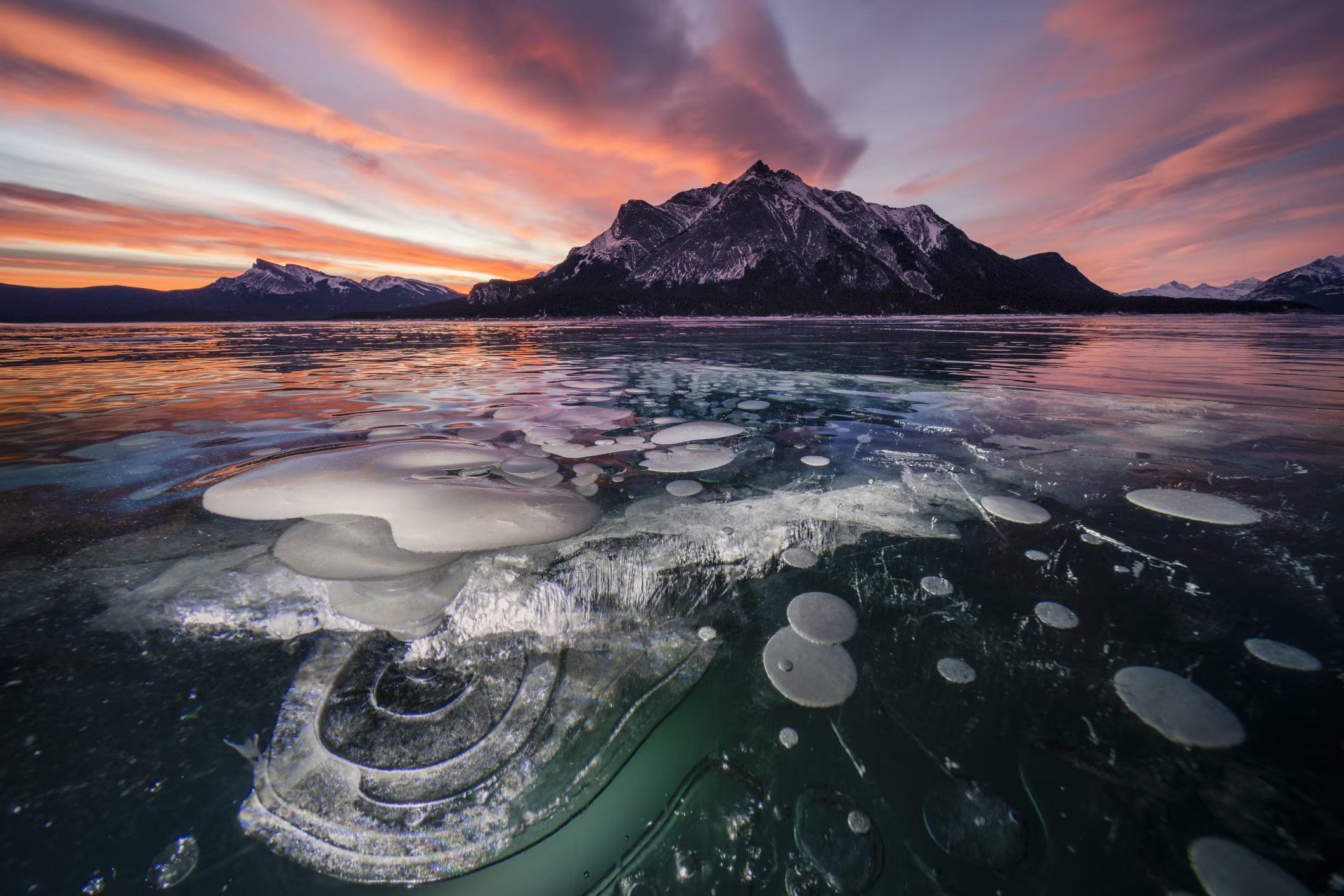
Every winter in Canada, the country with the most lakes in the world, a very suggestive natural phenomenon occurs: in Abraham Lake, artificial body of water formed by the North Sasktchewan River, located in the province of Alberta, in the Rocky Mountains, in fact particular columns of frozen bubbles.
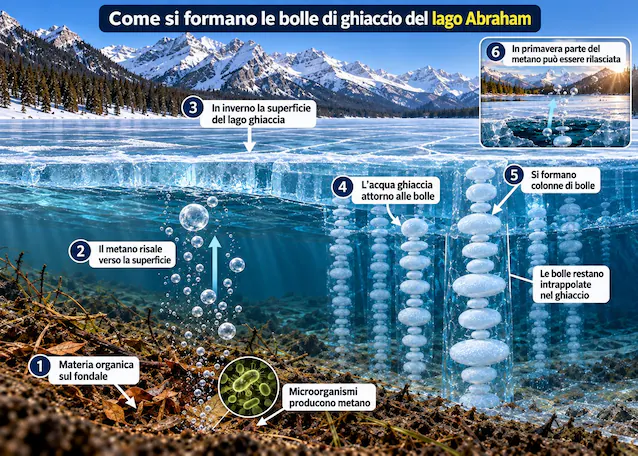
In fact, as temperatures drop, the lake freezes on the surface. In the waters below, however, something continues to happen all year round: on the bottom of the lake there are in fact microorganisms that decompose the organic matter present. Some of these microorganisms releasing methane. The gas that is produced naturally moves upwards, rising towards the surface, but is unable to reach the outside air due to the layer of ice. Upon contact with the layer and the temperature, the water surrounding the gas bubbles also freezes, trapping the methane. It is not the methane that freezes: it remains in a gaseous state, as at atmospheric pressure it only solidifies at temperatures close to −183 °C, decidedly lower than those of the lake in winter!
The columnsthen, are formed due to the repetition of the phenomenon. The new bubbles, rising towards the surface, encounter the previous ice formations and in turn become trapped. And as the ice continues to grow downwards, the bubbles are gradually incorporated at successive depths. Here, what appear to be vertical columns made of white disks are created, clearly visible in the areas where the ice is more transparent: the bubbles appear white because the light, upon encountering the surfaces that separate the gaseous methane from the ice, is scattered in different directions. The winds in the area help to remove the layer of snow that forms on the surface, offering optimal conditions for viewing them.
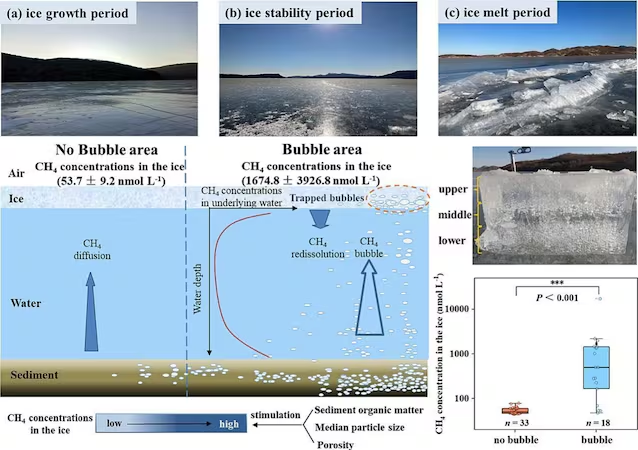
But, taking a step back, how methane is formed? Abraham Lake was born in 1972 following the construction of the Bighorn hydroelectric power plant: in the creation of the basin, the vegetation present, together with other organic matter, was submerged, favoring the production of gas. Since the lake experiences seasonal variations in water level, when it is lowest vegetation regrows in temporarily emerged areasto then be submerged again, allowing the phenomenon to repeat.
When the thaw occurs in spring, the methane is “freed”: a part of it is released into the atmosphere, while another part can remain dissolved and undergo microbial oxidation processes. Here is the reconstructed cycle: