THE fast radio burst (FRB) or fast radio bursts are very short pulses of radio waves coming from deep space which generally last a few milliseconds. For a long time, theirs physical origin it remained a mystery and, according to the main hypotheses, they could have originated from extremely compact and energetic objects like the neutron stars. A research team recently identified the most distant fast radio burst knownnamed FRB 20240304Bmanaging to identify the host galaxyand thanks to the space telescope James Webb.
The galaxy is relatively small and not very massive (its mass is approximately a thousand times lower to what the research group expected) characterized by an irregular structure and with an intense star formation activities.
The signal presents a redshift of about 2.1, corresponding to a time when the universe had just 3 billion years. Redshift measures how much the light is “stretched” by the expansion of the universe during its travel: the higher its value, the further away the source is and the further back in time we are observing. The lightning light has then traveled for approximately 10.8 billion years before reaching Earth.
Observing an FRB in the early universe has given scientists further insights into the mysterious origin of these rare astronomical phenomena. Furthermore, observing an FRB so far away has allowed scientists to study the distribution of matter in the universe over large distances, using the FRB as a kind of cosmic torch that indirectly illuminates the intergalactic plasma (i.e. the primordial gas dispersed between the various galaxies) present along the line of sight.
What are fast radio bursts and why are they mysterious
Most known FRBs come from other galaxies often billions of light years away.
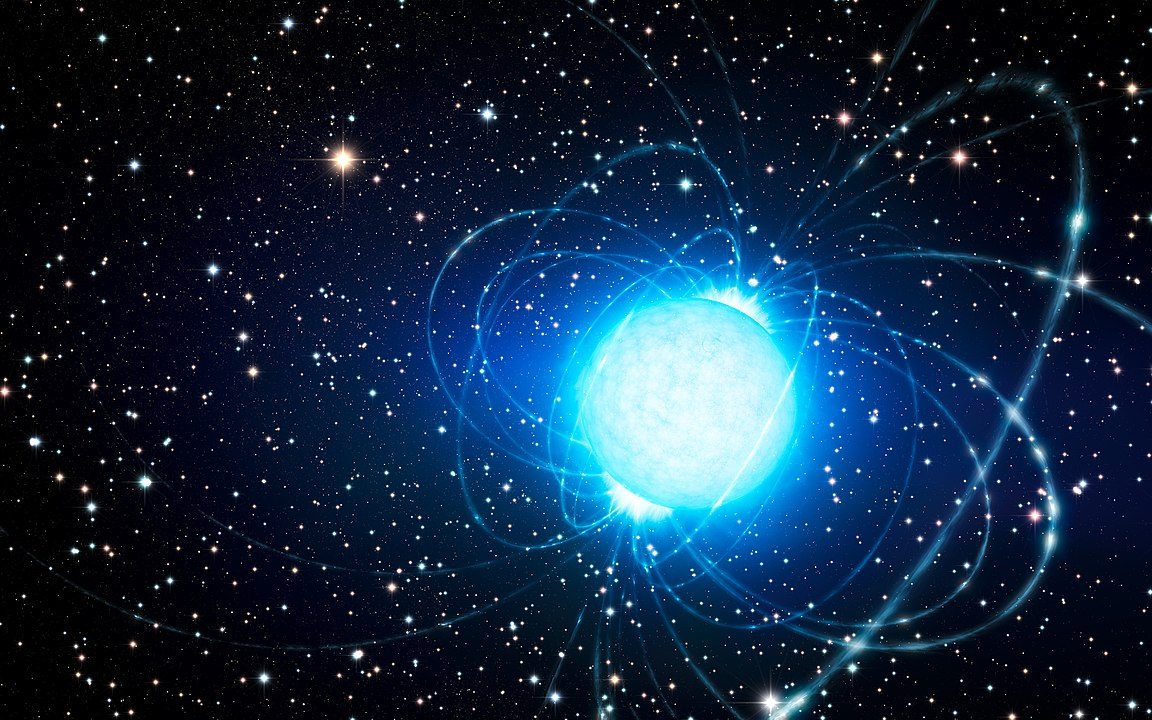
One of most accredited hypotheses that scientists have raised to explain their origin concerns the magnetara particular class of neutron stars characterized by extraordinarily intense magnetic fields.
Neutron stars are very compact objects that can form when one massive star ends its evolution and explodes like supernova. Magnetars, in particular, have magnetic fields that can be hundreds of trillions of times more intense of those of Earth’s magnetic field.
In a neutron star, matter is compressed to very high densities. These stars have a radius of just one ten kilometers and can contain a mass on the order of that of the Sun. During the collapse of the mass of the stellar core which gives rise to the neutron star initial magnetic field of the star it can be amplified enormously (if the magnetic flux is conserved during the collapse, then the reduction of the star’s radius causes an increase in the intensity of the magnetic field). The neutron star thus becomes a rapidly rotating magnetar.
However, the magnetic field of a magnetar can be subjected to strong tensions and over time the external magnetic field can abruptly reconfigure through processes called magnetic reconnection (the same phenomenon also causes solar flares).
In a reconnection the configuration of the field lines changes allowing energy to be released and accelerated charged particles producing a very intense electromagnetic emission.
In 2020, astronomers detected an FRB from our own galaxy associated with the named magnetar SGR 1935+2154 and this observation it was fundamental because he proved that some magnetars can produce signals of this type. However, he did not prove it that all fast radio bursts necessarily have the same origin.
Indeed, they exist other hypothesesincluding the merger of two neutron stars, and furthermore it is not yet ruled out That different physical phenomena can produce FRBs with different characteristics.
The unexpected origin in a primordial galaxy of the FRB: the study
The discovery of an FRB in the host galaxy allows you to reconstruct the conditions in which the flash occurred getting clues about the nature of the object who created it.
The research developed through two complementary observational phases. The first occurred in March 2024, when the research project MeerTRAP detected the radio burst using MeerKAT, a radio telescope system located in South Africa. The characteristics of the signal suggested that it came from an extremely distant region. To determine the distance precisely, however, it was necessary identify the galaxy where he was from match.
Using later James Webb Space Telescope the research team of astronomers is managed to detect the very faint host galaxy via the spectrograph NIRSpec to measure its redshift, confirming the enormous cosmological distance of the source.
The galaxy hosting FRB 20240304B belongs to one very active and primordial evolutionary phase. Its characteristics suggest that a substantial part of its stars may have formed in a relatively short interval of the order of 30 million years.
This data allowed scientists to strengthen the hypothesis that the FRB may have originated from a magnetar. A magnetar can in fact form following the explosion of a massive and young star that is very abundant in primordial galaxies. His training it can therefore happen relatively soon after the birth of the progenitor star, without requiring the long times necessary for other possible scenarios.
Radio bursts as probes of cosmic matter
The observation of FRBs is important as a means to measure ordinary matter which is found between galaxies and which we cannot observe easily with telescopes.
In fact, a substantial part of baryonic matter of the universethat is, the one composed of protons, neutrons and electrons, it does not emit light because it does not form stars and galaxies but it is very rarefied and widespread. This is the so-called intergalactic medium (in abbreviated English IGMthat is to say intergalactic medium).
The IGM is mainly made up of hydrogen and helium and in many regions of the universe these elements are ionized. The IGM is in fact made up of a plasmaa gas composed of free charged particles, i.e. the electrons and nuclei of atoms.
The density of this plasma is extremely low compared to that of gases we encounter on Earth such as air (lower by more than twenty orders of magnitude, an almost unimaginable difference).
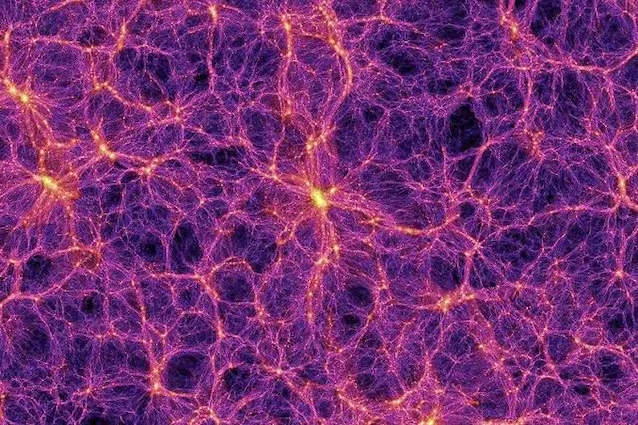
However, as it extends on enormous cosmological distancesthe overall amount of matter can be considerable. Also intergalactic gas it is not evenly distributedand a large part is concentrated in enormous filaments that connect galaxies and galaxy clusters, forming the so-called cosmic network.
When un radio pulse passes through the plasma interacts with free electrons. Signal propagation depends on radio wave frequency. The components of the wave to frequency lower they generally arrive later than those at higher frequencies.
During an FRB, an extremely short radio pulse containing several frequencies is therefore emitted. At the moment of departure from the source these components are concentrated in a very narrow time interval. While traveling through the IGM plasma different frequencies accumulate different delays.
When the signal reaches a radio telescope, astronomers therefore observe a characteristic sequence: the higher frequencies arrive first, while the lower ones arrive later.
The peculiarity is that this delay depends from the quantity of free electrons crossed during the journey. The greater the layer of electrons along the path, the greater the accumulated delay will be, at the same frequency.
Then a radio pulseeven if of a few milliseconds like that of an FRB, it can preserve information about the distribution of intergalactic matterwhich he encountered along a journey of billions of light years.
Astronomers can then study how the amount of ionized matter varies (and thus map intergalactic material) along cosmological lines of sight through FRB measurements at different distances and directions.
