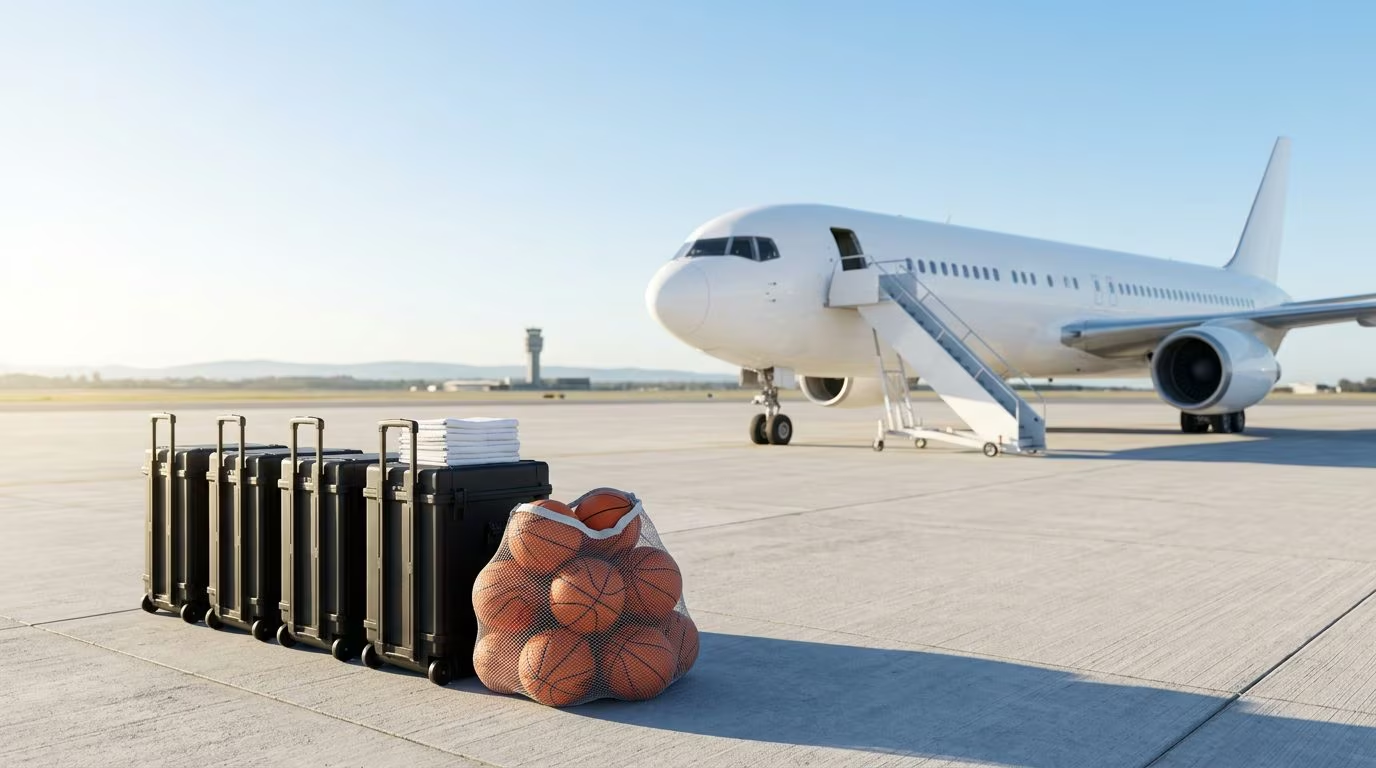
The NBA season starts again and each team will fly on average for around 68,400 km, more than one and a half times around the Earth. The Pelicans and Spurs, who will play in Paris and Manchester in January, will arrive between 87,000 and 89,000 km, while the Knicks will need 56,500. Studies show that the direction of the flight and the time of the game can shift some victories.
When the first tap-off of the regular season kicks off on October 20th NBA 2026-27the 30 teams of the league will also start another championship, that of kilometers. According to estimates released by the NBA, each team will travel by plane approximately 68,400 kma distance equal to 1.7 times the circumference of the Earth at the equator. Behind this average, however, there are enormous differences, because the New Orleans Pelicans and the San Antonio Spurs will fly approximately 89,000 and 87,000 km respectively, also due to the two championship matches that they will play in Europe in January, while the reigning champions New York Knicks and the Toronto Raptors will need around 56,500.
It’s not just a geographical curiosity, because several studies on NBA data show that the distance, the direction of the flight and the time in which the game is played can affect shooting accuracy, rebounds and the probability of winning.
How many km do NBA teams travel in the 2026-2027 season
Every team plays 82 matches in 174 daysfrom October 20th to April 11th, and based on the season calendar it has been calculated that each team will board a plane between 51 and 62 voltsAnd. The United States (excluding Alaska and Hawaii) spans 4 time zones, and a flight from New York to Portland covers just under 4,000 km as the crow flies, the same distance that separates Lisbon from Moscow. The teams of Western Conferencedistributed between the Rocky Mountains, Texas and the Pacific coast, will travel an average of 76,400 km, compared to “only” 62,600 km for those of the Eastern Conferencemuch more concentrated along the Atlantic coast and around the Great Lakes. The only Eastern franchises above the league average are the two from Florida, the Miami Heat and the Orlando Magic.
Mileage doesn’t say it all though, because the Portland Trail Blazers will be taking the plane”only” 51 timesthe lowest number in the league, as their away games are grouped into longer rounds, while LeBron James’ Philadelphia 76ers, surrounded by nearby NBA cities, they will take 62 with much shorter flights.
Then there are the international matches. For years the NBA has taken some championship games abroad to broaden its audience, and this year Victor Wembanyama’s Spurs will face the Pelicans in two matches scheduled for January Paris and Manchester. That trip alone is worth over 15,000 km per team, in addition to the 7 hours of time difference to absorb. The Denver Nuggets’ trip to the Indiana Pacers will be more comfortable Mexico City on November 7.
How they travel: humidifiers, controlled pressure and jet lag
The NBA teams travel on planes rented by the League itself and customized ad hoc, with fully reclining beds, humidifiers and one pressurized cabin as if it were at around 1800 meters above sea level. In fact, US civil aviation regulations allow you to reach the equivalent of 2,438 metres, a pressure at which the body receives a little less oxygen, as happens in the mountains. In this way, athletes keep blood saturation high and avoid dehydration.
NBA away games cross a maximum of 3 time zones and last a few days, a condition for which the players take to the court with their internal clock stopped at home time, and what matters becomes biological time of the match. For a Knicks player, a game that starts at 7pm local time in Portland corresponds to 10pm in New York, when the body is already preparing for sleep. For a team from California that plays at 7pm in Boston, the opposite is true, because for its internal clock it is 4pm, close to the afternoon period in which physical performance tends to be highest. Because of this those who pay the highest price are often the visiting teams who fly west.
The most interesting confirmation came from Orlando bubble of 2020, when due to the pandemic the last matches of the season were all played in the same complex, without travel. The researchers of Oregon Health & Science University they compared the two parts of that season and saw that before the stop the 22 teams of the second half won 63.8% of their games at home and 50.8% away, and that those who flew one or two time zones west lost significantly more. In the bubble, the difference between “home” and “away” games was no longer statistically significant, leveling the results.
Back-to-backs and those who have an advantage
The most tiring situation on the calendar is called back-to-back and indicates two games in two consecutive nightsoften with a night flight in between. In 2026-27 each team will play 14.2 on average, compared to 19.3 in 2014-15, and those with more than 1,200 km of flight time will drop to 59, compared to 74 last season. The League reduced them because in the second match, played after a few hours of sleep, statistically there are fewer wins, especially away from home.
Crossing kilometers, time zones and back-to-backs, the heaviest calendar is that of New Orleans Pelicansfirst in distance, with 16 back-to-backs, the most in the League together with Brooklyn Netsand expected seven consecutive away matches. At the other extreme there are the New York Knicks reigning champions, who in the center of the densest area of NBA teams will fly least of all together with the Toronto Raptors.
These are effects of a few percentage points, but in an 82-game league in which the standings decide the field factor in the playoffs, a few more or less victories can change a season, and this is why the researchers suggest planning players’ sleep with the same care reserved for training and recovery between one match and another.
