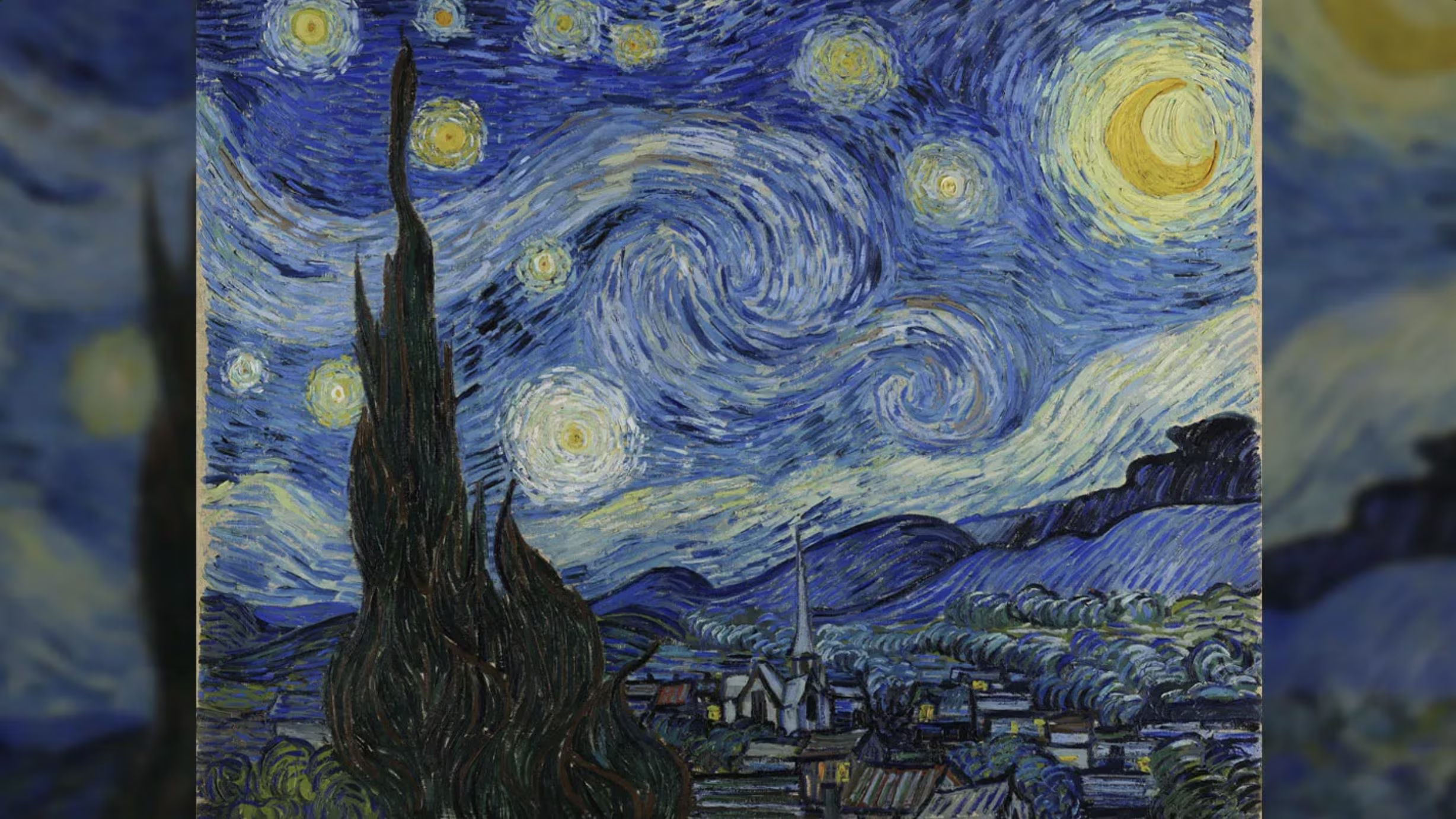
Did the sky in Van Gogh’s Starry Night really exist? A study published in Scientific Reports identifies a possible astronomical configuration observable at dawn on July 22, 1889, but the astronomical reconstruction divides experts and reopens the debate on dating.
It is without a doubt among the most famous works of art of all time and the trait makes its author immediately recognisable: it is the Starry night (in Dutch De Sterrennacht) by Vincent Van GoghVincent Van Goghpainted in 1889 and exhibited at MoMA (Museum of Modern Art) of New York. A new study, published in Scientific Reports, The actual sky of Van Gogh’s Starry Night: a multidisciplinary reconstruction, coordinated by Elijah Jeong-hyun Kim, proposes a new answer to a question that has remained without a definitive answer for over a century: “Was the sky he depicted the result of a spontaneous imagination or a realistic representation?”. In this study by the Space Research School of Kyung Hee University in Seoul, in collaboration with the South Korean company Sllab specialized in space sciences, the astronomical configuration observable from Saint-Rémy-de-Provence was identified around dawn on Monday 22 July 1889: it would be theHyades cluster, whose main stars in the painting form a V-shaped asterism, located in the constellation Taurus. This is a new date: the creation of the post-impressionist work is in fact traditionally placed in June 1889.
Made by Van Gogh during his voluntary hospitalization in Saint-Rémy-de-Provencein a psychiatric clinic after the episode of self-mutilation of the left ear, the Starry night depicts a night landscape just before sunrise. It is one of the many works that the painter produced during his hospitalization period, many of which were the fruit of his imagination. As MoMA explains, the painter was inspired by what he observed from the window of his room: the village depicted is invented, the bell tower recalls Dutch architecture. The study proposes that this oil on canvas, 73.7 × 92.1 cm, is not only the fruit of the artist’s imagination, but a pictorial reworking of a precise, actually observable astronomical configuration.
As the researchers explain, previous astronomical interpretations, linked to conventional dating in Junereached incompatible conclusions, and the arrangement of the stars in the painting was never subjected to quantitative verification. Many experts have traced the work back to June 1889, referring to a letter written by Van Gogh around 18 June to his brother Theo, in which he told him that he had created “a landscape with olive trees and also a study of a starry sky”.
There has never been a shortage of dating controversy, but this study, published on October 22, 2026, would narrowed the date range in which the Moon and Venus would re-enter the painter’s field of vision, confirming through astronomical simulations the choice of the stellar configuration, after comparing it with meteorological data and seasonal clues contained in Van Gogh’s letters (including references to cicadas), topographical reconstructions, historical documents, as well as with the original letters. Additionally, in June and July 2019 Kim traveled to France to attempt to locate the field of vision that Van Gogh might have had from the hospital window. The analysis of a preparatory drawing and the surrounding landscape allowed the researchers to reconstruct a possible visual field of the artist: astronomical simulations showed that on July 22, 1889, at around 3:00 am, local mean solar time, the Moon, Venus and the Hyades cluster were in a configuration compatible with that hypothesized for the painting, with the Hyades in a central position and the Moon and Venus towards its extremities.
The authors do not claim to have definitively demonstrated that Van Gogh painted the sky on July 22nd: this correspondence is a hypothesis and not direct evidencewhich however reopens the controversies regarding the dating of the work. The reconstruction doesn’t make everyone agree this time either. In an in-depth study published in the popular newspaper Science News, the astronomer’s doubts are collected Donald Olsonwho previously studied astronomy within Van Gogh’s paintings: according to Olson the field of vision restricted used by researchers to identify the Hyades it would be incompatible with the breadth of the landscape depicted. Furthermore, the astronomer raised doubts about the actual correspondence between some stars in the painting, including Aldebaran, and their astronomical positions.
The proposal of 22 July also seems to clash with some historical documents: according to the Van Gogh Museum in Amsterdam, the painting dates back to June 1889: on 2 July Van Gogh sent his brother Theo a drawing based on the composition of The Starry Night. Furthermore, according to the museum’s reconstruction, around July 22 the artist went through a serious health crisis that prevented him from painting for at least a month.
That the Starry night is one of the most famous paintings in the world, as confirmed by various rankings: in 2024 the Sotheby’s Institute of Art placed it at second place among the most searched paintings on Googlebehind the Mona Lisa by Leonardo da Vinci and in front of Guernica by Pablo Picasso, American Gothic by Grant Wood and The scream by Edvard Munch. Google Arts & Culture also included it among the most visited works in the worldattributing to her the third place: an estimate of around 3 million visitors per year (based on attendance at MoMA, not a direct count of those viewing the painting).
Finally, in the ranking updated in October 2026 by the site specialized in reproductions Art and See, the painting once again occupies the second place among the 100 most famous paintings in the worldpreceded by Mona Lisa and followed by The School of Athens by Raphael, The Last Supper by Leonardo e Guernica by Picasso. The ranking in this case is based on four indicators: views on Wikipedia, volume of online searches, number of languages in which an entry dedicated to the work is available and annual attendance of the museum that houses it.
