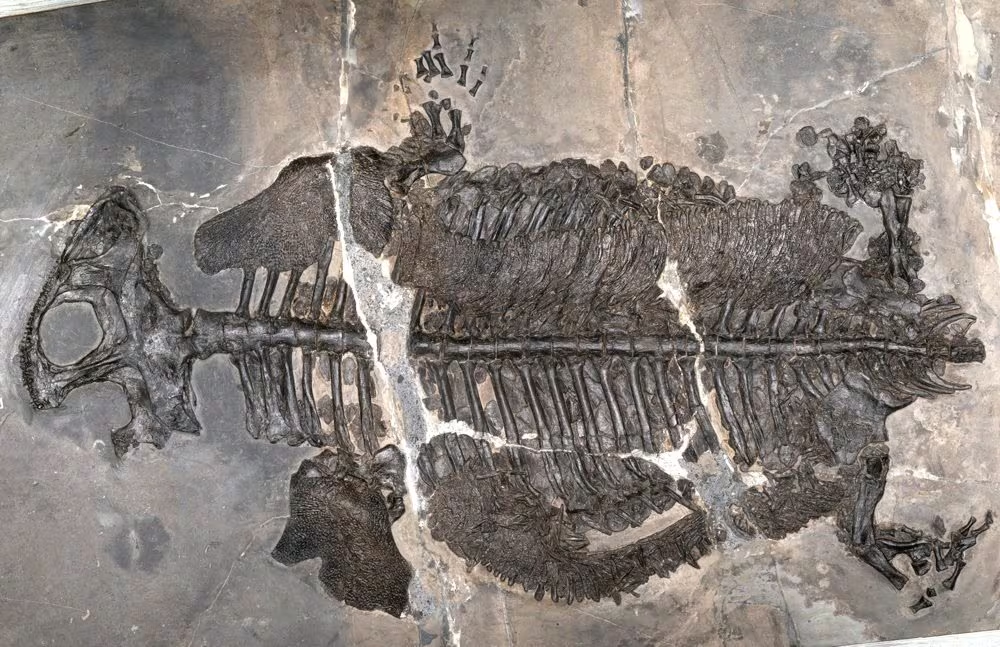
Lived in the Upper Triassic, Gerrothorax maritimus was an armored amphibian and was about one meter long. Two almost complete fossil skeletons found in China, together with geochemical analyses, indicate that it lived permanently in a marine environment unlike modern amphibians.
We know more than 8000 species of amphibians, but most are strongly linked to freshwater and none live completely at sea. Yet, in the Late Triassic, about 237 million years ago, there was at least one exception. Is called Gerrothorax maritimus and it was an armored amphibian about a meter long. Two nearly complete skeletons discovered in China’s Guizhou province represent, according to a study published in Nature Ecology & Evolutionthe first test known of an amphibian completely adapted to marine life.
However, let’s start from a fundamental question: why is no amphibian known to science entirely marine? The answer is in theirs skinwhich in these animals is thin and very permeable to allow skin breathing. This permeability, however, also makes amphibians not very tolerant of salt water. At sea, in fact, the fort osmotic gradient (the difference in the concentration of salts between body fluids and those of the environment) favors water loss through the skin and, at the same time, theabsorption of salts in excess, making it difficult to maintain the body’s internal balance. A limit that G. maritimushowever, seemed to overcome.
A first important characteristic of this animal with a large and flattened body lies in its armour. According to the authors of the study, G. maritimus it was in fact covered largely by an armor of bone materiala structure that could have physically isolate the animal’s skin from the surrounding water thus limiting the entry of salts and the loss of liquids. This amphibian also had some gills – which would have helped eliminate excess salt – and a digestive system capable of absorbing sea water ingested. Three elements which, combined with each other, would have made its physiology in some ways more similar to that of marine fish. Even the latter, in fact, use a sort of armor (or rather, scales), gills and a particular digestive system to osmoregulate, as described in a 2003 study by Greenwell and colleagues.
But how do we know that G. maritimus did he really live permanently at sea? The first clue comes from place of discoveryi.e. sediments deposited around 237 million years ago in a marine basin, an area which at the time was located around 30 km from the nearest emerged lands. In the same environment, among other things, other marine animals have also been found, including ichthyosaurs.
However, there is the possibility that his remains simply ended up there after death, perhaps transported by the water of a river. Here, in reality, the exceptional state of fossils helps us. It is in fact about two almost complete skeletonsin which even delicate parts such as hands and feet are preserved. According to the researchers, it is very unlikely that carcasses transported tens of kilometers would have remained so intact. Rather, it is possible that the animals died and became fossils very close to where they lived.
The analyzes of the data also reinforce this interpretation Strontium isotopes in bones. The values found are compatible with those of Upper Triassic marine water and different from those of the surrounding terrestrial rocks, suggesting that – indeed – G. maritmus it may be the first completely marine amphibian that we have evidence of so far.
