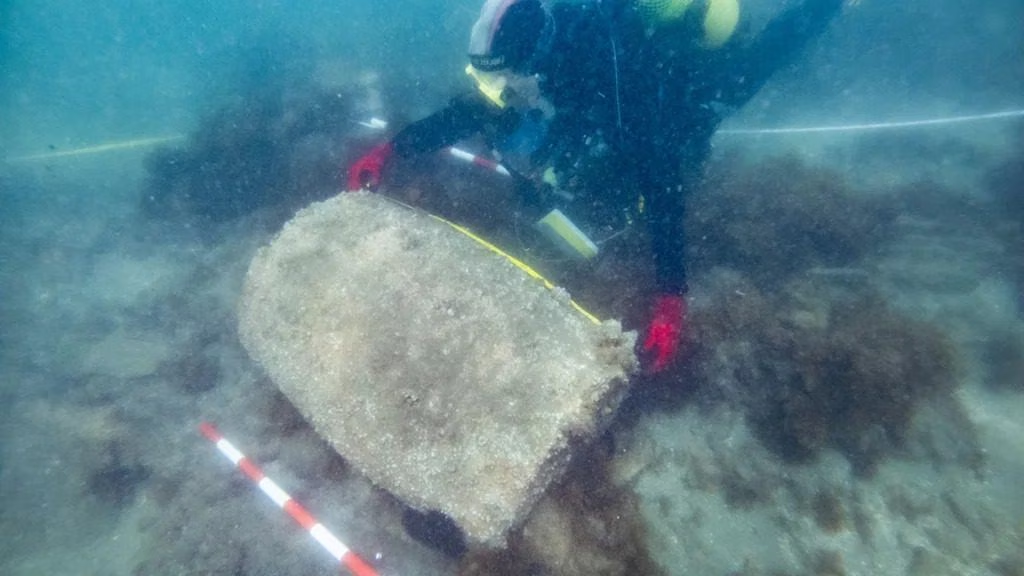
Off the coast of Marbella, Spain, a nineteenth-century wreck may belong to the Italian brigantine Garigliano, shipwrecked in 1887 during the voyage to Buenos Aires. Tiles, tiles and barrels of hydraulic cement part of the load could help confirm the identification.
A wreck spotted off the coast of Cabopinoalong the coast of Marbellain Andalusiain the Southern Spainit could be that of Gariglianoa barque (type of three-masted sailing ship, unlike traditional brigs which had two) Italian shipwrecked in 1887 during a crossing from Marseille to Buenos Aires. Providing new elements for identification was one underwater archaeological campaign conducted in September 2026 fromAndalusian Institute of Historical Heritage (IAPH)through his Centro de Arqueología Subacuática (CAS)in collaboration with theUniversity of Granada.
The underwater intervention lasted fifteen daysallowed us to document 34 meters of the structure still visible. THE’analysis of construction characteristics confirms that it is a merchant ship intended for transoceanic transports in the second half of the 19th centuryinserted in trade routes which connected Europe and America. According to historical documentation, boats of this type could reach approximately 45 meters long. The investigations also made it possible to reconstruct the position assumed by the ship after the sinking: the hull ran aground with the bow facing the beach and a marked one inclination on the left side. The researchers hypothesize that, once stability is lost, the weight of the load contributed to making give in both sides of the hull, opening them outwards.
To deepen your knowledge of internal structure of the wreck were carried out two archaeological essays: one a bowin the area of the foremast seat, the bow mast, and a second in the central partnext to a part of bulkhead preserved. The goal was to better understand the compartmentalization of the ship andorganization of spaces intended for the stowage of goods. They were also conducted archaeological cleaning operations on the right side and in a portion of the load, where they were recognized different levels of stowage. In this regard, particularly significant is the documentation of transported goods. Archaeologists have identified four different tile productions from the second half of the 19th century: three attributable to French producers Pierre Lancon, Roux B. Martin And A. Remuzatactive in the area of Marseille (Garigliano departure port) e Aubagne. They have also been identified tiles produced by the manufacturer Pierre Sacomanin Saint-Henri, near Marseille.
Another element of interest, which could be crucial in identifying the wreck, consists of 26 barrels identified by archaeologists. The historical sources indicate that the Garigliano transported hydraulic cementbut this information will have to be verified through the sample analysis taken from some containers, which appear to still retain part of their contents. They were also collected samples of the hull wood and of copper claddinguseful respectively for identifying the essences used in construction and for deepening knowledge of the techniques adopted. By analyzing wood and copper, one could obtain elements for definitively attribute the wreck.
The entire campaign of Spanish archaeologists was accompanied by 360 degree video footage and from photogrammetric surveysintended for the creation of a three-dimensional model of the wreck. The research is not yet concluded: the CAS predicts new dives in 2027 to deepen the study and further verify the identification of the vessel.
