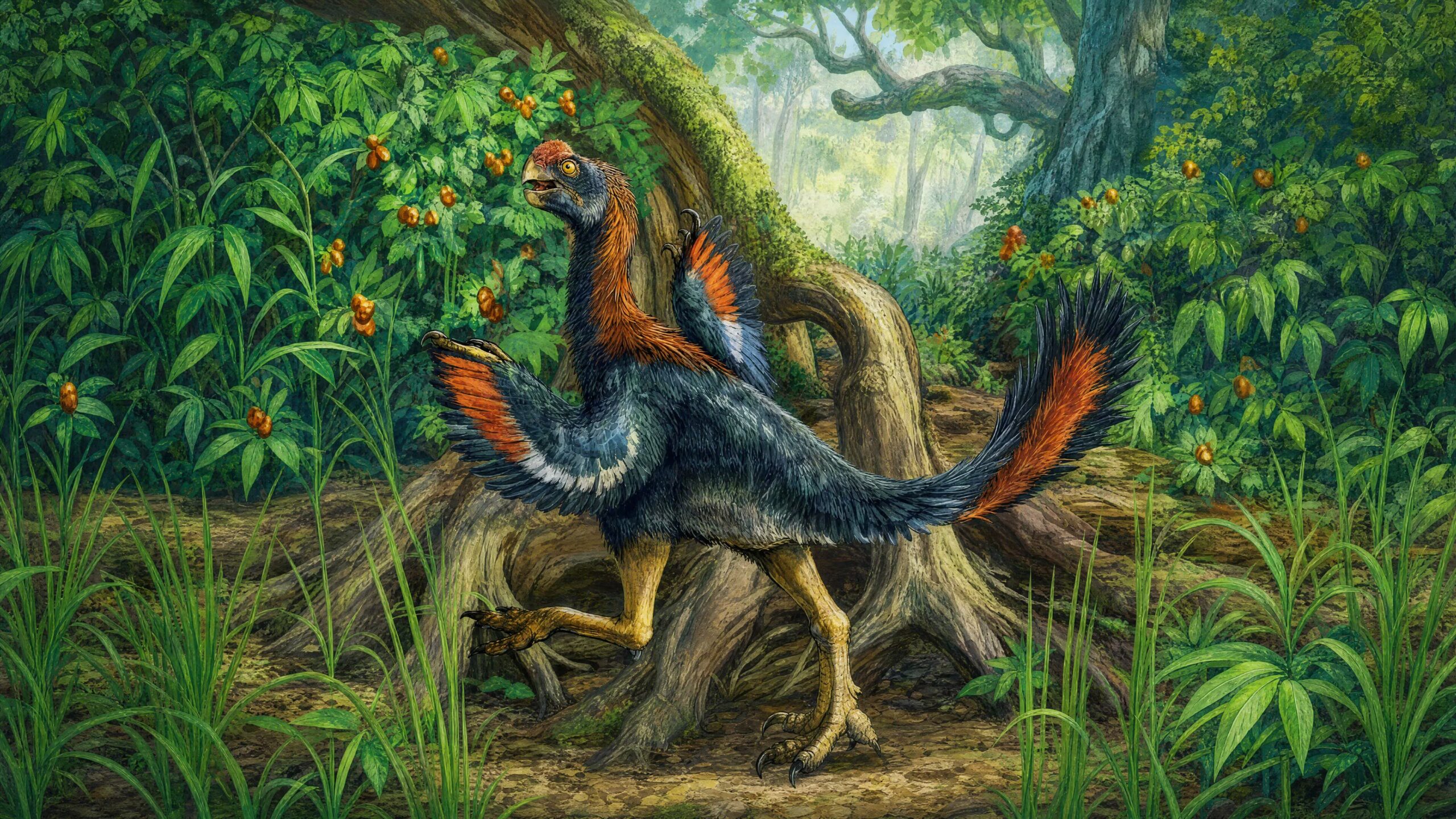
Infernogallus jamesi, an Upper Cretaceous oviraptorosaur the size of a turkey found in the United States and which lived in the same period as the T-Rex, had a jaw capable of moving antero-posteriorly. Its anatomy suggests that this is an adaptation to a fruit-rich diet.
The Infernogallus jamesi – commonly called “hellish chicken” – is an extinct genus of dinosaur oviraptorosaur theropod belonging to the Caenagnathidae family, lived in Upper Cretaceous (between 100 and 66 million years ago) in the same environments as iconic giants such as Tyrannosaurus rex, Triceratops and Ankylosaurus.
About the size of a turkey (or a large parrot), about 1.5 meters long and with an average weight estimated between 9 and 15 kilograms (12 kg on average), this small dinosaur could clarify the evolutionary link between herbivorous theropods and the spread of flowering plants (angiosperms).
This new species was described in a study led by Gregory F. Funston of Stony Brook University (New York) published in Nature.
The specimen object of the morphological and taxonomic study was found in Hell Creek Formationone of the most important fossiliferous deposits in the United Statesessential for the study of the fauna of the Upper Cretaceous. The most important element of the research is the skull of the animal, almost complete and articulated. This is the first one found in these excellent storage conditions for the group. Its anatomy has allowed scholars to reconstruct the organization of the muscles responsible for mandibular movementsidentifying unusual features compared to other non-avian theropods. There disposition of the muscles would have allowed the mandible to move predominantly in antero-posterior directionthat is, back and forth, rather than limiting itself to the vertical movement typical of many dinosaurs.
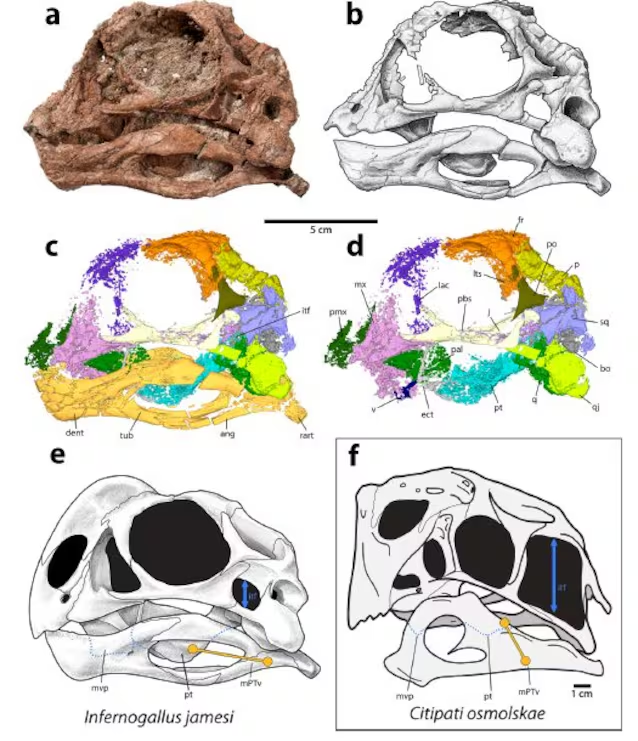
This particular mechanic allowed a prolonged food processing inside the mouth. The ridges and grooves present on the contact surfaces of the jaw bones could match during movement, contributing to crush and process soft foods.
A similar configuration, developed independently in the course of evolution, is observed in some today parrots specialized in the consumption of fruits. It must be said that caenagnathids represent one of the most common groups of non-avian theropods traits in common with avian theropods, the birds.
Based on these characteristics, the authors interpret caenagnathids as highly specialized herbivoreswhose diet would have largely consisted of fleshy fruits produced by angiospermsflowering plants. This division of plants became widespread during the Cretaceous.
Angiosperms (and their fruits) progressively increased in size and variety during the Cretaceous, in parallel to the diversification of oviraptorosaurs, who were probably greedy consumers.
The research thus identifies one of the more convincing candidates to document the adaptation of dinosaurs to a diet based on the fruits of flowering plants.
However, it remains to be clarified what role these animals had in the spread of angiosperms during the Upper Cretaceous and, more generally, inevolution of plant ecosystems that would characterize the subsequent Cenozoic. At the moment, in fact, there are not enough elements to hypothesize that oviraptosaurs played an active role in the proliferation of angiosperms (defecating and spreading seeds), as happens instead for other animals.
