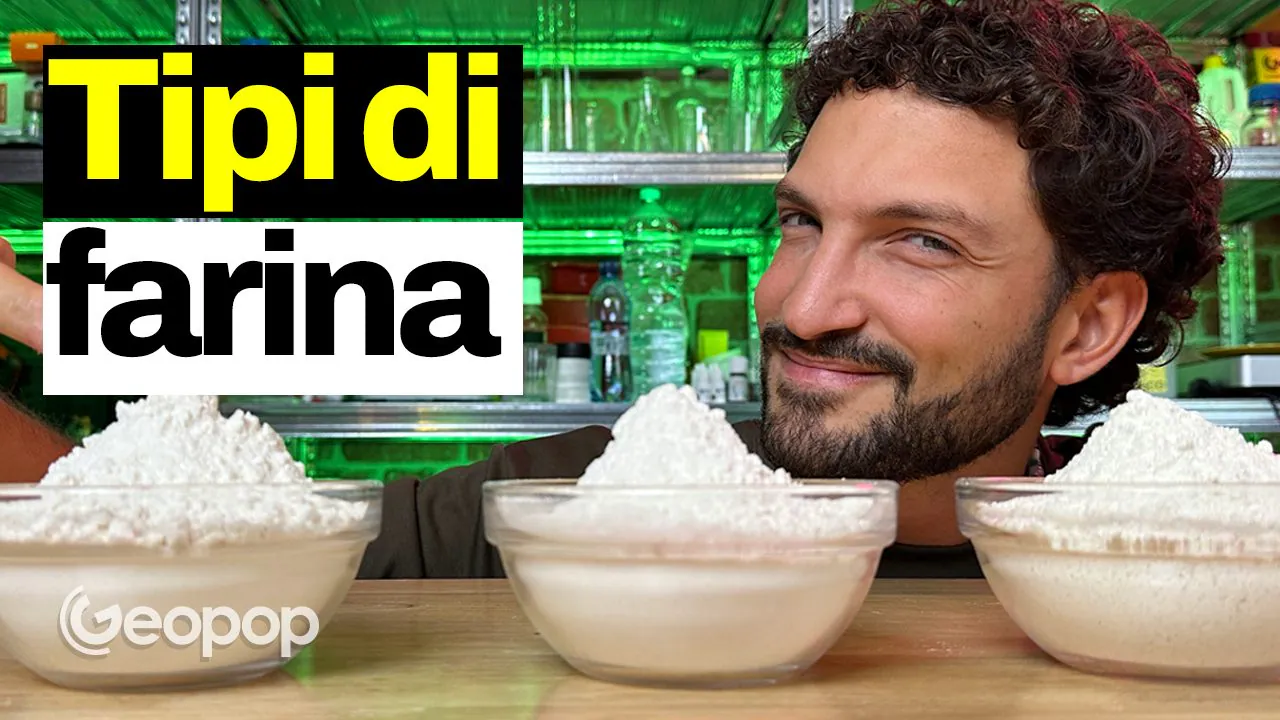
The difference between 00, 0, 1, 2 and wholemeal flour does not depend on the grain, but on the way in which the grain is processed. We take you to a mill to discover how flour is made.
There Flour it is one of the most used ingredients in our kitchens, yet few really know what distinguishes one 00 flour from one 0, 1, 2 or integral. And above all: why do all these types exist? We’ll immediately tell you something that surprises almost everyone: the difference does not depend on the type of wheat, but on which parts of the grain are discarded during processing.
It all starts from the bean. In the video we use a3D animation to show you what a grain of soft wheat looks like: in the center there is theendospermrich in starch and proteins; then the germa sort of concentrated embryo of fats, proteins and vitamins; and finally the branthe outer shell full of fibers. This is where everything comes from: if we grind only the endosperm we obtain 00 flour, while by increasing the numbers – 0, 1, 2 – we reintroduce increasing quantities of germ and bran, up to wholemeal flour, which contains practically the entire grain. And this is precisely why it has that typical brownish color.
Inside the mill. But in practice, how do you separate the bran and the germ from the endosperm? To find out we entered the Casillo factories, in the province of Bari, where 00 flour is created from soft wheat grains. In the video we show you the two crucial steps: first the grains are slightly wet and left to rest, so the bran absorbs the water, becomes more elastic and comes off better; then the millstoneswith grooved cylinders and flat rollers that scrape away the bran and flatten the germ, sifting it until you obtain a perfectly white flour.
And what happens to the parts we eliminated? Usually bran and germ end up in moles animal feedand there is a precise technical reason: the germ contains fats that go rancid in a few hours, ruining the flavor of the final product. In the video we tell you how, with the patented method, circular processingCasillo instead manages to recover the germ and a layer of bran (thealeurone), extract the oil and replenish the nutrients obtaining Altograno. The result is a flour with more proteins and fibers and fewer carbohydrates, with which you can even make a protein pasta with 19 grams of proteincompared to around 13 for a normal pasta.
There’s a lot more science behind a simple bag of flour than you might imagine. Watch the video to discover all the steps, from bean to plate!
