
An experiment on China’s Tiangong Station cooled about 20,000 rubidium atoms to near absolute zero (9.7 picokelvin) to form a Bose-Einstein condensate, an achievement made possible by taking advantage of the unique microgravity environment in Earth’s orbital space.
A gas of approx 20,000 rubidium atoms has been cooled to a temperature never achieved before equivalent to just 9.7 picokelvins. A picokelvin is a thousandth of a billionth of a kelvina limit close to absolute zerocorresponding to the limit temperature of zero degrees kelvin, i.e. − 273.15 degrees centigrade. The experiment published on Science was made on board the Chinese Tiangong space station in the ultracold atom laboratory called Cold Atom Physics Rack (CAPR) of the Mengtian module.
The sample formed a Bose-Einstein condensate where at extremely low temperatures atoms behave collectively as a single quantum wave. Quantum properties then become observable on a macroscopic scale. The measured temperature of 9.7 pK (with an uncertainty of +3.2 and −2.7 pK) is about a quarter of the previous value of 38 pK obtained in a laboratory in Germany.
The Bose-Einstein condensate is often called the “fifth state of matter” in addition to the canonical ones of solids, liquids, gases and plasma. This is a particular state in which a gas of bosons (particles like photons) is cooled to temperatures extremely close to absolute zero. A gas composed of atoms in particular conditions behaves as if it were composed of bosons and can therefore generate a Bose-Einstein condensate with unique behavior, becoming a kind of single macroscopic atom. In fact, atoms lose their nature as isolated particles and collapse into the same minimum energy quantum state, behaving as a single entity with particular properties. For example, Bose-Einstein condensates are used to create i superfluidcapable of minimizing friction to almost zero and of passing through the walls of solid containers.
Because the microgravity of the Tiangong space station is needed to reach such low temperatures
In a microgravity environment like orbital space, physical processes can be triggered for experiments that are impossible or difficult to carry out on Earth, such as in the field of fluids, crystallography and for the search for new materials. The Chinese Tiangong space station, like the International Space Station (ISS), hosts fundamental physics research and allows the setup of very complex experiments to be reproduced on Earth.
In microgravity experiments, particular conditions of apparent weightlessness can be obtained where the object of the experiment and the instruments they are both in free fall. In fact, certain physics or chemistry experiments require long times to be studied: from several seconds to minutes and even hours. The drop towers (laboratories built inside towers where experiments are literally dropped) such as the ZARM tower in Bremen and parabolic aerial flights they can reproduce microgravity, but only for short intervals. In orbit, however, the weightlessness is continuous and therefore gravity no longer becomes an obstacle for experiments.
In terrestrial laboratories, Bose-Einstein condensates are obtained by cooling atomic gases down to a few nanokelvins (one billionth of a kelvin). Going down to the picokelvin scale, however, is more difficult because when atoms are freed from optical traps, gravity causes them to fall and limits the time to observe them. A laser optical trap it is a scientific instrument that uses a highly focused laser light beam to block or move submicroscopic objects (such as atoms and molecules) and is used to “cool” atoms.
How atoms cool to almost absolute zero
The experiment conducted in the CAPR installed in the Mengtian science module of the Chinese space station is a miniaturized version of a similar experimental laboratory located on Earth. The original instrumental system created in terrestrial laboratories occupied approximately 20 cubic meters and weighed ten tons. To take it into space it was miniaturized into a space rack measuring approximately 0.7 cubic meters and weighing only 500 kilograms.
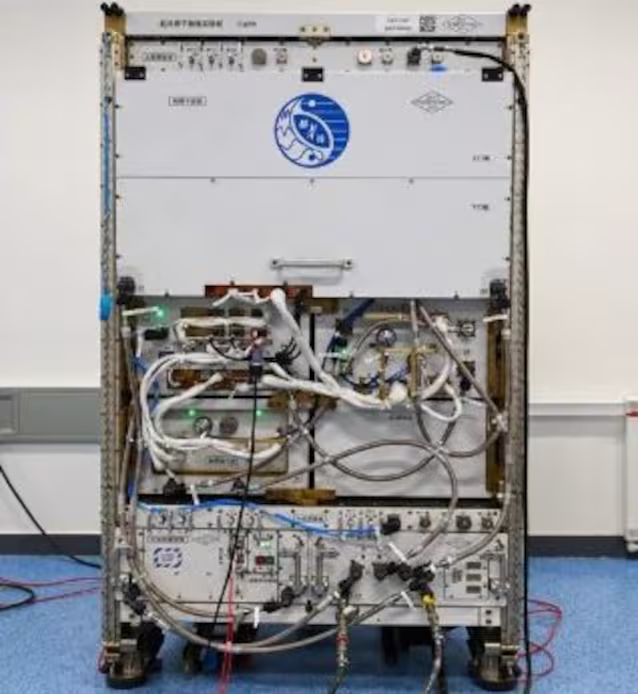
In the CAPR apparatus, focused laser beams are generated to lock the atoms into a real one potential hole which holds the particle in place. The laser thus slows down the atoms through the exchange of momentum with photons, taking kinetic energy and cooling them. We then move on to evaporative cooling in which the trap is adjusted so as to let the most energetic atoms escape. Those that remain redistribute at a lower average energy and therefore at a lower temperature.
It was thus possible to obtain the Bose-Einstein condensate. The cloud was then transferred to a larger optical trap and the confinement was further weakened, reducing the energy of the atoms through further expansion of the gas.
To measure the temperature of the gas, the researchers measured its expansion in three dimensions (i.e. the residual kinetic energy of the particles). The equivalent temperature of 9.7 pK was then obtained by adding the three dimensions. To measure such a low temperature therefore a thermometer is not usedbut the spatial distribution of the atoms and the speed with which they move away are analyzed.
Scientific applications that could use ultracold atoms
According to the researchers of the study, the result obtained on Tiangong could open up two important research directions in fundamental physics.
The first would allow the behavior of complex quantum systems to be reproduced in the laboratory and to recreate exotic phases of matter that are difficult to study directly. For example, through appropriately configured laser beams it is possible to create images optical gratingsperiodic structures that function as a sort of artificial crystal made of light, in which the atoms are confined in regular positions.
By changing the intensity and placement of the lasers used to trap atoms, researchers can control the interactions between atoms and study different states of matter. Among these are the phases by Mott that describe a particular transition of matter in which a material that should behave like an electrical conductor actually turns out to be an insulator due to the strong repulsive interactions between electrons.
The second direction concerns the development of Space atomic interferometers. Through laser pulses, exploiting the wave nature of atoms, it is possible to divide an atomic cloud into two wave packets, make them follow different paths and subsequently recombine them (the phenomenon precisely called interferometry).
The waves then interfere with each other, producing a signal that is extremely sensitive to accelerations and variations in the gravitational field. Lower temperatures and longer observation times improve the precision of these measurements. In perspective, tools that use this technique could allow us to map the Earth’s gravitational field more accurately and conduct precision tests on some fundamental principles of physics such as equivalence principle provided for by Einstein’s general relativity.
The equivalence principle states that all bodies, regardless of their mass and composition, fall with the same acceleration in a gravitational field when other forces are negligible. Measuring this principle in microgravity allows us to observe atoms in free fall for much longer periods than in a terrestrial laboratory, significantly increasing the precision of the measurement.
