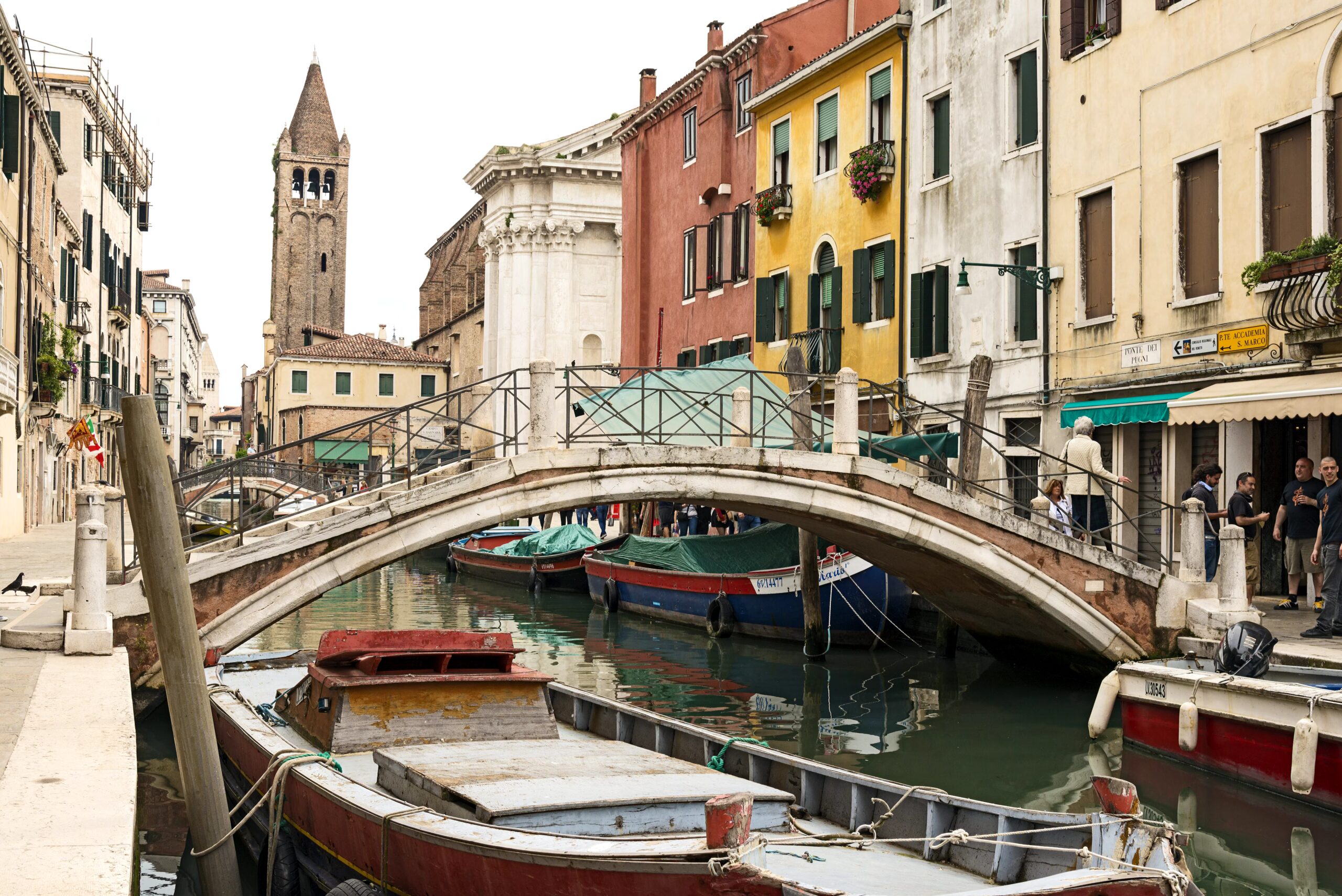
In Venice there are approximately 435 bridges, which connect 121 islands together, allowing pedestrian passage. The most famous and traveled are the four that cross the Grand Canal (Rialto, Scalzi, Accademia and Constitution), built in different eras, from 1591 to 2008. Here’s how many there really are, how and when they were built and their stories.
Have you ever wondered how many bridges are there in Venice? According to data reported by the Municipality, they are 435, although the number may vary depending on which crossings are included in the count. They seem like a lot, but Venice is located on an archipelago of 121 islandsseparated from each other by a dense network of canals and streams: without the bridges, moving between the different parts of the city on foot would be impossible. There are four that cross the Grand Canal, the main waterway almost 4 km long: built in very different eras, the Rialto Bridge, the Scalzi Bridge, the Accademia Bridge and the Constitution Bridge alone tell the story of over four centuries of engineering.
Venetian bridges were once (almost) all without railings
The very first bridges in Venice were built in woodcomposed of simple planks that were thrown from one bank to the other to allow the transit of horses and carriages and, above all, not to hinder that of boats.
Over time, the wood of bridges and walkways was replaced by Istrian stonea white and slightly porous limestone capable of resisting the continuous action of brackish water, also used in the construction of buildings.
What may surprise us today is that at the time the bridges, even when they began to be built in stone, they had no parapets or safety guards on the sides. This is a testimony to this Chiodo bridgein the Cannaregio district, still today without a railing as at the time of its construction.
As we can see from the image below, it has the typical “humpback” shape, with a central hump. This is not an aesthetic quirk, but was used for structural reasons and to raise the arch enough to allow the passage of boats.
The four bridges over the Grand Canal, from the oldest to the most recent
For centuries, the Grand Canal could be crossed in only one point, Rialto, mostly by boat. The idea of crossing it with stable structures has spanned very different eras, and in fact the four current bridges were built over a period of approximately 450 years: first the Rialto Bridge (1591), followed by Accademia Bridge (in the current version, 1933 and then 1985), from that of the Scalzi (1934) and finally from Constitution Bridge (2008).
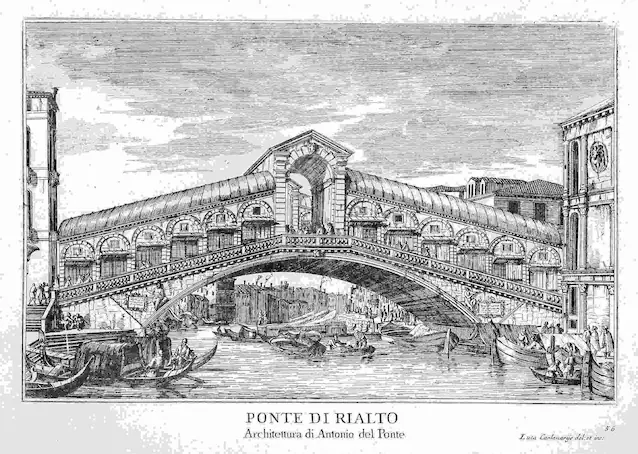
The Rialto Bridge: three centuries of wooden bridges before the stone one
The oldest and most famous is the Rialto Bridgeand its history carries with it that of its collapsed predecessors. At the narrowest and commercially strategic point of the Grand Canal, a floating boat crossing existed already in the twelfth century, later replaced by a wooden bridge on stilts built by the engineer Nicolò Barattiero and called Coin Bridgedue to the nearby mint or the toll that is said to be required for passage.
That wooden bridge and its successors were damaged several times by fires and collapses (including the famous collapse of 1444, when the structure could not withstand the weight of the crowd who had come to witness a wedding procession), making reconstruction necessary on several occasions. At the end of the sixteenth century it was decided to move to stone: the Republic of Venice announced a design competition which, according to tradition, attracted the greatest designers of the time. The winner was an engineer with a surname that seemed auspicious, Antonio da Ponte. The Rialto Bridge was built between 1588 and 1591.
It was a technical challenge: in order not to obstruct the passage of boats, Da Ponte designed a single arch of Istrian stone, without intermediate pillars. The bridge, the one we still walk on today, is approximately 48 meters long, and rests on thousands of wooden poles driven into the muddy seabed – the founding technique of all of Venice, which exploits the absence of oxygen in the mud to slow down the deterioration of the wood.
On the back of the bridge, to the princes, they run two rows of shops: at the time they were merchants’ stalls, today they are jewellery, mask and souvenir shops. A feat that seemed impossible, more than 400 years after its creation, is still there.
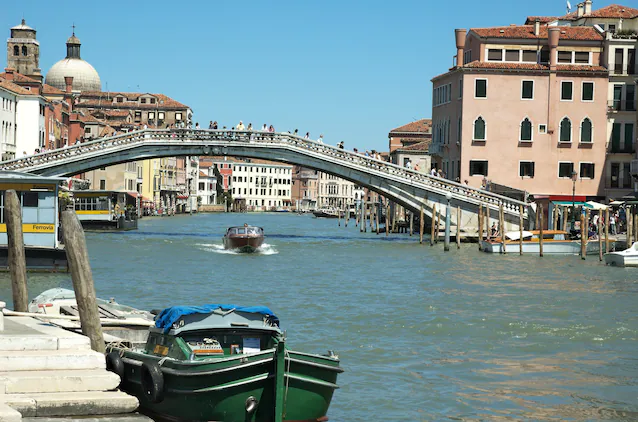
The Scalzi and Accademia bridges: two bridges created by the same engineer
To have a second and third bridge over the Grand Canal we had to wait until the nineteenth century: at the time the Austrians built two iron walkways, at the Scalzi and at the Accademia. These structures were replaced in the 1930s thanks to the engineer Eugenio Miozzi.
The Scalzi Bridgelocated in front of the Santa Lucia train station, was inaugurated on October 28, 1934: it is an elegant single-arch stone bridge, designed to dialogue with the historic architecture of the city.
The Accademia Bridgewhich connects Dorsoduro to the San Marco district, has a more curious history: inaugurated in February 1933 after less than two months of work, it was born as a structure temporary wooden onewaiting for a final stone project that was never realized.
That bridge, which remained in use well beyond expectations, has undergone numerous transformations: in 1948 it was reinforced with steel arches, becoming a metal structure covered in wood, and has been the subject of maintenance and consolidation interventions, including that of 1986 and the restoration of 2017-18.
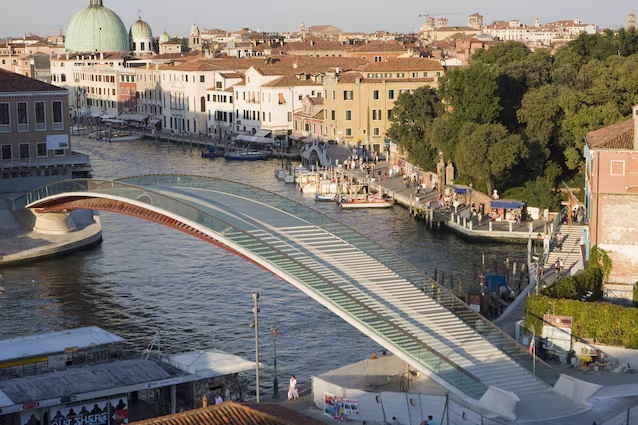
The Constitution Bridge: the most discussed
The fourth and final bridge is the youngest and most discussed: it is the Constitution Bridgeknown to all as Calatrava Bridge, named after its designer Santiago Calatravastarchitect of Spanish origins.
The bridge, which connects Piazzale Roma (the car and bus terminal) to the railway station, traffic hubs which until then had no direct connection on foot over the Grand Canal, was opened to the public onSeptember 11, 2008.
From a design point of view it is a hyper modern bridge, made up of a thin arch steel with the steps in glass and plates of trachyte (a dark, rough volcanic stone). The first controversies are linked precisely to the materials: the costs for its construction have risen from the 6.7 million euros initially estimated to over 11 million.
THE glass stepselegant, but very slippery in rainy and humid conditions, have caused numerous falls and injuries, so much so that interventions were necessary to improve the safety of the flooring. Furthermore, without ramps, the bridge cannot be crossed independently by passengers people in wheelchairs up: the solution adopted in 2013, an ovoid cabin that ran along the arch, proved to be a failure due to mechanical failures and usage problems, and was dismantled.
The story also ended in front of the Court of Auditorswhich in 2015 acquitted Calatrava and the municipal managers of the accusation of damage to the treasury, but in 2019, on appeal, sentenced the architect to compensation of 78 thousand euros.
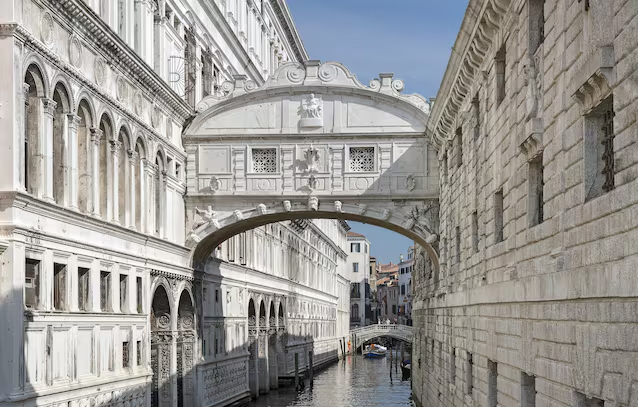
Other historic bridges in Venice
No review of the bridges of Venice can be considered complete without the Bridge of Sighs. Built at the beginning of the seventeenth century based on a design by Antonio Contino, grandson of Antonio da Ponte who designed the Rialto, it is a covered bridge in white Istrian stone in Baroque style, with small lattice windows.
The name “dei Sospiri” is neither ancient nor official: it is aromantic invention of the nineteenth centuryalso linked to the verses that the English poet dedicated to him Lord Byron. The image is that of the prisoner who, crossing the bridge, cast a last glance – and a last sigh – at the freedom and beauty of Venice from the small grated windows before disappearing into the dungeons. The bridge connected the court rooms of Doge’s Palace at New Prisonsbeyond the Rio di Palazzo, and was the obligatory passage for the condemned who, after the sentence, were transferred to their cells.
In addition to the big names, Venice is full of smaller bridges with curious stories. There is the Bridge of Fistsin San Barnaba, the scene until the beginning of the eighteenth century of ritual brawls between the city factions of the Castellani and the Nicolotti: four marble footprints set in the stone still mark the starting positions of the contenders.
There is the Spiers Bridgein Cannaregio, recognizable by the four obelisk-shaped pinnacles that decorate it. On the nearby island of Torcello, there is the Devil’s Bridgeone of the very few left without a parapet like the Chiodo Bridge.
The Bridge of Tits it is instead located in the Carampane area, which between the sixteenth and seventeenth centuries hosted prostitution activities regulated by the Serenissima. According to tradition, the name derives from the habit of women to look out of the windows and balconies of homes showing their breasts to attract potential customers.
Finally, the Liberty Bridgealmost 4 km long and 20 meters wide, which connects Venice to the mainland. The road bridge was inaugurated on April 25, 1933 with the name of Ponte Littorio, later changed to Ponte della Libertà in 1946. It runs parallel to the railway connection inaugurated in 1846, the Grand Bridge of the Venetian Lagoon.
