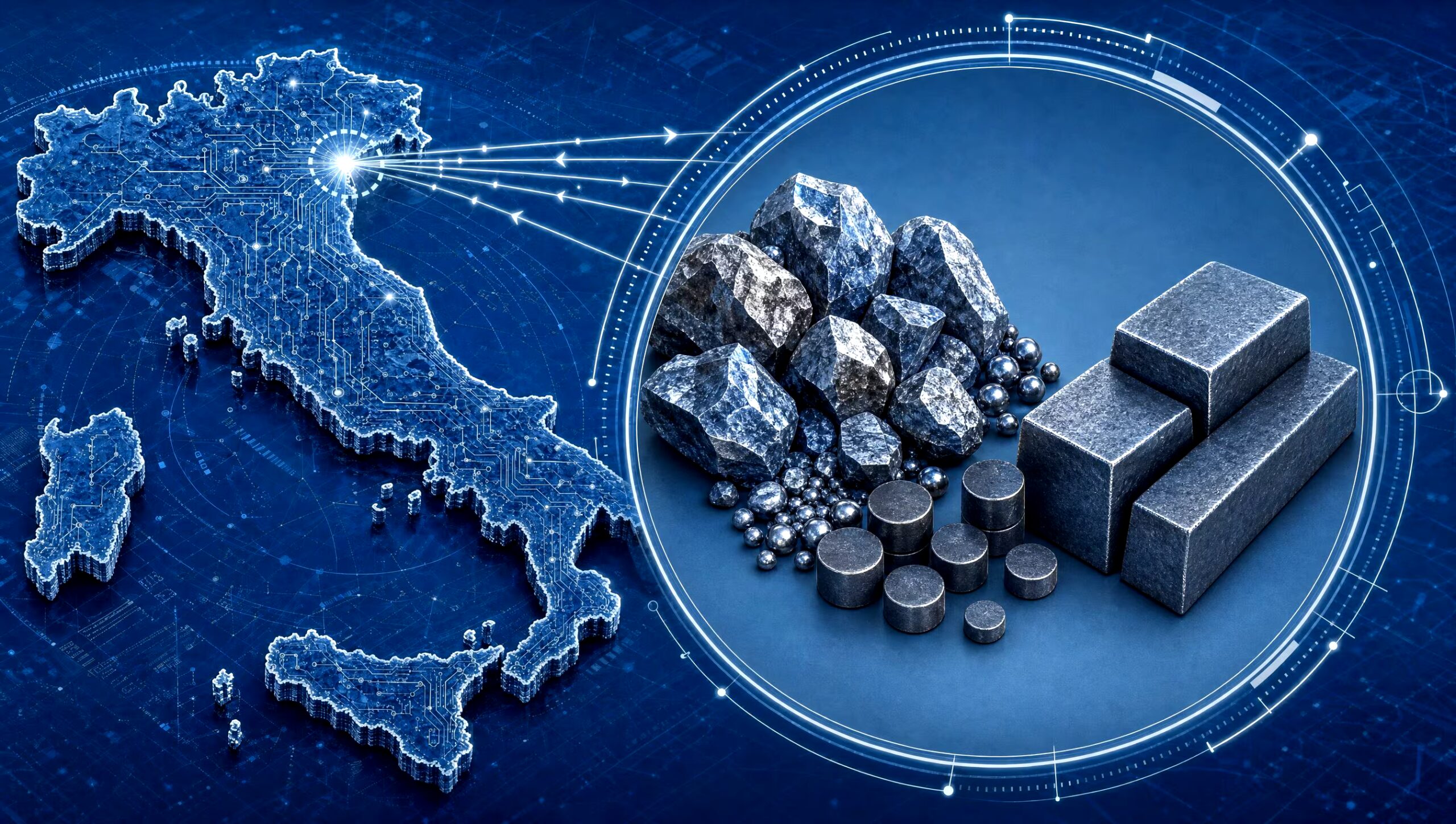
The center of the project for the strategic storage of critical raw materials will be in Porto Marghera, in a vast industrial area located in the municipality of Venice, on the mainland. The program will include a network of infrastructures located in the North-East, from Ravenna to Val di Non.
THE’Italy will host the first European strategic storage hub for critical raw materials. On 19 November 2026 the European Commission gave the green light to the Italian project, developed together with the Netherlands: the heart will be Port Margherain Venice, and the first materials to be accumulated will be lands rare And tungsten.
With this project, Europe is preparing to accumulate a reserve of metals indispensable for various industrial sectors, such as electric cars, wind turbines, electronics and defense, to be opened in the event of a crisis. Why is there a need? Because today, for many of these materials, we are almost entirely dependent on China.
Where the deposits for rare earths and tungsten will be built
The first aspect to clarify is that we must not imagine the deposit as a single enormous warehouse full of metals. The project, conceived by the Ministry of Business and Made in Italy (Mimit) with Cassa Depositi e Prestiti, is a infrastructure network of the North-East where each node has its role:
- Porto Marghera (Venice): the hub, with available port areas and decades of chemical expertise;
- Interporto Quadrante Europa (Verona): hub for transporting goods by road and rail;
- Port of Trieste: free port and gateway to Central and Eastern Europe;
- Port of Ravenna: specialized in bulk goods;
- Tassullo dolomite mine (Val di Non): in a subsequent phase it could offer underground spaces.
As anticipated, two families of materials will initially be stored. The first are the rare earthsa group of 17 elements essential for permanent magnets, and next to them we find the tungstenthe metal with the highest melting point ever, over 3,400 °C.
The deposit is the first piece of the European storage pilot programmeforeseen by the plan RESourceEU presented by the Commission in December 2025. The budget is 14 million euros and the goal is to start testing in 2027. In the coalition of ten countries working on it, Italy is responsible for logistics and sites. Germany, on the other hand, is responsible for analyzing demand and France for financing.
However, to date there are still some issues to be clarified: who will buy the materials? Who will own it? And under what conditions will companies be able to draw on it? For these reasons, the pilot phase will purchase limited volumes and will carry out at least a “general test” of release with companies and authorities, to understand if the system really works in an emergency.
Why it is important to have a warehouse of critical raw materials
According to the European Parliamentary Research Service, the EU currently imports from China all heavy rare earthsthe85% of the light ones and the 98% of magnets based on rare earths. This should not surprise us: Beijing controls approximately the 60% of the world’s production of rare earths and about the 90% of the refining. For tungsten the situation is similar: in 2025 China extracted approximately it 67,000 tons out of 85,000almost the80% of the world totalaccording to the US Geological Survey.
This is a European weakness, as observed for example in February 2025when China introduced tungsten export controls. The result was a doubling of the price. However, without these materials there are entire supply chains that are destined to stop and – at least at the moment – there are no equally valid alternative solutions.
The presence of a deposit, therefore, would allow you to have some stocks able to amortize changes in pricesallowing industries to reduce the shock and have time to find alternative suppliers, without stopping production lines.
