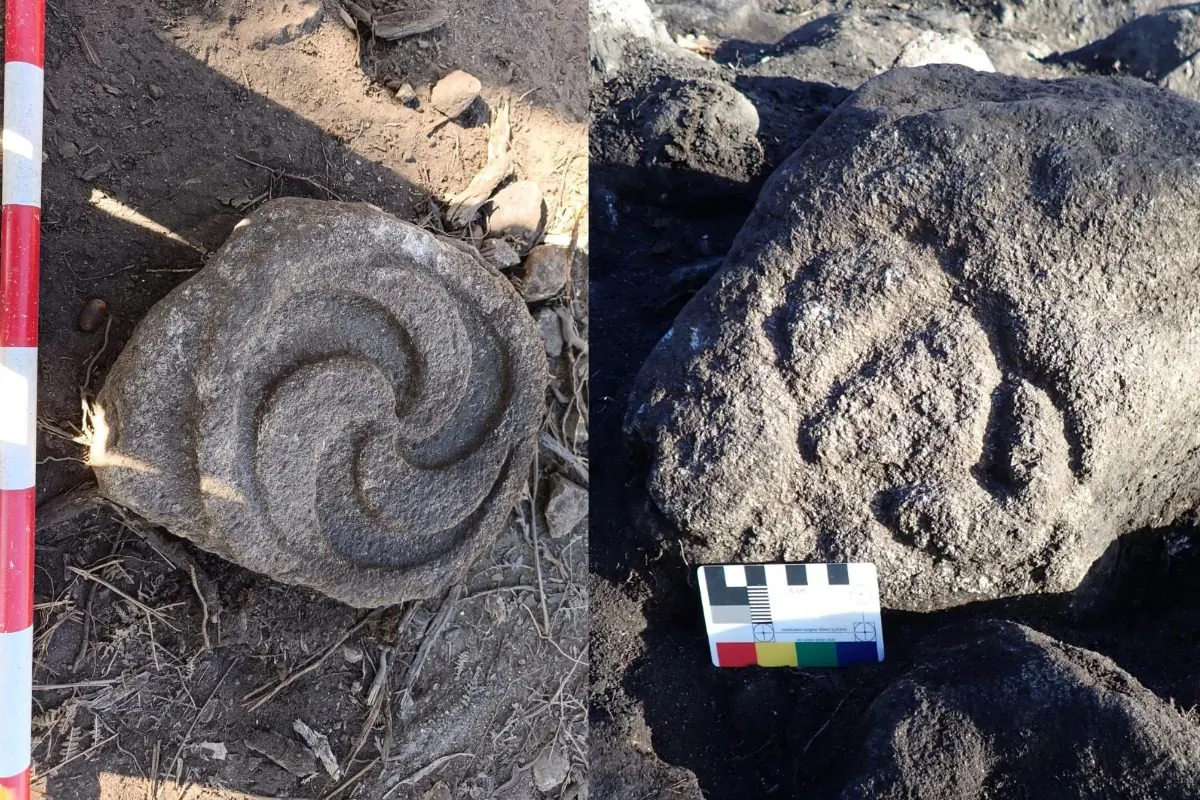
In the fortified settlement of Pico da Bandeira, in Galicia (Spain), a block of granite was found with a petroglyph and a triskelion engraved on opposite faces. The stone comes from a house frequented between the 1st century BC and the 1st century AD, but the dating of the engravings remains uncertain.
A triskelion engraved on a block of granite, with a petroglyph on the opposite face: it is the find found in the fortified settlement of Pico da Bandeirain the parish of Salcidos, near A Guarda, in Galiciain northwestern Spain. According to the archaeologist Benito Vilasof the excavation team, it is a unique specimen in that regionprecisely due to the presence of the two motifs on opposite faces of the same stone.
The discovery was made by the cooperative Árbore Arqueoloxía during an excavation campaign that also brought to light some circular huts. The block, which measures 26 × 33 centimeters, emerged among the remains of one of these houses, inhabited between the 1st century BC and the 1st century AD and then collapsed. Fragments of Roman amphorae.
There dating However, it derives from the archaeological context and does not, on its own, allow us to establish when the two engravings were made. The archaeologists themselves do not exclude that the petroglyph was older and that the stone was reused at a later time.
In that period, Galicia was inhabited by the Galleci, populations of the so-called castros culture, with strong affinities with the Celtic world. These territories ended up definitively under the dominion of Rome at the end of the 1st century. B.Cwith Iberia’s pacification campaigns August (27 BC -14 AD).
On one side of the stone appears the triskeliona motif composed of three arms arranged according to a rotating structure. It’s one very ancient figureprobably linked to the sunwhich is often associated with Celtic culture but is actually common to many civilizations of the past. We also know it well in Italy: a variant of it, with three legs instead of arms, has been the symbol of Sicily since Greek times.
The triskelion of Pico da Bandeira it has been preserved in particularly good conditions thanks to a truly lucky circumstance: when the structure it was in collapsed, the block remained with the face of the triskelion in contact with the ground. Thus the incision was protected from the impact of other debris that fell subsequently.
On the opposite side there is a petroglyphthat is, a rock carving, which represents a figurative motif. Compared to the triskelion, however, it appears simpler and less elaborate.
It remains to be clarified whether the symbols were imprinted at the same time or in different moments: in the first case they may have been connected to the beliefs and imagination of the community that created them. Alternatively, the petroglyph could be previous and the triskelion to have been added laterwhen the stone came reused as a building material.
For the moment, therefore, it is not possible to establish with certainty the original function of the object.
At the end of the archaeological research on the Pico da Bandeira site, the find will be transferred to Quiñones de León Museum Of Vigo. Before the transfer, however, the team intends make it visible to the local population through some guided tours.
