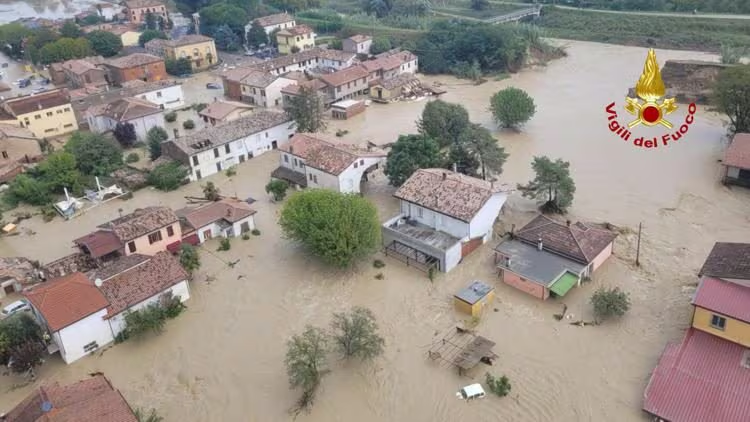
In Italy, flooding caused by intense rains went from 18 in 2015 to 140 in 2025. This is according to Legambiente’s Città Clima 2026 report. The region most affected by extreme events is Lombardy, while the city is Rome.
In recent times the Italian cities they are facing a change increasingly evident: since the extreme weather events such as floods, wind damage, flooding and storm surges, roads, homes and infrastructure must deal with damage ever greater.
According to i data that emerge from the report of the Legambiente City Climate Observatory, in Italy the number of extreme weather events which caused damage from 2015 to 30 September 2026 he arrived at 2,689events that led to the death of 221 people.
Again according to the Legambiente document, in the three-year period 2015-2017 the average of these events was around 60 per year, between 2023 and 2025 rose to 372. And 2025 also ended with just under 6% more events than 2024.
The numbers from the Legambiente report
Among the most frequent events which have a particular impact are the flooding from heavy rain and wind damage. For intense rains alone there were 950 cases, from 2015 to 30 September 2026, more than a third of the total. They were 18 in 2015 and reached 140 in 2025. In ten years the increase is 678%.
For i wind damage there were 684 episodes in the same period, from 5 cases in 2015 to 86 in 2025, i.e. 1,620% more. 2026 had 88 events in the first nine months alone. Added together, water and wind are worth 1,634 episodes, 60.7% of everything the Observatory has recorded.
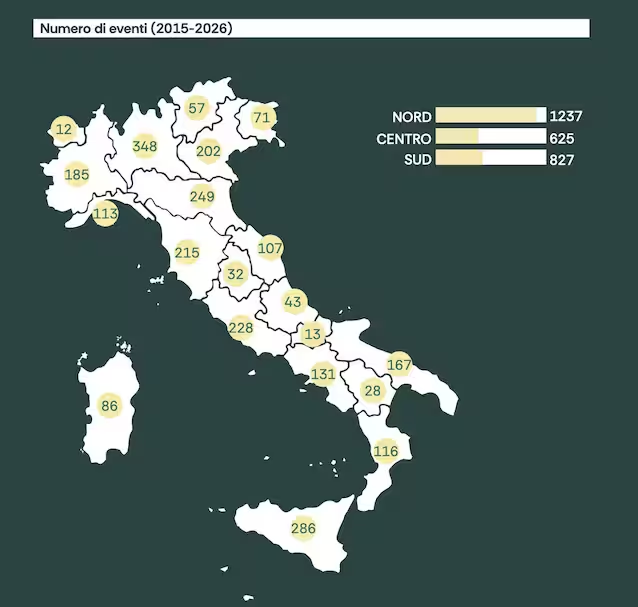
There geography of events registered from 2015 to September 30, 2026 leans towards North who collects it 1,237against the 827 of South hey 625 of Center.There most exposed region it’s there Lombardy, with 348 episodes since 2015. They follow the Sicily with 286, Emilia-Romagna with 249, the Lazio with 228, the Tuscany with 215 and the Veneto with 202.
The more detached the Friuli-Venezia Giuliaat 71, and the Trentino-Alto Adigeat 57. Friuli-Venezia Giulia had not recorded any events either in 2015 or 2016 and in 2025 it counted 14. Sicily went from 6 episodes in 2015 to 45 in 2025. And 2026 has already delivered two negative records, namely Calabria, with 19 events in nine months, which reached its historical maximum, and the Marche which reached 14, when in the whole of 2025 they had stopped at 9.
The cities most affected by extreme events in Italy
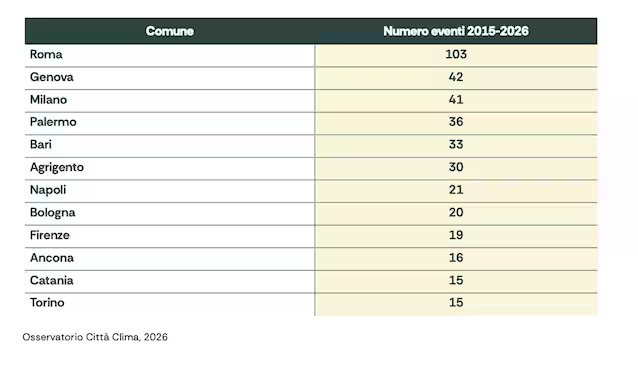
As far as city data goes, it is Rome leads the ranking with 103 events. Behind it are Genoa with 42 and Milan with 41, then Palermo with 36, Bari with 33 and Agrigento with 30. The list is completed by Naples (21), Bologna (20), Florence (19), Ancona (16) and, paired with 15, Catania and Turin.
That some cities in particular are the most fragile point is no coincidence. In fact, Legambiente observes that urban areas and coasts suffer the impacts and damage of extreme events more than others and that 83% of the national population lives in those areas. For example, as stated in the report, “right at the beginning of the year, on 4 January, a real tornado (classified IF1.5 on the international Fujita scale) occurred in Frattocchie, a hamlet in the municipality of Marino (RM)”, while on 3 June a tornado crossed the north-eastern quadrant of Rome, causing the fall of numerous trees and causing damage to homes and cars.
The most serious episode of the year remains Cyclone Harrybetween 16 and 23 January, with 600 millimeters of rain in 72 hours between Sicily, Sardinia and Calabria and damages which, citing the Civil Protection, Legambiente quantifies at over one billion euros for Italy alone. In fact, according to the report, “the violent storms destroyed seafronts, flooded commercial activities and tore away sections of roads and the Ionian railway in Sicily, with sinkholes and flooding”. On a Mediterranean scale, the toll is at least 390 victims, many of them migrants attempting to cross the sea.
The adaptation plan
On paper, the tool to react exists. The National plan for adaptation to climate change (Pnacc) was approved at the end of 2023 and includes 361 measures. The limit, according to Legambiente, is that it does not have financing lines and economic resources to be put into practice. In fact, it is no coincidence that many urban adaptation plans were born thanks to European funds.
Legambiente asks to give the Pnacc adequate resources and support it with a specific plan for urban areas and coastsrestoring the program for municipalities with a duration of at least five years and opening it also to smaller towns, under 60 thousand inhabitants, to approve the law against land consumption, to prohibit new constructions in areas at hydrogeological risk, to reopen ditches and rivers and to spread sustainable urban drainage systems. The other requests concern the management of the water emergency, with protocols against drought for each basin, the training of local administrators, a national mapping of the urban areas most at risk from heat waves and the creation of a network of climate refuges.