The wreck of the 1855 wooden gunboat, 19 meters long and weighing 65 tonnes, was identified thanks to sonar off the coast of Queensland on the exact anniversary of its sinking, which occurred on 21 August 1898.
It seems like an almost incredible coincidence Exactly 128 years after its shipwreck (21 August 1898), has been identified off Far North Queensland the wreck of HMCS Spitfirethe first warship built in Australia for the defense of its colonies.
The discovery was announced only now – almost three months after the discovery (21 August 2026) – due to Australian wreck protection lawswhich mandate a series of notification processes between government agencies prior to press releases.
The discovery of this gunboat – whose acronym denotes it as “His Majesty’s colonial schooner” – has been defined as “extraordinary luck” by marine archaeologists of Australian National Maritime Museum and the government of Queensland.
The HMCS Spitfire: from its birth in 1885 in Australia to its sinking
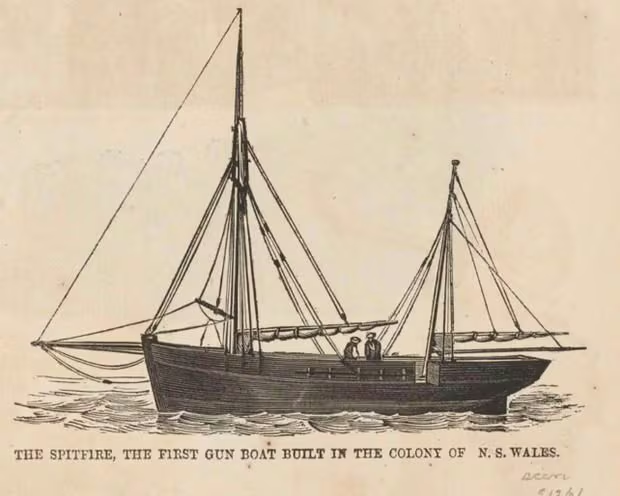
The Spitfire was built in Sydney and launched in April 1855 in Darling Harbour.
As James Hunter, head of maritime archeology at the Australian National Maritime Museum, explained, the colonial government of New South Wales at the time he feared an incursion into the Pacific by the Russian fleet during the Crimean War (1853–1856). What was also worrying was the Francewhich had annexed New Caledonia in 1853, effectively placing a foreign military power on Australia’s doorstep.
The recent one discovery of gold in New South Wales and Victoria had made the colonies a attractive targetwhile the ships of the British Navy were scarce in that remote corner of the Empire.
So it was that the government entrusted the shipbuilder John Cuthbert the task of build a warship. Delivered in just two months — a rapidity that according to Hunter suggests that the hull was already being built for other purposes — the Spitfire was a two-masted ship 19 meters long and weighing 65 tons, made entirely from local wood (ironbark, blackbutt and kauri) and covered in copper below the waterline.
He was riding a single 32 pounder cannon on a revolving carriage. There disproportion with the enemy, however, was evident: The Russian Pacific Fleet consisted of heavily armed, iron-hulled steamships, and—as Hunter himself noted—a cannonball from the Spitfire would probably have bounced off them. In any case, that cannon never fired a shot: the Crimean War, in fact, ended in 1856 without the Spitfire entering combat, and the ship was used to patrol the coast and supply the lighthouses.
In 1859 he came given to Queensland as a pilot vessel to guide ships into port and to buoy maintenanceand then sold to private individuals in 1885 for sea cucumber fishing.
After over forty years of service, the August 20, 1898 the ship was surprised by a violent cyclone off the coast near the Lockhart River (Piper Island): the waves opened the joints between the planks of the now old hull and made it take on water until it sank completely on August 21st.
The crew — made up largely of Aboriginal Australians who inhabited the Torres Strait Islands and the South Pacific Islands — were forced to abandon ship hastily, and managed to reach a nearby island. As luck would have it, he was rescued not many hours later by the Japanese steamer Omi Maru.
How the wreck was found: The gunboat was camouflaged in the Coral Reef
Locating the hull of the Spitfire required a joint expedition of Australian National Maritime Museumthe Queensland Government and the Royal Australian Navy aboard the HMAS Diamantina minehunter.
Finding a wreck in the Coral Reef is like looking for a needle in a haystack, because the rapid growth of vegetation tends to camouflage everything.
As Queensland heritage officer Celeste Jordan explained, archaeologists’ trick is to search through sonar and underwater cameras «only straight lines and particularly round objects, because they don’t exist in nature».
The divers and underwater robots have thus confirmed that approximately 16 meters of the hull emerges from the sand, revealing the bow and a small boiler.
The wreck it will not be recovered (by law, in Australia historical wrecks are preserved in situ), but the archaeologists of the Australian National Maritime Museum will return to the site next year to carry out further research, which will focus on the internal part: the crew, who, as we have said, fled while the ship sank, had left everything on board, and for this very reason the Spitfire is a time capsule perfect for studying life at sea at the end of the nineteenth century.