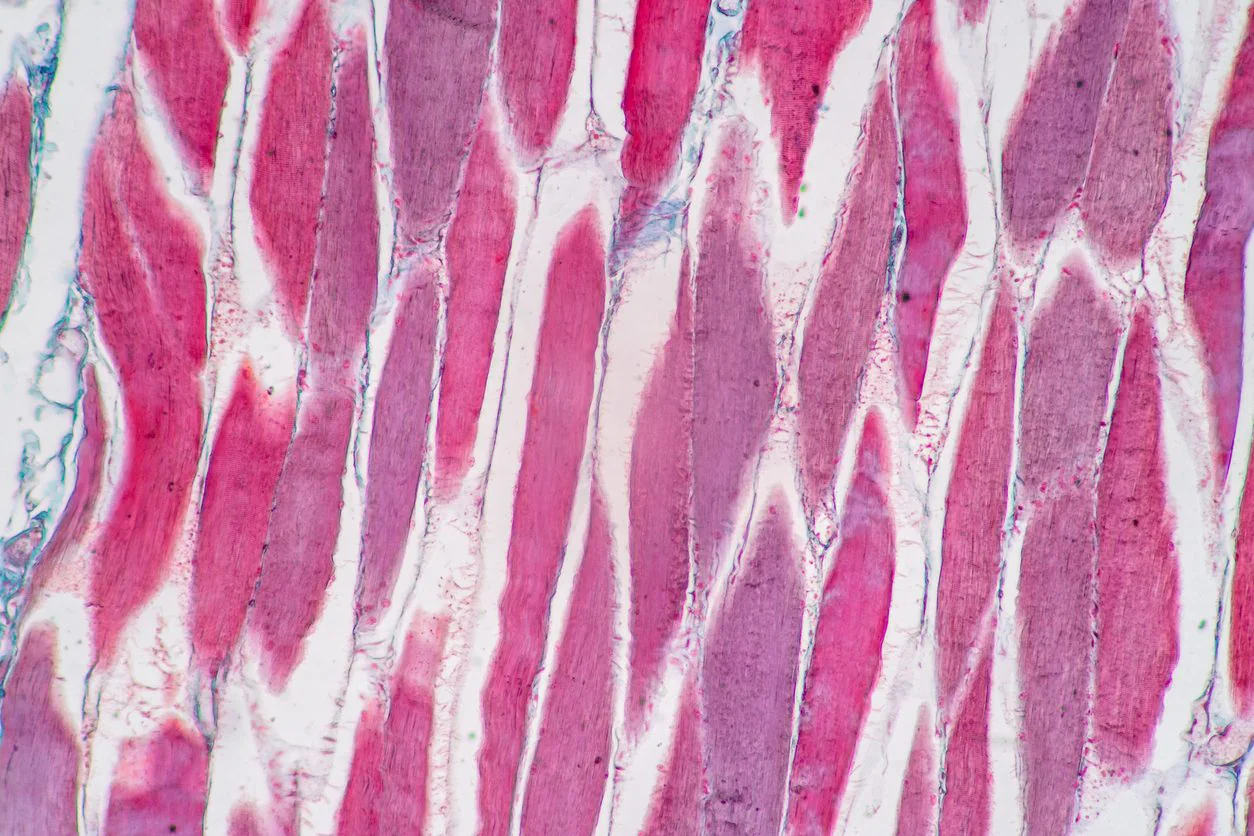
With age, the decline in cardiolipin in the mitochondria pushes the muscle to convert fast fibers into slow ones and to reorganize the metabolism to defend itself from free radicals. A study in mice suggests that restoring this lipid could reverse muscle atrophy.
With age i muscles they lose mass and strength, and their composition also changes: the fast-twitch fibres, which are more powerful, give way to the slow-twitch ones, which are more resistant to fatigue. A study published in Nature Aging suggests that this change is due to the decline in cardiolipina lipid found in the inner membrane of the mitochondria. In experiments on mice, its reduction activates a signal that leads the muscle to produce more slow fibers and reorganize the metabolism to defend itself from free radicals.
The muscular paradox and the role of cardiolipin
Muscle fibers are divided into two families: type I fibers (slow twitch), which obtain energy mainly from mitochondria; and type II (fast twitch) fibers, many of which derive energy primarily from the breakdown of sugars. With age, the proportion of type I fibers, which rely heavily on mitochondria, increases, but as we age, mitochondria tend to become less efficient. This phenomenon is connected to sarcopeniadefined by the European consensus group EWGSOP2 as a common muscle disease in old age.
There cardiolipin it is a lipid, i.e. a fat, which is found in the internal membrane of the mitochondria where it plays both a structural and functional role. All its variants depend on a single enzyme called Crls1.
Comparing young (9 weeks) and elderly (2 years) mice, the researchers observed that in the elderly mice, cardiolipin and the expression of Crls1 they were lower. The same decline also appears in human muscle samples from people between 53 and 69 years old compared to people between 22 and 35 years old. However, the human sample is very small as it is made up of 5 elderly people and 4 young people.
To understand whether the decline in cardiolipin is a cause or a consequence of aging, the authors eliminated the gene Crls1 only in skeletal muscle in both developing and adult mice. In both cases, the onset of signs of muscle aging was observed, although at different times: mitochondria with altered and less efficient structure, atrophy, reduction of more glycolytic (i.e. the fastest and most powerful ones) and early death. In adult mice, the researchers then suspended the treatment that turns off the gene. The expression of Crls1 recovered only partially and cardiolipin increased from 27% to 67% of the level in controls. It was enough to reverse weight loss and atrophy and to avoid early mortality.
When cardiolipin decreases, the mitochondria send a real alarm signal to the cell nucleus, activating a molecular “switch”. It is this command that drives the muscle’s change and reorganizes its metabolism to put it into a defensive mode.
The switch to slow fibers could be a defense mechanism: the new study
When cardiolipin decreases the mitochondria tend to produce more reactive oxygen species, i free radicals. The increase in these molecules works as an alarm signal that prompts muscle cells to absorb more glucose from the blood. However, rather than degrading it completely to produce energy, the muscle diverts part of it towards metabolic pathways that fuel antioxidant defenses. In this way, according to the researchers, the muscle sacrifices power in exchange for protection, increasing the slow-twitch fibers.
However, one experiment in the study led to a counterintuitive result. In fact, by administering an antioxidant (N-acetylcysteine) to mice, which in theory should neutralize free radicals, muscle atrophy worsened. The authors hypothesize that this reduces the glucose available for metabolic defense pathways. However, it must be considered that this is a result obtained on a very specific animal model and that it does not demonstrate a negative effect of antioxidant supplements in people.
The results should be read with caution. The experiments were carried out mainly on mice, in which the cardiolipin gene was drastically eliminated, while in people the decline is gradual. Additionally, the human data comes from just nine muscle samples. In animals, it is the atrophy caused by the lack of cardiolipin that regresses, not that of natural aging. Many studies will therefore be needed to understand whether increasing cardiolipin can work against age-related muscle mass loss.