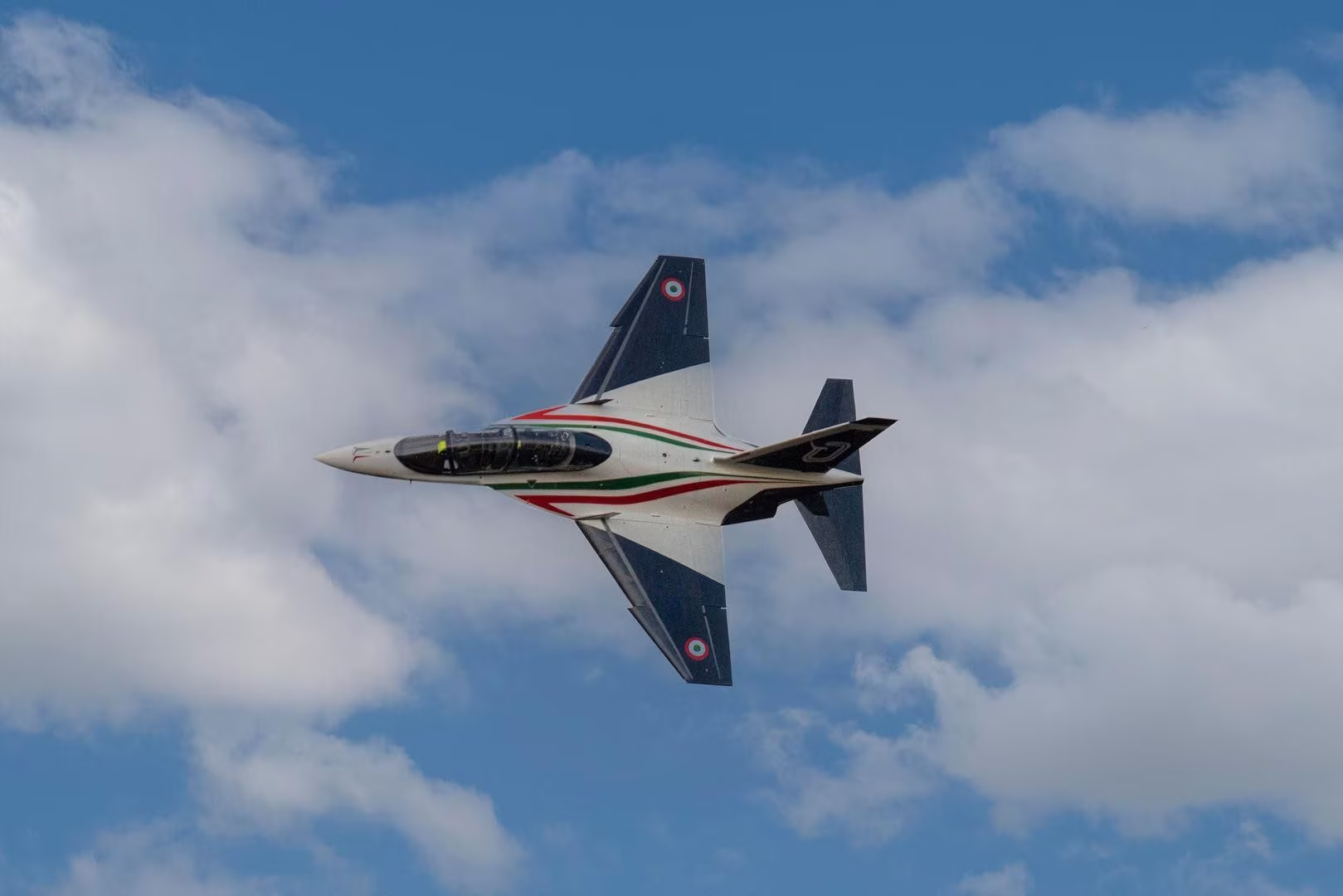
Presented by Leonardo on 26 November 2026, the M-346 PAN is the first new aircraft of the Frecce Tricolori after over 40 years. Equipped with two engines that develop more than triple the thrust of the MB-339, digital flight controls and systems dedicated to aerobatics, it will allow larger maneuvers and faster energy recoveries. The performance debut is expected in 2028.
Why do you need a plane with more than triple the thrust to draw a tricolor in the sky? The answer is under the blue livery of the new one M-346 PAN (acronym for National Acrobatic Patrol, official name of the Frecce Tricolori), presented by Leonardo on 26 November 2026 in the Venegono Superiore factory, in the province of Varese.
It is the first new aircraft model intended for the Frecce Tricolori after over 40 years and collects the legacy of the Fiat G-91, in service with the Pattuglia since 1963, and the MB-339, supplied since 1982. Those hoping to see it soon at an air show will, however, have to be patient: it is unlikely to debut in exhibition before the 2028 season.
Why the M-346 PAN was chosen
To understand why why the change of plane If it’s a small revolution, we need to start from what makes the Frecce special. Born in 1961 in Rivolto, Friuli, they fly with ten planes, nine in formation and one solo: they are thethe only aerobatic team in the world to fly with ten jets.
Keeping such a large formation compact, while looping or fanning out, requires a specific aircraft with energy always in reserve.
This is precisely why in 2024 the Air Force changed its mind. The M-345 was chosen to replace the MB-339, a cheaper single-engine aircraft, later judged less suitable for large aerobatic formations. The choice fell on its twin-engine big brother, theM-346accepting higher operating costs. The program includes 15 planes: 10 for the formation, 1 for the commander and 4 in reserve. The order is worth approx one billion eurosbut it is not the price of the planes alone: it also includes technical and logistical support, simulators, pilot and maintenance training and work at the Rivolto base.
But how much more powerful is the new plane? The MB-339 has only one engine, which develops thrust equal to its weight a small car and a half (considering approximately 1,200 kg per car). The M-346 has two of them, which together generate thrust equivalent to the weight of almost five small cars. The new plane is heavier (about 4.6 tons empty versus just over 3), but the thrust increases to a much greater extent than weight: with pilot and fuel on board, for every kilo of weight of the aircraft you have approximately double the thrust available. It’s a bit like going from a loaded van to a sports car.
The maximum speed goes from 900 to 1,090 km/h and the new aircraft can sustain accelerations between +8 and −3 g. At +8 g the apparent weight of the pilot’s body is eight times normal. In aerobatics, however, maximum speed matters relatively little.
What matters is theenergylinked to the speed and altitude of the aircraft, which the pilot “spends” in the execution of each figure and must recover before facing the next one. Greater thrust therefore allows you to perform larger figures, recover energy more quickly and have a greater safety margin.
How it is made and features: digital controls, smoke and cameras
In the MB-339 the yoke moves the wing and tail control surfaces via mechanical linkages. THE‘M-346 is instead a fly-by-wire aircraft: the yoke sends signals to a computer, which moves the surfaces without exceeding the structural and aerodynamic limits of the aircraft. It’s the same principle as regular Airbuses.
For formation flying Leonardo has added one “Acro” mode, which manages the airbrake in a dedicated way: with a single command it opens it completely or closes it completely. The gregariousthat is, the pilot who flies attached to the leaderholds the position by continuously correcting the throttle, and a heavy and aerodynamically “clean” airplane struggles to slow down when needed.
An airbrake with predictable behavior takes away a variable from him to dose just when all his attention is on the next plane; according to Leonardo, this mode reduces the pilot’s workload and makes it easier to maintain training.
The other changes concern information dedicated to aerobatics on theHUDthe transparent screen in front of the pilot, a telescopic ladder stowed in the nose and the possibility of mounting two additional tanks under the wings. For the rest, explains Leonardo, the general systems of the aircraft have not been significantly modified.
The magazine The Aviationistciting unofficial sources, also speaks of reinforced wings and modified control software to increase flight limits, but Leonardo has not confirmed this. The real news, however, are the eight cameras on the fuselage: four transmit images in real time to the control room on the ground, the other four record additional shots. The public will be able to see the figures live, from inside the formation.
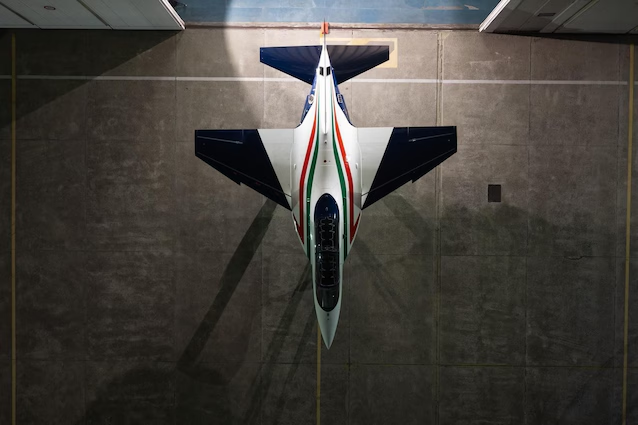
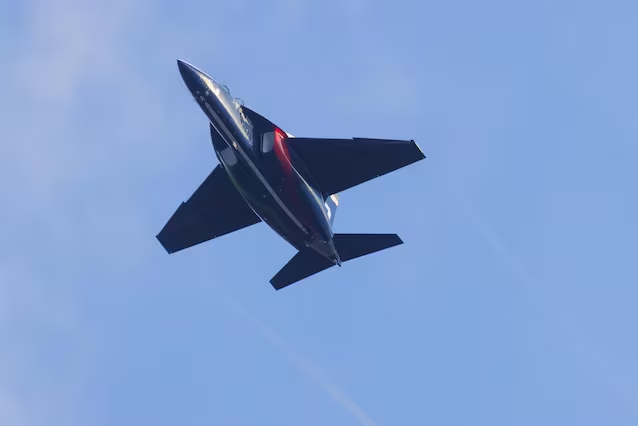
The livery is also signed Pininfarina: dark matte blue (instead of the shiny blue of the MB-339), a large white area on the back and an asymmetrical tricolor on the belly. To some enthusiasts the matte blue I didn’t like it, but the choice has a logic: the contrast separates the plane from the sky and It lets you know at a glance whether it is straight or backwardvaluable information in close training.
And does tricolor smoke pollute? It doesn’t come out of colored gas cylinders: under the belly of the M-346 PAN there is a canister divided into three parts, one for each color, connected to two lines that run along the fuselage. White is Vaseline oil; for red and green pigments are added to the same base which, according to Leonardo, they are non-toxic and non-polluting, as required by Air Force specifications. The liquid is injected into the very hot jet of the engines, where vaporizes instantly and forms the wake; the pilot controls it both from the control stick and the throttle.
By spring 2028 the new Frecce Tricolori
In 2027 the Arrows will still fly with MB-339s: in all likelihood it will be the last season complete to see live the plane that designed the tricolor for 44 years. Training on new M-346 PAN is expected between summer 2027 and spring 2028under the leadership of Lieutenant Colonel Pierluigi Raspa, commander of the Patrol since 18 November.
Each figure will have to be reconstructed starting from small formations, up to ten planes: some historical figures will remain, others could make their debut thanks to the new plane.
Leonardo and the Air Force