
A child was born from a frozen embryo for thirty -one years (from 1994) in liquid nitrogen. The story, reported by Mit Technology Review who told the story at the end of July, he turned on the spotlight on a practice usually confined to assisted fertilization clinics. Scientific research tells us that the Slow freezing of embryos used in the past he had several limits, then exceeded by vitrificationa technique that today guarantees the survival of almost all of the embryos. The results though they are not always unique: According to a great meta-analysis of 2021, the conservation time does not affect the results, while other research suggests a drop in the probability of live birth when the embryo remains frozen for more than a year, with some signal to be monitored as a higher birth weight or cases of placenta prior. Overall, i data remain reassuring, With only a few signal to be monitored as the highest birth weight and cases of placenta prior, but open questions that deserve to be carefully followed. Today vitrification is not only used for couples who undergo a assisted fertilization But it has also become a means of preserving the fertility: women who have to face oncological care, couples who choose to postpone the motherhood and programs of donation, Like this recent case. The birth of Thaddeus Daniel Pierce reassures us, but science still needs studies that they follow these generations over time.
The techniques in history: from ice to glass
Until twenty years ago the embryos were subjected to the so -called “Slow freezing”. It worked, yes, but not always: the cells are composed largely of water and the freezing could lead to the formation of ice crystals (both inside and outside the cells) and, like small aghetti, they could damage the cells and not all embryos survived the defrosting.
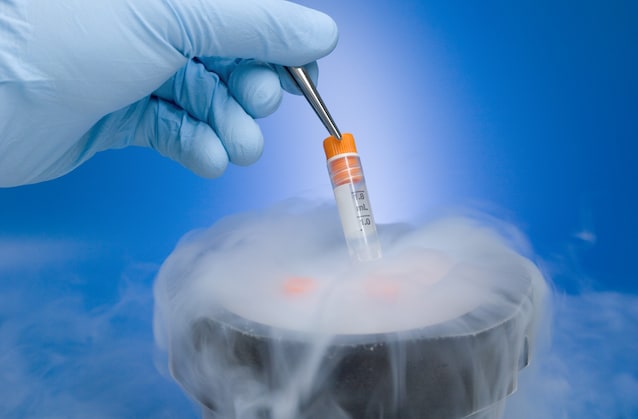
With the vitrification The situation has changed. As Dr. Nagy and his colleagues from the Reproductive Biology Associates By Atlanta in a 2020 study, the liquid that envelops the embryo turns into a sort of glass, avoiding the formation of ice and preserving the cells almost intact. From there the numbers spoke clearly: survival after the defrosting over 95%with pregnancies carried out with the same probability of fresh embryos.
What happens if an embryo remains frozen for months, years or decades
Scientific literature does not offer a single response. According to a meta-analysis published by MA and colleagues in 2021, The freezing time does not seem to make a difference. Thousands of cycles have been compared and No drop in pregnancy rates was observednor an increase in abortions or malformations. This conclusion is based on over 7000 embryonic transfer cycles collected in several centers: a large sample that strengthens the idea that the conservation time, in itself, does not compromise the results. In short, the embryo seems suspended in a limbo Without watch.
Other data, however, are not so linear. A more recent Chinese study, published in 2024, observed a curious phenomenon: After 6 months of cryopreer, the chances of obtaining a live birth begin to go downand beyond the year the drop becomes more evident. But the dynamic suggests that not all the details of the process are still clear.
The discrepancy between the data is not accidental: each research reflects different conditions – from laboratory techniques to patient selection – and this explains why some studies do not see differences while others notify more than six or twelve months.
Children born with the freezing technique
The next question is obvious: how are the little ones born from “old” embryos? Research available reassures. Both the Meta-analysis of 2021 and the 2024 study have not found increases in malformations or significant complications. Some works cite a slight increase in birth weight, with infants with a higher weight of the average (the so -called “Large for Gestational Age “), and a slight increase in placenta prior (i.e. implanted in the lower part of the uterus), signs that do not arouse immediate alarm but deserve to be monitored carefully.
The story of the child born from the embryo of ’94 therefore seems to confirm what science suggests: freeze an embryo does not make him less capable of giving life to a healthy son. It seems that biological time, at least for embryos, can really stop. What is missing, rather, are Systematic long -term studies of the children born from embryos left in liquid nitrogen for decades.
