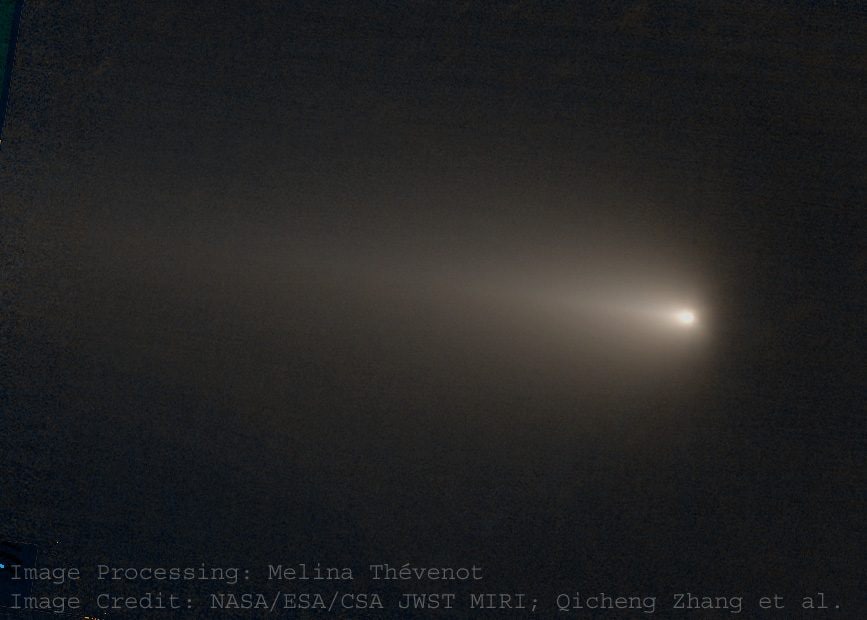
The comet C/2026 A1 (MAPS) could put on a show in the April sky, becoming the most important of the year when on 4 April 2026 it “grazes” the Sun just 160,000 km away, even if the odds are not in its favor: precisely because of its flyby so close to the Sun, it could disintegrate completely before reaching the perihelion (the closest point to the Sun) and for this reason some have nicknamed it the “suicide comet”.
Discovered on January 13 in Chile by the MAPS telescope network, C/2026 A1 (MAPS) belongs in fact to the family of Kreutz’s grazing comets (or Kreutz sungrazer), a class of comets with very elongated orbits which lead them to pass very close to the Sun, giving them the possibility of reaching very high brightness peaks due to the intense sublimation of its volatile materials. The forecast for C/2026 A1 (MAPS) speaks of a possible maximum brightness even 16 times that of Venusthe brightest celestial body in the sky after the Sun and Moon. However, as already mentioned, it is much more likely that this will not happen and the celestial body will disintegrate completely.
Furthermore, maximum brightness will be reached when the comet is very close to the Sun and therefore completely immersed in its glow, effectively making observation difficult. The best time to observe it from Italy it is therefore from now until mid-Marchbefore it gets too close to the Sun.
What we know about comet C/2026 A1 (MAPS): the characteristics
The comet C/2026 A1 (MAPS) was discovered on January 13, 2026 from the telescope of the amacs1 observatory, in the Chilean Atacama desert, as part of the MAPS program. At the time of discovery the comet shone with a magnitude of 17.8 at a distance of about 2 astronomical units (about 300 million km), which makes it the type comet sungrazer farthest from the Sun ever discovered at the time of first observation.
The observations conducted in the following weeks allowed us to estimate its dimensions (2.4 km in diameter) and reconstruct its orbit. It turned out that it is one grazing comet (sungrazing comet) with a period of 1700 years which will reach the April 4, 2026 a “very narrow” perihelion to suns 160,000 km from its surface, well inside the solar corona, and on the other hand an aphelion (maximum distance from the Sun) very far away with its 44 billion km distance from the Sun. closest approach to Earth instead you will have the April 5, 2026 to 144 million km away, just a day after perihelion.
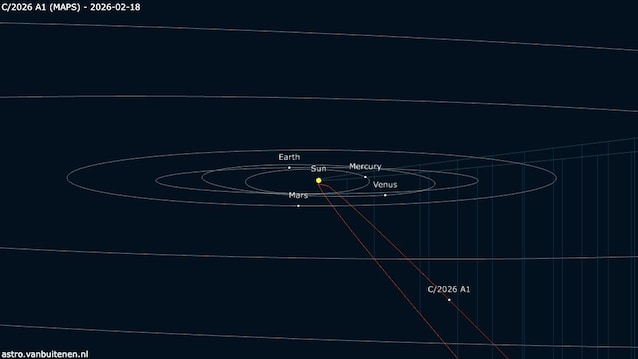
There is, however, a big “but” in all this. The very close passage of C/2026 A1 (MAPS) to the Sun will cause a sdramatic sublimation of gases of the comet, with a double effect: the comet could become extremely bright (magnitude –7.8), at the cost however of coming ccompletely disintegrated by the Sun. Most comets sungrazing it does not survive the flyby of our star, and it is likely that this is the fate that also awaits C/2026 A1 (MAPS).
Even if the comet survives, maximum brightness will be reached when the comet is angularly very close to the Sun, making observation of this object at its brightest possible only through solar telescopes.
Visibility forecasts from Italy: what we might observe
Comet C/2026 A1 (MAPS) is visible mainly in the southern hemisphere: at our latitudes it appears very low on the horizon. At the moment it is still dim (magnitude 14.2), so it could be observed only using telescopes of good diameter and long exposure poses.
The comet is now visible from Italy starting from approximately an hour after sunset at 20° on the south/southwest horizon in the constellation of Eridanus. As the days pass, the comet will get closer and closer to the Sun, both physically and angularly, progressively bringing forward the time of its sunset. At the end of February the comet will set around 10pm, while in mid-March it will drop below the west/southwest horizon around 8pm.
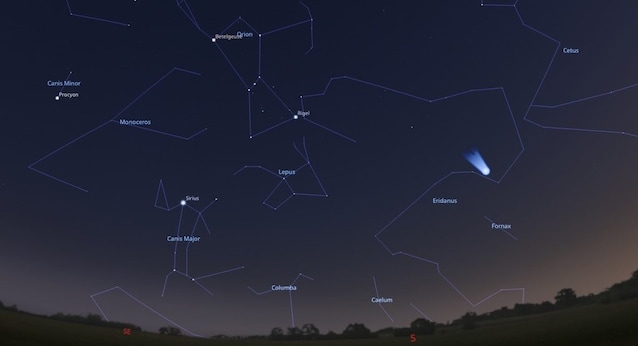
The increase in brightness of the comet will go hand in hand with its approach to the Sun, so the chances of it becoming visible to the naked eye are very low: even if it were to reach a magnitude that allows observation without binoculars or a telescope, at our latitudes this will most likely happen when the comet is immersed in the glow of the setting Sun. After the closest approach to the Sun – provided the comet survives the flyby – C/2026 A1 (MAPS) it will not be visible from our latitudes at least for the entire first half of Aprilfavoring southern observers instead. It will return to being visible in Italy from the end of April, however too close to sunset to be seen easily.
What are Kreutz’s grazing comets?
The grazing comets (sungrazing comets) are objects that pass extremely close to the Sun at perihelion, sometimes within a few thousand kilometers of the surface of our star. The grazing passage very often causes a dramatic sublimation of gases which completely destroys especially the smaller comets of this family.
The Kreutz’s grazing comets like C/2026 A1 (MAPS) are a particular family of comets sungrazing. They owe their name to the German astronomer Heinrich Kreutz who was the first to demonstrate thecommon origin of these objectsi.e. fragments of a single large progenitor comet which was destroyed several centuries ago in various fragments as it passed through the inner Solar System. At the aphelion of their orbits, Kreutz’s grazing comets can reach distances that are hundreds of times greater than those of the Earth from the Sun, while at perihelion they get close enough to graze the surface of our star. Since the launch of the SOHO satellite in 1995, more than 5,000 Kreutz grazing comets have been discovered. None of the smaller comets of this family has ever managed to survive the passage to perihelion, a precedent that certainly does not speak in favor of C/2026 A1 (MAPS).
