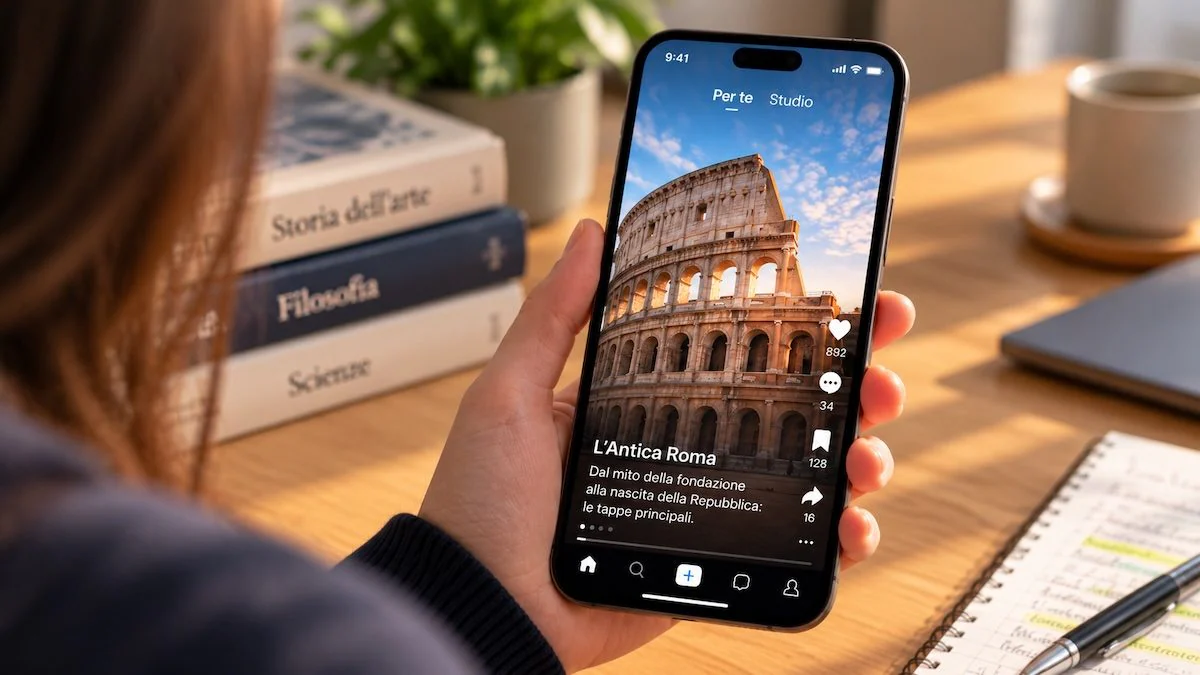
What if, instead of opening TikTok and start scrolling videos one after the other, the concepts of a book, a multiple choice question or the explanation of a topic to be studied appear on the screen? It’s the idea behind ScrollEdan app that tries to exploit the vertical scroll on the smartphone, a gesture that is now automatic for many people, with the aim of transforming it into a tool for reading and learning.
The project starts from a simple consideration: short and vertical contents are now a familiar format, while books and other study materials require a greater level of depth. ScrollEd therefore tries to put these two worlds together, by offering short content that can pave the way for more in-depth explanations and also allowing you to rework your study materials with AI.
How ScrollEd works and why it resembles TikTok
ScrollEd is a startup based in Palo Alto started in 2026 by university students Utsav Gupta And Rebecca Neff and selected among the startups of the Startup Battlefield 200. Gupta studies AI and human purpose at Stanford University, while Neff studies computer science at the University of Pennsylvania. The idea was also born from the dissatisfaction of the two founders with the time spent doing doomscrolling before going to sleep. Hence the attempt to use typical social media gestures for something other than entertainment.
The company defines this approach “depth scrolling”that is, a scroll that not only serves to move on to the next content, but allows you to stay on the same topic by gradually adding new levels of context. The discovery feed offers short videos made by verified creatorsdedicated for example to scientific curiosities and historical episodes.
ScrollEd also allows you to transform text files, including PDFs and books, into a path in which information can be presented in the form of video, audio, text and interactive quizzes generated with artificial intelligence.
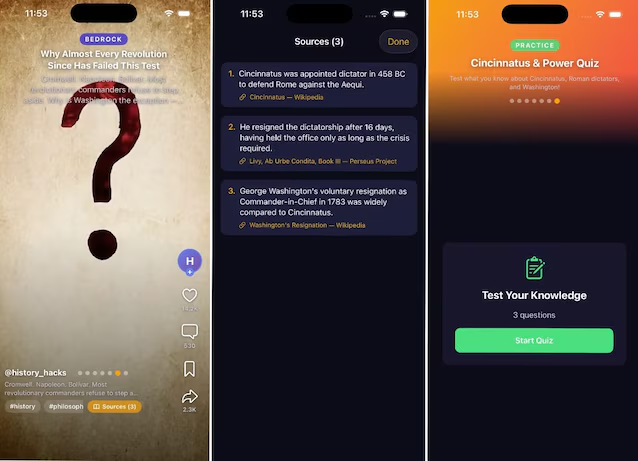
Operation revolves around two navigation directions. With one swipe up we move on to a new topic. If something catches your attention, moving laterally instead you enter a “scroll”, that is, a short sequence of cards dedicated to the same theme. The path starts from the information that aroused curiosity and gradually adds explanations and context, until reaching more in-depth levels. At the end, a quiz appears designed to check what you have just learned.
What changes compared to a normal social feed and the limits of the platform
In the main social networks, what appears in the feed is also selected through recommendation algorithms that take into account the interests and behaviors of users. ScrollEd wants to distance itself from a logic designed above all to prolong scrolling: the declared objective is not to maximize involvement, but to use a familiar interface to encourage learning.
Another feature is the traceability of information. The statements contained in the sheets are associated with the sources used to verify them, which can be consulted through a specific indicator. The user can therefore trace the references behind what they are reading, an important difference compared to the circulation of unverified content that can characterize normal social feeds.
The structure of the paths is also inspired by principles used in learning research, including microlearning, information segmentation and active recall. The former aims to propose notions in reduced units, segmentation divides a complex topic into more manageable parts and active recall instead requires retrieving what has just been learned from memory. In ScrollEd this last principle comes into play above all in the verification that concludes the path.
This, however, does not mean that the app necessarily allows you to learn better or faster than traditional reading or other educational tools. In the public information available at the moment they are not presented independent studies that have directly measured the effectiveness of ScrollEd. How these principles are combined in the app will therefore need to be evaluated in the field.
Then there is the question of AI. Part of the content can be generated by artificial intelligence and generative models can produce information that is inaccurate or inconsistent with the starting sources, the phenomenon of so-called AI hallucinations. The ability to trace references can facilitate the control of information, but does not eliminate the need to verify what is generated.
When does it arrive and how much does it cost
ScrollEd it is not yet publicly available on the App Store. The app is listed as coming soon, while the offer for users is expected to launch at TechCrunch Disrupt 2026scheduled from 13 to 15 October to San Francisco.
The economic model announced is freemium. A is expected free feedsupported by a subscription ScrollEd Pro for a fee, the price of which has not yet been disclosed. There are also annual licenses aimed at organizations, including educational institutions and corporate training programs, who will be able to distribute material through the platform and receive reports on user engagement and lesson progress.
In the coming months, the startup plans to expand its library of lessons, refine its source-checking process, and get started pilot projects with institutions and organizations. Later he would also like to develop tools that allow educators to evaluate the needs of individual students and adapt the path accordingly.
It therefore remains to be seen whether ScrollEd will truly be able to transform a typical social dynamic into an interface capable of taking the user from the rapid discovery of a topic to a more in-depth understanding.
